Pay Down Debt Or Invest First? 6% Rule And Hybrid Plan
Discover the smart strategy: Compare debt interest rates to investment returns and decide whether paying off debt or investing grows your wealth faster.
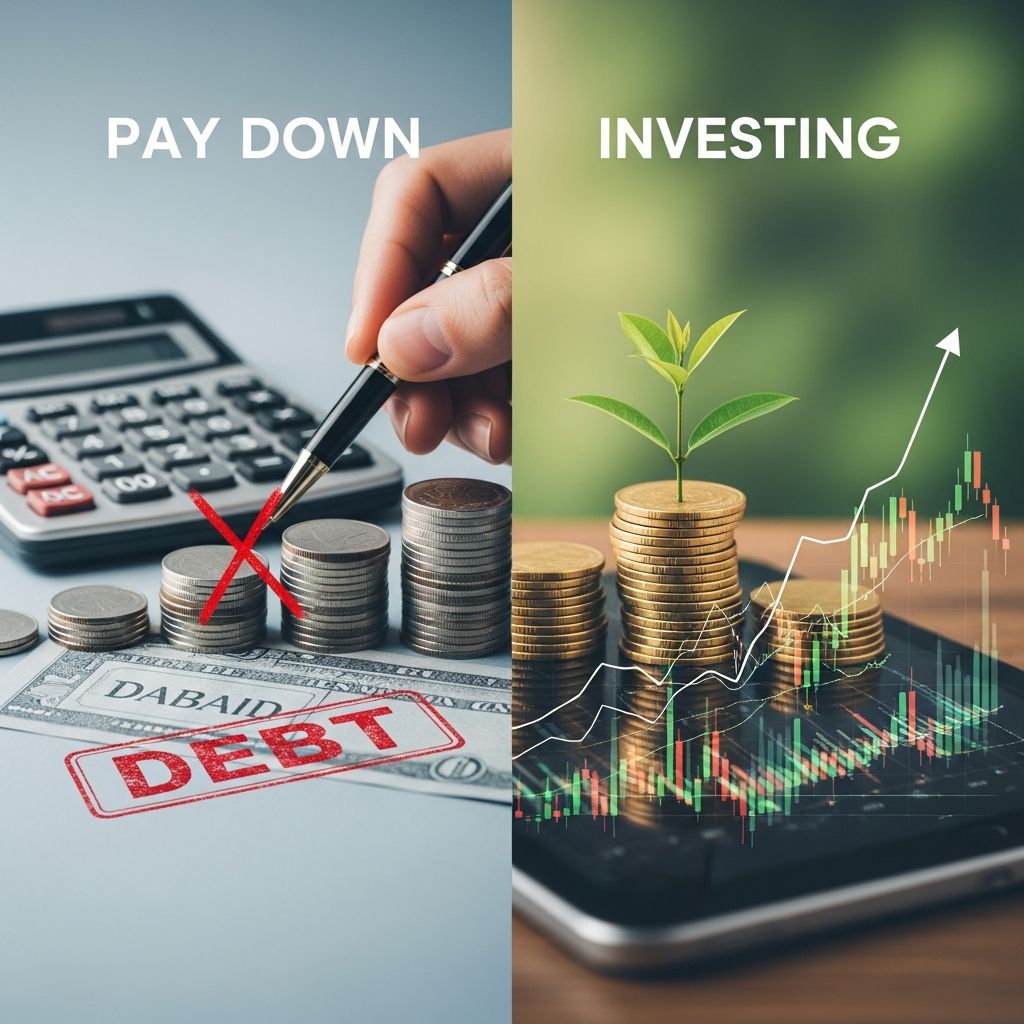
One of the most common financial dilemmas people face is deciding whether to use extra cash to pay down debt or invest it for future growth. This choice can significantly impact your long-term financial health, as it pits the guaranteed savings from reduced interest payments against the potential (but uncertain) returns from investments. The answer isn’t always straightforward—it depends on factors like your debt’s interest rate, expected investment returns, risk tolerance, and personal circumstances.
Paying down debt provides a risk-free “return” equal to your debt’s interest rate, since you’re avoiding future interest charges. For example, eliminating 20% credit card debt is like earning a guaranteed 20% return on that money. Investing, on the other hand, offers the potential for higher returns through compound growth in stocks, bonds, or retirement accounts, but comes with market volatility and no guarantees. Historical stock market returns average 7-10% annually after inflation, but short-term losses are possible.
Understanding this trade-off requires math, psychology, and strategy. This article breaks it down step-by-step, helping you make an informed decision tailored to your situation.
The Math Behind Debt vs. Investing
At its core, compare your debt’s after-tax interest rate to your expected after-tax investment return. If investments are likely to outperform, direct extra funds there (while making minimum debt payments). Otherwise, prioritize debt payoff.
High-interest debt like credit cards (often 15-25%) almost always wins out over investing, as it exceeds typical market returns. Low-interest debt, such as mortgages at 3-5%, may favor investing if you can earn more elsewhere.12
The Rule of 6% (or Higher)
A practical guideline from financial analysis: Pay off any debt with an interest rate of 6% or higher before aggressive investing. This assumes a balanced portfolio (50% stocks), 10+ years to retirement, and tax-advantaged accounts like 401(k)s or IRAs. Why 6%? It factors in historical returns, taxes, and a 70% probability that investing beats debt payoff.2
- Debt >6%: Prioritize payoff (e.g., credit cards, personal loans).
- Debt <6%: Invest extra funds, as long-term returns likely exceed the cost.
- Adjust for risk: Conservative portfolios lower the threshold; aggressive ones raise it.
Quick Comparison Table
| Debt Type | Avg. Interest Rate | Recommended Action | Guaranteed Return if Paid Off |
|---|---|---|---|
| Credit Cards | 15-25% | Pay off first | 15-25% |
| Personal Loans | 10-15% | Pay off first | 10-15% |
| Student Loans | 5-8% | Pay if >6%; else invest | 5-8% |
| Mortgage | 3-5% | Invest (make min. payments) | 3-5% |
Note: Rates are approximate U.S. averages; check your statements. Always consider taxes—e.g., mortgage interest may be deductible.34
Types of Debt: Prioritize Wisely
Not all debt is equal. Categorize by interest rate and terms:
- High-Interest (Toxic) Debt: Credit cards, payday loans (>10%). Attack these aggressively—they erode wealth fastest.1
- Medium-Interest Debt: Auto loans, private student loans (6-10%). Compare to returns; often pay down if above 6%.
- Low-Interest Debt: Federal student loans, mortgages (<6%). These are often “good debt” if assets appreciate (e.g., home value).
Pro tip: Always pay minimums on all debts to avoid fees and credit damage, then snowball or avalanche the rest (smallest balances first or highest interest first).5
Investment Opportunities That Trump Debt Payoff
Sometimes investing wins hands-down:
- Employer 401(k) Match: Free money! A 50% match is an instant 50% return—better than most debt payoffs. Contribute enough to max it first.3
- Tax-Advantaged Accounts: IRAs/ Roth IRAs offer tax-free growth, boosting effective returns.
- Long-Term Stock Market: S&P 500 historical average ~10% annually. Over 10+ years, beats most debt rates <6%.2
However, markets fluctuate—don’t invest money needed short-term.
Psychological and Lifestyle Factors
Math isn’t everything. Debt stress affects sleep, health, and decisions. If debt weighs on you, pay it off for peace of mind—it’s a guaranteed emotional win.13
- Peace of Mind: Debt-free living reduces anxiety, even if investing mathematically superior.
- Risk Tolerance: Conservative? Pay debt. Aggressive? Invest.
- Liquidity: Investments are sellable; prepaid debt isn’t (refinancing costs apply).3
- Credit Score Boost: Lower debt utilization improves scores, unlocking better rates.1
Can You Do Both? The Hybrid Approach
Yes! Split extra cash: e.g., 60% to debt, 40% to investments. This balances risk, growth, and relief.
- Build emergency fund (3-6 months expenses) first.
- Max employer match.
- Payoff >6% debt.
- Invest remainder; chip at lower debt.
Example: $500 extra/month. $300 to 18% credit card (saves $54/year interest), $200 to index funds (potential $20+/year growth).2
Real-World Scenarios
Scenario 1: High Credit Card Debt
Jane has $10k at 22% APR. Minimum: $250/month. Investing at 8%? No—payoff saves $2,200/year guaranteed vs. risky $800 growth.
Scenario 2: Low Mortgage + 401(k) Match
Bob’s 4% mortgage, employer matches 100% up to 5%. Invest there first (200% return), then extra to mortgage or stocks.
Scenario 3: Balanced Approach
Sarah pays minimums on 5% student loans, invests in Roth IRA. Debt shrinks slowly; nest egg grows via compounding.4
Step-by-Step Decision Framework
- List all debts: balances, rates, minimums.
- Calculate after-tax rates (deduct tax benefits).
- Estimate returns: Conservative 5-7%, Aggressive 8-10%.2
- Prioritize: Emergency fund > Match > High debt > Invest > Low debt.
- Reassess quarterly—rates change, goals evolve.
- Consult advisor for complex taxes/portfolios.5
Frequently Asked Questions (FAQs)
Is it ever better to invest with high-interest debt?
Rarely, unless employer match exceeds it (e.g., 100% match > 20% debt). Otherwise, no—guaranteed savings trump risk.3
What about inflation?
Inflation erodes debt value (good for fixed-rate borrowers) but boosts nominal investment returns. Still, high real rates favor payoff.2
Should I refinance before deciding?
Yes, if it drops rate below 6% (e.g., consolidate cards). Improves either path.1
Hybrid strategy for beginners?
Start with 70/30 debt/invest, adjust based on progress. Builds habits without overwhelm.
References
- Paying Down Debt vs Investing — Credit Human. 2024. https://www.credithuman.com/building-slack/paying-down-debt-vs-investing
- Pay down debt vs. invest | How to choose — Fidelity Investments. 2025-01-10. https://www.fidelity.com/learning-center/personal-finance/pay-down-debt-vs-invest
- Should I Pay Down Debt or Invest? — JG Wentworth. 2024. https://www.jgwentworth.com/resources/should-i-pay-down-debt-or-invest
- Should I Pay Off Debt or Invest First? — John Hancock. 2024. https://www.johnhancock.com/ideas-insights/should-i-pay-off-debt-or-invest.html
- Should I pay down debt or invest? — Edward Jones. 2025. https://www.edwardjones.ca/ca-en/market-news-insights/guidance-perspectives/pay-down-or-invest
Similar Articles








Read full bio of medha deb