Should I Elect to Have My LLC Taxed as a Corporation?
Explore LLC tax election options: Understand when C-Corp or S-Corp taxation benefits your business.
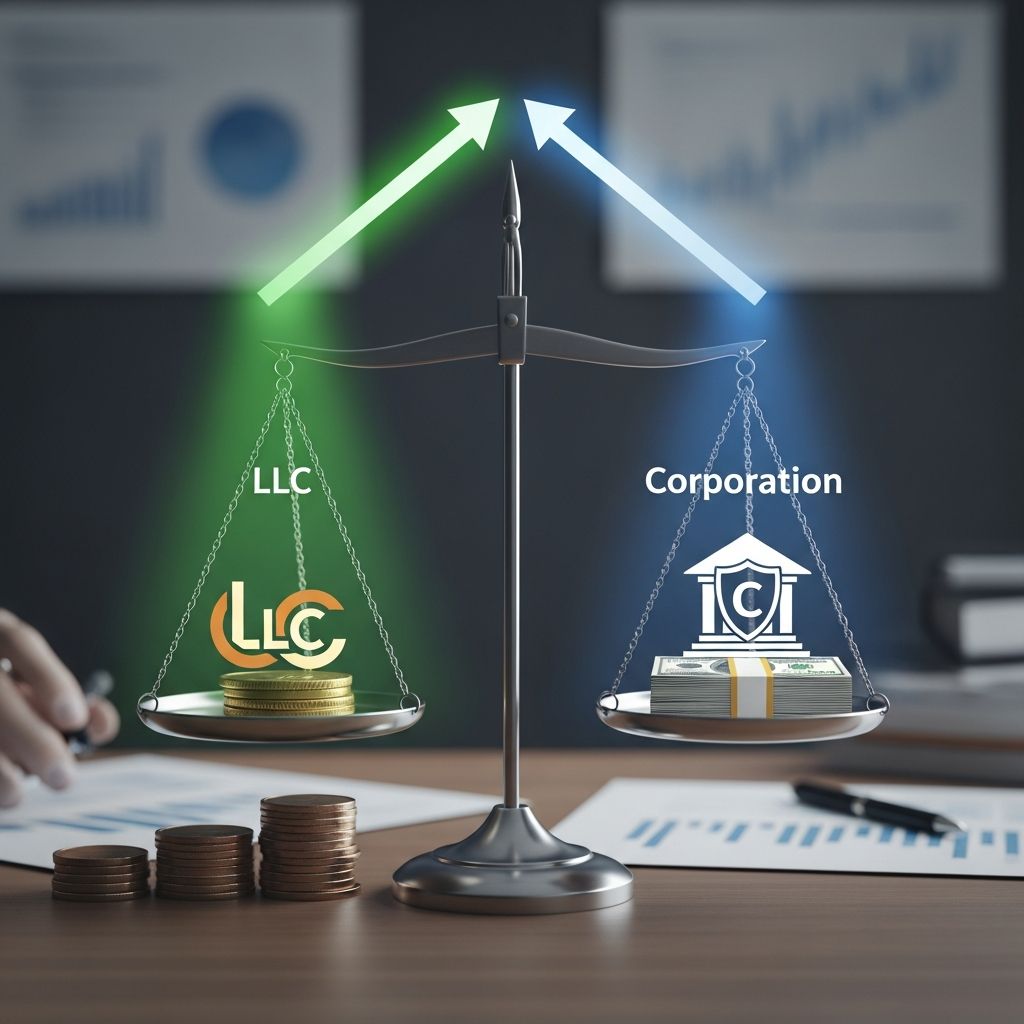
One of the most significant advantages of forming a Limited Liability Company (LLC) is the flexibility it provides regarding tax treatment. By default, LLCs are taxed as pass-through entities, meaning that business income passes through to the owners’ personal tax returns without being taxed at the business level. However, the IRS allows LLC owners to make an election to have their LLC taxed as a corporation—either as a C Corporation or an S Corporation. This election can have profound implications for your business finances, and the decision requires careful consideration of your specific circumstances.
Understanding whether to elect corporate taxation for your LLC is not a one-size-fits-all decision. The choice depends on factors such as your business income level, reinvestment plans, growth projections, and personal financial situation. This comprehensive guide explores the mechanics of LLC tax elections, the advantages and disadvantages of each option, and how to determine whether corporate taxation is right for your business.
Understanding LLC Default Taxation
To appreciate the significance of electing corporate taxation, it’s important to first understand how LLCs are taxed by default. The IRS does not have a specific tax classification for LLCs. Instead, the agency determines tax treatment based on the number of members (owners) the LLC has.
A single-member LLC is taxed as a disregarded entity, meaning the LLC is ignored for tax purposes and treated as a sole proprietorship. The owner reports all business income and expenses on their personal tax return (Form 1040). Multiple-member LLCs are taxed as partnerships by default. Like sole proprietorships, partnerships are pass-through entities where income is reported on the owners’ individual tax returns rather than at the business level.
This default pass-through taxation structure offers significant simplicity and avoids double taxation, which is why many small business owners choose the LLC structure in the first place.
What Does It Mean to Elect Corporate Taxation?
When an LLC elects to be taxed as a corporation, the IRS begins treating the business as a separate taxable entity. This means the LLC files its own corporate tax return (Form 1120 for C Corporations or Form 1120-S for S Corporations) rather than having income pass through to the owners’ personal returns. The election doesn’t change your state-level business structure—your LLC remains an LLC under state law—but it changes how the federal government taxes your business for income tax purposes.
LLCs can make this election by filing specific IRS forms. To elect C Corporation taxation, you file Form 8832 (Entity Classification Election). To elect S Corporation taxation, you file Form 2553 (Election by a Small Business Corporation). These elections take effect on the date specified in the form, which can be retroactive to the entity’s formation date or effective on a future date.
C Corporation Taxation for LLCs: Advantages and Disadvantages
Electing to have your LLC taxed as a C Corporation creates significant changes in how your business is taxed and operated. Understanding both the benefits and drawbacks is essential before making this election.
Advantages of C Corporation Taxation
Unlimited number of owners: Unlike S Corporations, which are limited to 100 shareholders with specific residency and citizenship requirements, a C Corporation can have an unlimited number of owners (shareholders). This advantage is particularly valuable if your business plans to raise substantial capital through investment or eventually go public.
No ownership restrictions: C Corporations have no restrictions on who can own shares. S Corporations prohibit non-U.S. residents and certain entities from owning shares, but C Corporations welcome foreign investors and corporate shareholders. This flexibility makes C Corporation taxation advantageous for businesses seeking international investment.
Greater access to capital: The venture capital and angel investor communities have greater familiarity and comfort with corporate share structures. Investors typically prefer purchasing shares rather than membership interests in an LLC, making C Corporation taxation more attractive to business owners seeking outside funding.
Employee benefit deductions: C Corporations can deduct certain employee benefits that pass-through entities cannot. These include contributions to retirement plans, gym memberships, meals provided at work, education assistance programs, company-owned vehicles, and moving and housing benefits. For businesses with employees, these deductions can provide meaningful tax savings.
Disadvantages of C Corporation Taxation
Double taxation: The most significant disadvantage of C Corporation taxation is double taxation. The corporation pays federal income tax on its profits at the corporate rate (currently 21%), and then shareholders pay individual income tax on dividends received. This means the same income is taxed twice, significantly reducing the amount available to owners.
No personal loss deductions: In pass-through entities, owners can deduct business losses on their personal tax returns to offset other income. With C Corporation taxation, corporate losses can only offset corporate income on the corporate tax return, not the owners’ personal income. This limitation can be problematic for businesses experiencing losses or during start-up phases.
Increased record-keeping requirements: C Corporations face stricter record-keeping requirements than pass-through LLCs. Your business must maintain more comprehensive financial records, corporate documentation, and tax compliance materials. This creates additional administrative burden and potential costs for accounting and legal services.
More complex tax compliance: Filing and maintaining a C Corporation tax return is more complex than pass-through taxation. You’ll need to prepare Form 1120, handle payroll taxes if you take a salary, and manage more sophisticated tax planning considerations.
S Corporation Taxation for LLCs: Advantages and Disadvantages
Many LLC owners find S Corporation taxation more appealing than C Corporation taxation because it combines pass-through taxation with potential self-employment tax savings.
Advantages of S Corporation Taxation
Pass-through taxation without double taxation: S Corporations are pass-through entities where income is reported on shareholders’ individual tax returns, avoiding corporate-level taxation. This eliminates the double taxation problem associated with C Corporations.
Self-employment tax savings: One of the most significant advantages of S Corporation taxation is the potential to reduce self-employment taxes. In a pass-through LLC, all net income is subject to self-employment tax (approximately 15.3%). With S Corporation taxation, only the salary you pay yourself as a W-2 employee is subject to payroll taxes; distributions from profits can be taken as dividends, which avoid self-employment tax. For profitable businesses, this can result in thousands of dollars in annual tax savings.
Simpler than C Corporation taxation: S Corporation taxation is simpler to manage than C Corporation taxation because you avoid the double taxation and corporate loss limitations associated with C Corporations.
Perpetual existence: S Corporations have perpetual existence, meaning the entity continues to exist even if an owner leaves or passes away. This provides business continuity and stability.
Disadvantages of S Corporation Taxation
Ownership limitations: S Corporations are limited to 100 shareholders, and those shareholders must be U.S. citizens or residents. This restriction makes S Corporation taxation unsuitable for businesses seeking foreign investment or planning to raise capital from numerous investors.
Reasonable salary requirement: The IRS requires that S Corporation owners who materially participate in the business pay themselves a “reasonable salary” subject to payroll taxes. You cannot simply take all profits as dividend distributions to minimize self-employment taxes. If the IRS determines your salary is unreasonably low, it may reclassify distributions as wages and impose penalties and interest.
Additional compliance requirements: Operating as an S Corporation requires more compliance than a standard pass-through LLC. You must file Form 2553, maintain corporate records, hold shareholder meetings, and file Form 1120-S tax returns. These requirements increase administrative and professional service costs.
Potential IRS scrutiny: The IRS carefully monitors S Corporation salary elections to ensure owners are not improperly minimizing self-employment taxes. Aggressive salary planning can attract IRS scrutiny and audits.
Comparing Tax Structures: LLC Pass-Through vs. C-Corp vs. S-Corp
| Feature | LLC (Pass-Through) | C Corporation | S Corporation |
|---|---|---|---|
| Default Taxation | Pass-through (sole proprietorship or partnership) | N/A (must elect) | N/A (must elect) |
| Double Taxation | No | Yes | No |
| Self-Employment Tax on Income | Yes, on all net income | Only on salary | Only on W-2 salary |
| Number of Owners | Unlimited | Unlimited | Maximum 100 |
| Foreign Ownership Allowed | Yes | Yes | No |
| Loss Deductions on Personal Returns | Yes | No | Yes |
| Record-Keeping Complexity | Low | High | Medium |
When Should You Elect Corporate Taxation?
Determining whether to elect corporate taxation requires analyzing your specific business situation. Corporate taxation is generally most beneficial in specific scenarios:
High profitability with reinvestment plans: If your LLC generates significant profits that you plan to reinvest in the business rather than distribute to owners, C Corporation taxation can be advantageous. The corporate tax rate of 21% may be lower than your personal marginal tax rate, allowing you to retain earnings at a lower tax cost. You only face double taxation when you distribute profits as dividends.
Seeking substantial outside investment: If you plan to raise capital from venture capitalists, angel investors, or other outside sources, corporate taxation (typically C Corporation) makes your business more attractive to investors who prefer equity ownership structures.
Significant self-employment income: If your LLC generates substantial net income and all income is subject to self-employment tax under pass-through taxation, electing S Corporation taxation can provide meaningful tax savings. An LLC owner earning $150,000 in net income might save $15,000 or more annually through S Corporation taxation, depending on the reasonable salary determined.
Multiple employees with benefits: If your LLC employs multiple people and you want to provide significant employee benefits (gym memberships, education assistance, meals), C Corporation taxation allows you to deduct these benefits as business expenses rather than taxable compensation.
Planning for future public offering: If your business may eventually go public, C Corporation taxation from the outset simplifies the process and aligns with investor expectations.
When Should You Avoid Corporate Taxation?
For many small business owners, particularly those just starting out, avoiding corporate taxation is the better choice:
Early-stage businesses: Start-up companies often operate at a loss or with minimal profits in their first few years. C Corporation taxation prevents you from using business losses to offset personal income, which is particularly disadvantageous during this stage. Pass-through taxation allows you to deduct losses on your personal return.
Businesses seeking to minimize complexity: The administrative burden and compliance requirements of corporate taxation can be substantial for small businesses. If your business is relatively simple and generates modest income, the additional complexity and professional service costs may outweigh any tax benefits.
Businesses with low to moderate income: If your business generates income below approximately $60,000-$75,000 annually, S Corporation taxation rarely provides sufficient self-employment tax savings to justify the added complexity. Similarly, if your income is below your personal marginal tax rate, C Corporation taxation offers no rate advantage.
Businesses needing loss deductions: If your business generates losses that could benefit you by offsetting other personal income (such as spousal income or investment income), corporate taxation eliminates this advantage.
How to Make the Election
If you determine that corporate taxation is right for your LLC, you must file the appropriate IRS form to make the election:
For C Corporation taxation: File Form 8832 (Entity Classification Election) with the IRS. This form must be signed and filed with your tax return or mailed separately to the IRS. You can specify an effective date for the election, which can be retroactive to your LLC’s formation date or a future date.
For S Corporation taxation: File Form 2553 (Election by a Small Business Corporation) with the IRS. All shareholders must sign this form. Unlike Form 8832, this form is typically filed with your tax return. The election is generally effective on the first day of your tax year or 30 days after filing, whichever is later.
It’s crucial to work with a qualified tax professional when making these elections to ensure compliance and optimize your tax strategy.
Frequently Asked Questions (FAQs)
Q: Can I change my LLC’s tax election later?
A: Yes, you can generally change your tax election, but there are timing restrictions. The IRS typically requires a waiting period before you can revoke a previous election and make a new one. Consult with a tax professional about timing and procedures for changing your election.
Q: Does electing corporate taxation change my LLC status under state law?
A: No. Your LLC remains an LLC under state law regardless of your federal tax election. Only your federal tax treatment changes; your state-level liability protection and legal structure remain unchanged.
Q: How much can I save with S Corporation taxation?
A: S Corporation tax savings depend on your business income and the reasonable salary you determine. Generally, owners don’t see significant savings until net income exceeds approximately $60,000-$75,000 annually. Savings can range from a few thousand dollars per year for moderate-income businesses to tens of thousands for highly profitable enterprises.
Q: Do I need a separate business bank account for corporate taxation?
A: While not legally required, maintaining separate business accounts is strongly recommended for accounting clarity, audit defense, and legal protection. This practice is essential whether or not you elect corporate taxation.
Q: What professional help do I need to make a corporate tax election?
A: Consult with both a tax professional and potentially a business attorney. A CPA or tax advisor can analyze your specific situation and determine whether corporate taxation is beneficial. An attorney can ensure your LLC agreements and operating documents properly reflect the tax election.
Q: Is C Corporation taxation ever beneficial for small businesses?
A: C Corporation taxation is rarely beneficial for small businesses due to double taxation. It’s primarily valuable for businesses planning to raise substantial outside capital, retain substantial earnings for reinvestment, or go public. For most small businesses, S Corporation taxation (if beneficial at all) is the better choice.
Conclusion
Deciding whether to elect corporate taxation for your LLC is a significant financial decision that depends on your specific business circumstances. While pass-through taxation is appropriate for most small businesses, certain situations may benefit from electing C Corporation or S Corporation taxation. S Corporation taxation can provide meaningful self-employment tax savings for profitable businesses, while C Corporation taxation may benefit businesses seeking substantial outside investment or planning for substantial retained earnings.
Before making any election, carefully evaluate your business’s income level, growth plans, investment needs, and personal financial situation. Work with qualified tax and legal professionals who understand your complete financial picture and can provide personalized recommendations. The right tax structure can result in significant savings or provide better flexibility for your business’s future growth and success.
References
- LLC Tax Benefits: Pros and Cons of a Limited Liability Company (LLC) — Block Advisors. November 2024. https://www.blockadvisors.com/resource-center/small-business-owners/llc-taxes/
- LLC vs Corporation: Key Differences, Pros & Cons Explained — My Corporation. 2024. https://www.mycorporation.com/learningcenter/llc-vs-corporation.jsp
- LLC taxed as C-Corp (Form 8832) [Pros and cons] — LLC University. 2024. https://www.llcuniversity.com/irs/llc-taxed-as-c-corp/
- Corporations Vs. LLCs, Risks and Benefits — Caleb Bland Law, PLLC. 2024. https://calebblandlaw.com/blog/corporations-vs-llcs-risks-and-benefits/
- LLC vs. S corporation: Advantages and disadvantages — Wolters Kluwer. 2024. https://www.wolterskluwer.com/en/expert-insights/llc-vs-s-corporation-advantages-and-disadvantages
- S Corp and LLC: Differences, Advantages, and Disadvantages — U.S. Chamber of Commerce. 2024. https://www.uschamber.com/co/start/strategy/differences-between-s-corp-and-llc
- Choose a business structure — U.S. Small Business Administration. 2024. https://www.sba.gov/business-guide/launch-your-business/choose-business-structure
Similar Articles








Read full bio of medha deb