Short Selling: Definition, How It Works, and Risks
Understanding short selling: A comprehensive guide to bearish trading strategies.

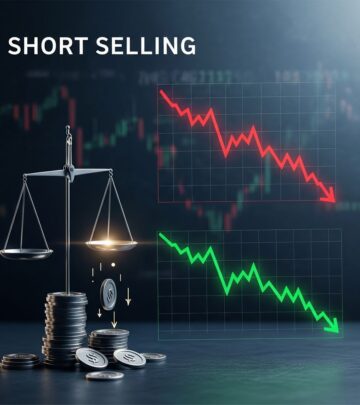
Short selling is an investment strategy where an investor borrows shares of a stock and immediately sells them at the current market price, with the intention of buying them back at a lower price in the future. The investor profits from the difference between the higher selling price and the lower purchase price. This practice represents a bearish bet against a company, as the investor profits when the stock price declines. Short selling is one of the most misunderstood and controversial trading strategies in the financial markets, often associated with market manipulation and excessive risk-taking.
Understanding Short Selling Basics
At its core, short selling is essentially the reverse of traditional “long” investing. When investors buy stocks long, they purchase securities hoping the price will rise. With short selling, investors do the opposite—they profit from stock price declines. This fundamental reversal of typical investing logic makes short selling a specialized strategy that requires significant experience and understanding of market mechanics.
The practice has been around for centuries and plays an important role in financial markets by providing liquidity and helping to establish accurate price discovery. However, short selling remains controversial because it involves negative sentiment about companies and the potential for abuse through manipulative tactics.
How Short Selling Works: Step-by-Step Process
Understanding the mechanics of short selling requires breaking down the process into its fundamental components:
Step 1: Borrowing Shares
The first step in executing a short sale is borrowing shares from a broker or another investor through the broker’s lending program. The short seller typically needs to have a margin account with their brokerage firm. The broker locates shares through its inventory, other clients’ holdings, or other brokers’ lending programs. A fee is charged for borrowing these shares, which varies based on availability and demand. Shares that are difficult to borrow command higher lending fees.
Step 2: Selling the Borrowed Shares
Once shares are borrowed, the short seller immediately sells them in the open market at the current market price. The proceeds from this sale are typically held in the investor’s brokerage account as collateral. The short seller does not pocket this cash immediately; instead, it serves as security for the borrowed shares that must eventually be returned.
Step 3: Monitoring Price Movement
After selling the borrowed shares, the short seller waits and monitors the stock price. The investor profits if the stock price falls as expected. The larger the decline, the greater the potential profit. However, if the stock price rises instead of falling, losses accumulate and can become substantial.
Step 4: Covering the Short Position
To complete the short sale, the investor must eventually “cover” their position by purchasing shares of the same stock at a lower price and returning them to the lender. The profit or loss is calculated as the difference between the selling price (when the shares were borrowed and sold) and the purchase price (when covering the position). This is often referred to as “covering your shorts.”
Short Selling Example
Consider a practical example to illustrate how short selling works:
Suppose an investor believes Company ABC is overvalued and expects its stock price to decline from its current price of $100 per share. The investor executes a short sale:
- Borrows 100 shares of Company ABC through their broker
- Immediately sells these 100 shares at the current market price of $100, generating $10,000 in proceeds
- The stock price subsequently falls to $60 per share as the investor predicted
- The investor purchases 100 shares at $60 per share, spending $6,000
- The investor returns the 100 shares to the lender
- The profit is $4,000 ($10,000 from selling minus $6,000 from buying), excluding borrowing fees and commissions
In this scenario, the investor successfully profited from the stock price decline. However, had the stock price risen to $150 instead of falling, the investor would have needed to buy shares at $150, resulting in a $5,000 loss on the trade.
Key Mechanics and Considerations
Margin Accounts and Requirements
Short selling requires a margin account, not a standard cash account. Brokers impose minimum margin requirements, meaning investors must maintain a certain percentage of the trade value as collateral. Initial margin requirements are typically 50% to 100% of the short sale proceeds, meaning the investor must have sufficient funds in their account. Maintenance margin requirements, usually 25% to 30%, must be maintained throughout the holding period. If the account value falls below maintenance requirements, the broker can force the investor to cover the short position, potentially at unfavorable prices.
Borrowing Costs
Short sellers must pay fees to borrow shares. These fees vary based on:
- Stock availability—hard-to-borrow stocks command higher fees
- Market demand for borrowing—increased demand drives up costs
- Interest rates—general market interest rate environments affect borrowing costs
- Broker policies—different brokers charge different rates
These costs can significantly impact the profitability of short trades, especially for long-term positions.
Dividend Payments
If a company pays dividends while shares are borrowed for a short sale, the short seller must pay the dividend to the lender. This reduces the profitability of the short position and represents an additional cost to the short seller beyond borrowing fees and commissions.
Risks Associated with Short Selling
Unlimited Loss Potential
Unlike buying stocks where maximum loss is limited to the initial investment, short selling carries theoretically unlimited loss potential. If a stock price rises indefinitely, losses continue to accumulate without a mathematical ceiling. For example, if you short a stock at $100, it can theoretically rise to $500, $1,000, or higher, with losses multiplying accordingly.
Short Squeeze Risk
A short squeeze occurs when a heavily shorted stock experiences sudden upward price pressure, often driven by positive news or buying enthusiasm. As the price rises, short sellers face mounting losses and rush to cover positions by buying shares. This increased buying demand drives prices even higher, creating a vicious cycle that can result in catastrophic losses for short sellers. The GameStop and AMC situations of 2021 exemplified extreme short squeeze scenarios.
Forced Buyback Requirements
Brokers can force short sellers to cover positions if borrowing costs become excessive or if shares become unavailable. Companies may also recall borrowed shares, forcing unexpected buybacks. Additionally, broker margin calls can force liquidation of short positions at unfavorable times and prices.
Regulatory and Structural Risks
Regulators in various jurisdictions have implemented restrictions on short selling, including temporary bans during market stress. “Naked” short selling, where shares are sold without actually securing them for borrowing, has been prohibited in most developed markets. Uptick rules and circuit breakers also constrain short selling activities during market downturns.
Timing and Market Risk
Even if an investor’s bearish thesis is ultimately correct, timing matters significantly. A stock can remain overvalued for extended periods before price declines materialize. During this waiting period, borrowing costs accumulate, margin requirements must be maintained, and short sellers must absorb any dividend payments. The emotional and financial stress of maintaining losing positions adds psychological risk.
Regulations and Restrictions
Short selling is heavily regulated to prevent market manipulation and excessive risk-taking:
- Uptick Rule: Reinstated in 2010, this rule generally requires short sales to occur at prices equal to or higher than the previous trade price, preventing aggressive downward price pressure
- Naked Short Selling Bans: Most jurisdictions prohibit selling shares without confirmed borrowing arrangements
- Disclosure Requirements: Large short positions must sometimes be disclosed to regulators and the public
- Emergency Bans: During market crises, regulators can temporarily ban short selling in specific sectors or broadly
- Pre-borrow Requirements: Some rules require confirmed borrowing before order entry
Short Selling vs. Long Investing: Key Differences
| Aspect | Long Investing | Short Selling |
|---|---|---|
| Market Outlook | Bullish (expects price increase) | Bearish (expects price decrease) |
| Initial Action | Buy shares | Borrow and sell shares |
| Maximum Loss | Limited to investment amount | Theoretically unlimited |
| Maximum Gain | Theoretically unlimited | Limited to selling price |
| Time Pressure | Low—can hold indefinitely | High—must eventually cover |
| Account Type | Cash or margin account | Margin account required |
| Borrowing Costs | None | Yes—share lending fees |
| Dividend Treatment | Investor receives dividends | Investor pays dividends |
When Short Selling Makes Sense
Short selling can be an appropriate strategy in certain specific scenarios:
- Hedge Against Long Positions: Investors with significant long stock positions can short correlated or related stocks to hedge portfolio risk
- Identified Overvaluation: When extensive research reveals a stock is significantly overvalued based on fundamentals or technical analysis
- Expected Negative Catalysts: When specific upcoming events (earnings disappointments, regulatory changes, competitive threats) are expected to pressure stock prices
- Market Corrections: During broader market downturns or sector corrections, short strategies may reduce portfolio losses
- Pairs Trading: Shorting weaker companies while buying stronger competitors in the same industry
Frequently Asked Questions (FAQs)
Q: Is short selling illegal?
A: No, short selling is legal in most developed markets when conducted according to regulatory requirements. However, naked short selling and certain manipulative practices are prohibited. Regulators may impose temporary restrictions during market stress periods.
Q: Can individual retail investors short sell stocks?
A: Yes, individual retail investors can short sell through brokers offering margin accounts. However, brokers set their own requirements and may restrict short sales of certain stocks or require higher experience levels.
Q: What is a short squeeze?
A: A short squeeze occurs when heavily shorted stocks experience sudden upward price pressure, forcing short sellers to buy back shares at higher prices, further driving prices up and creating significant losses for short positions.
Q: How much can you lose on a short sale?
A: Short sellers face theoretically unlimited losses. If a stock price rises indefinitely, losses continue accumulating without a mathematical ceiling, unlike long stock positions where losses are limited to the initial investment.
Q: Why do short sellers have to pay dividends?
A: Since short sellers borrowed shares, they must replicate the benefits of ownership for the original shareholders. When the company pays dividends, short sellers must pay equivalent amounts to the share lenders.
Q: What is the uptick rule?
A: The uptick rule requires short sales to occur at prices equal to or higher than the previous trade price. This regulation prevents aggressive downward price pressure and is designed to prevent market manipulation during downturns.
Q: How do I cover a short position?
A: To cover a short position, you purchase shares of the same stock you shorted and return them to the lender through your broker. Your profit or loss is the difference between the selling price and the purchase price.
Q: What are the main costs of short selling?
A: Main costs include borrowing fees for shares, commission charges, margin interest on borrowed funds, and any dividend payments due on the shorted stock during the holding period.
References
- Short Selling — U.S. Securities and Exchange Commission (SEC). 2024. https://www.sec.gov/investor/pubs/shortselling.htm
- Regulation SHO: Short Sale Rule Amendments — SEC Division of Trading and Markets. 2023. https://www.sec.gov/divisions/tradmkt
- The Mechanics of Short Selling in Equity Markets — Federal Reserve Bank of New York. 2022. https://www.newyorkfed.org
- Investor Bulletin: Understanding Short Sales — Financial Industry Regulatory Authority (FINRA). 2024. https://www.finra.org/investors
- Short Selling and Market Quality — CFA Institute. 2023. https://www.cfainstitute.org
Similar Articles








Read full bio of medha deb