Shitcoin: Understanding Worthless Cryptocurrencies
Learn what shitcoins are, how to identify them, and protect your investments from worthless tokens.
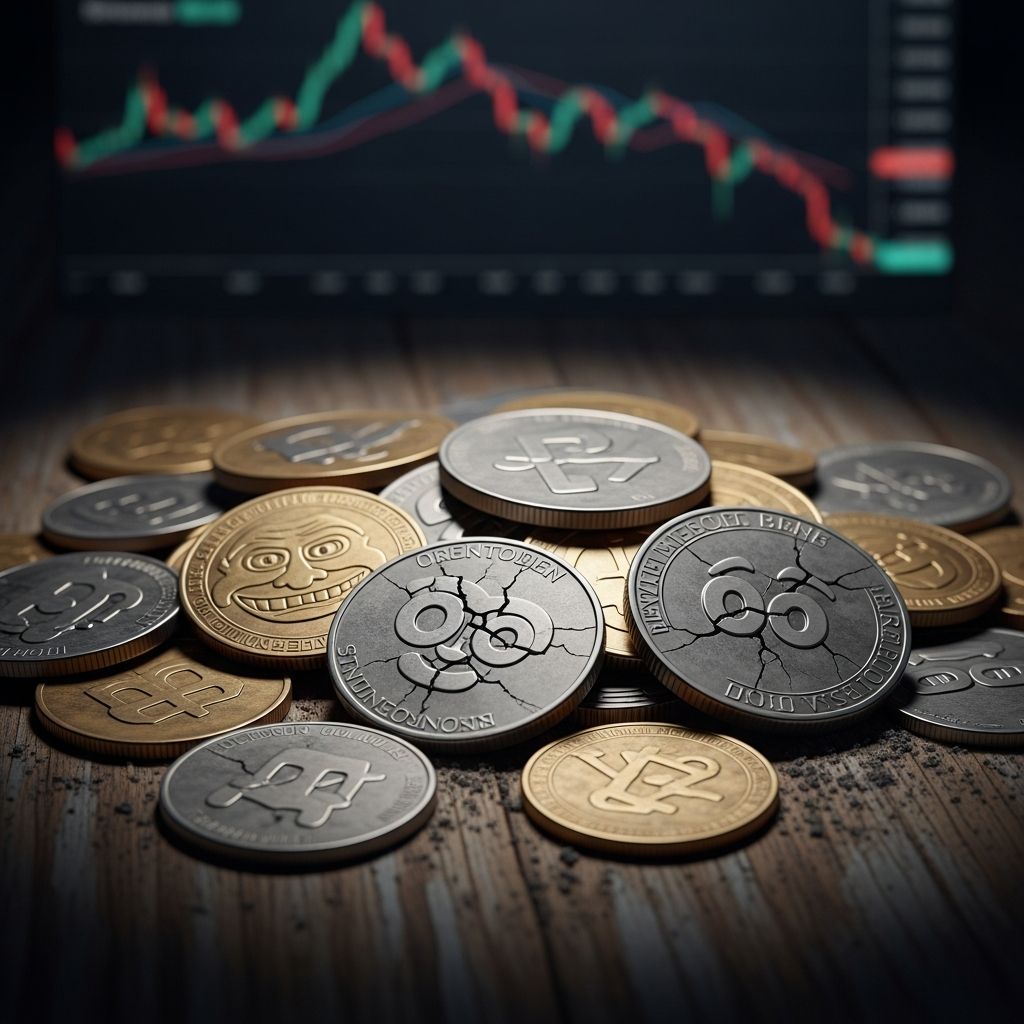
What Is a Shitcoin?
A shitcoin is a cryptocurrency token that possesses zero or near-zero utility and holds little to no intrinsic value for investors. The term, while crude in its nomenclature, has become the standard vernacular within cryptocurrency communities to describe altcoins that lack fundamental value propositions or legitimate use cases. Unlike established cryptocurrencies such as Bitcoin or Ethereum, which offer specific technological innovations or network functionalities, shitcoins typically emerge from projects with minimal development, no clear roadmap, or outright fraudulent intentions.
Shitcoins differ fundamentally from legitimate cryptocurrency projects in several critical ways. While Bitcoin introduced blockchain technology as a decentralized ledger system, and Ethereum enabled smart contracts and decentralized applications, shitcoins often copy existing blockchain technology without adding meaningful innovation. They frequently rely on massive, unlimited token supplies that create inevitable price dilution as more tokens enter circulation.
Key Characteristics of Shitcoins
Unlimited or Excessive Token Supply
One of the most defining characteristics of shitcoins is their tendency to have unlimited or extraordinarily large token supplies without any scarcity mechanism. Established cryptocurrencies like Bitcoin maintain value partly through fixed supply caps—Bitcoin’s maximum supply is capped at 21 million coins. However, shitcoins often lack such constraints, allowing unlimited minting of new tokens. This unbounded supply naturally depresses token value because investors recognize that their holdings will perpetually face dilution from newly created tokens.
Lack of Genuine Utility
Legitimate cryptocurrencies serve specific purposes within their ecosystems. Bitcoin functions as a store of value and medium of exchange, while Ethereum powers decentralized applications through smart contracts. Shitcoins, conversely, offer no genuine utility or functionality. They don’t solve real problems, don’t enable meaningful transactions, and don’t provide any practical application within their networks. The token essentially serves only as a speculative vehicle for trading.
No Clear Development Roadmap
Projects behind legitimate cryptocurrencies maintain transparent development roadmaps detailing future improvements, technological implementations, and milestone achievements. Shitcoin projects typically lack such documentation or provide vague, unrealistic promises. Their websites often contain minimal technical information, no whitepaper, or poorly written documentation that raises immediate credibility concerns.
Minimal or Non-existent Development Team
Established cryptocurrency projects feature identifiable development teams with verifiable credentials and public presence. Shitcoin projects frequently operate under anonymous teams with no verifiable background, or worse, use entirely fabricated team members. This anonymity creates ideal conditions for scam operations where developers can disappear after extracting investor funds.
How Shitcoins Are Marketed
Unrealistic Promise of Extraordinary Returns
The primary marketing strategy employed by many shitcoin projects involves promising unrealistically high returns that have virtually zero probability of materializing. Marketing materials explicitly claim that investors can turn minimal investments into life-changing wealth within short timeframes. These promises exploit the psychological vulnerability of retail investors seeking quick fortunes in cryptocurrency markets.
Shitcoin promoters frequently use phrases like “the next Bitcoin” or “100x potential” despite their projects lacking any fundamental basis for such valuations. They create elaborate narratives about upcoming partnerships, technological breakthroughs, or regulatory approvals that never come to fruition.
Social Media and Influencer-Driven Promotion
Shitcoins rely extensively on social media marketing across platforms like Twitter, Discord, Telegram, and YouTube. They often compensate influencers and content creators to promote their tokens to audiences numbering in the millions. This creates artificial buzz and perception of legitimacy that attracts unsuspecting investors.
The marketing campaigns frequently target inexperienced investors and cryptocurrency newcomers who may lack the expertise to evaluate tokens critically. Coordinated promotional efforts create echo chambers where positive sentiment appears organic but actually reflects paid promotions and coordinated hype campaigns.
Community-Building Without Utility
Some shitcoins take a different approach by openly acknowledging their lack of utility while simultaneously building passionate communities around their tokens. These projects market themselves as “community-driven” cryptocurrencies where value derivation depends entirely on collective enthusiasm and price momentum. Essentially, they acknowledge that their tokens have no real-world application but argue that community support will drive demand and thus appreciation.
This strategy proves particularly effective with retail investors seeking community belonging alongside investment exposure. The community becomes self-reinforcing as members recruit friends and family into the coin, creating a pyramid-like structure where early adopters profit from newer entrants.
Identifying Shitcoins: Red Flags and Warning Signs
Warning Signs in Project Documentation
| Red Flag | Significance |
|---|---|
| No whitepaper or poorly written technical documentation | Indicates lack of serious development or technical understanding |
| Vague mission statements and unclear use cases | Suggests the project lacks legitimate purpose |
| Unrealistic tokenomics with unlimited supply | Ensures inevitable price dilution and value destruction |
| No published roadmap or vague timeline | Reflects absence of concrete development plans |
| Anonymous or unverifiable team members | Creates conditions for exit scams and fraud |
Marketplace and Trading Red Flags
Shitcoins frequently exhibit suspicious marketplace characteristics. They may only trade on obscure, unregulated exchanges with minimal liquidity, making it difficult for investors to exit positions at favorable prices. The trading volume appears artificially inflated through wash trading, where large volumes execute between accounts controlled by the same entity.
Price movements in shitcoin markets often show suspicious patterns with coordinated pumps followed by rapid dumps, indicating potential price manipulation by project insiders or coordinated trading groups.
Social Proof Manipulation
Shitcoin projects manipulate various metrics to create false impressions of legitimacy and adoption. They inflate social media follower counts through bot networks, purchase positive reviews on cryptocurrency review platforms, and coordinate shilling campaigns across Reddit and cryptocurrency forums. They may claim partnerships with major companies or institutions without proper verification or disclose these partnerships in misleading ways.
The Economics of Shitcoin Failure
Shitcoins inevitably fail because their token economics guarantee value destruction. With unlimited or excessive supply and zero utility, the only mechanism supporting prices is continuous new investor inflows. Once such flows cease—which happens inevitably as new investors dry up—prices collapse catastrophically.
The mathematics are straightforward: if a token lacks utility and possesses an unlimited supply, its fundamental value should approach zero. Any price above zero reflects only speculation and hype that eventually dissipates. Early investors and insiders profit as they exit positions before the inevitable collapse, while later entrants absorb devastating losses.
Legitimate Cryptocurrencies Versus Shitcoins
Fundamental Differences
Legitimate cryptocurrency projects differentiate themselves through multiple factors. They offer genuine technological innovations or solving real-world problems. They maintain transparent teams, active development, and published roadmaps. They possess capped or carefully managed token supplies. They build communities around actual utility rather than speculative hype.
These projects undergo rigorous code audits, maintain active development repositories, and publish regular progress updates. Their marketing emphasizes authentic use cases and technological achievements rather than unrealistic return promises.
Potential Evolution of Shitcoins
While most shitcoins fail, some projects have demonstrated the capacity to evolve beyond their initial shitcoin status. When communities develop genuine passion for tokens, they sometimes collaborate to build real utility where none previously existed. Developers may join the project, introduce legitimate technological innovations, and transform the token into a functioning cryptocurrency with actual use cases.
This transformation remains exceptional rather than typical, but it demonstrates that shitcoin classification isn’t necessarily permanent. However, investors should not bank on such transformations, as the overwhelming majority of shitcoins simply disappear.
Investor Protection Strategies
Due Diligence Checklist
Prudent investors examining potential cryptocurrency investments should verify several critical elements. First, evaluate the whitepaper for technical depth and clarity. Second, research the development team using independent verification methods and LinkedIn profiles. Third, analyze tokenomics including supply schedule, distribution, and vesting periods. Fourth, examine the active development repository and commit history. Fifth, review independent security audits and code reviews. Sixth, assess genuine utility and compare the project against competitors in the same category.
Market Analysis
Examine whether the project trades on reputable, regulated exchanges or only obscure platforms. Analyze trading volume patterns for signs of manipulation. Research community sentiment across multiple platforms, distinguishing between genuine discussion and coordinated shilling. Compare the project’s metrics against established competitors in the same space.
Frequently Asked Questions
Q: How can I distinguish between a shitcoin and a legitimate altcoin project?
A: Legitimate projects maintain transparent teams with verifiable credentials, publish technical whitepapers and development roadmaps, trade on regulated exchanges with substantial liquidity, have capped token supplies, and communicate genuine utility and use cases. Shitcoins lack these characteristics, featuring anonymous teams, no documentation, vague promises, and unlimited supplies.
Q: Is investing in shitcoins ever justified?
A: While some investors engage in extremely high-risk speculation on shitcoins, such investments are essentially gambling with odds heavily stacked toward complete loss. The probability of profit is extraordinarily low, while the probability of losing your entire investment approaches certainty. Most financial advisors recommend avoiding such investments entirely.
Q: Can a shitcoin ever become valuable?
A: While theoretically possible, this outcome remains extraordinarily rare. A shitcoin would require the community to develop genuine utility, attract legitimate developers, and transform into a functioning cryptocurrency. The overwhelming majority of shitcoins simply fail and disappear, returning investors’ capital to zero.
Q: What should I do if I’ve already invested in a shitcoin?
A: If you’ve invested minimally or can afford the loss, you might hold while continuing your research into the project’s development. If your investment represents substantial capital, consult with a financial advisor about loss mitigation strategies. Generally, investors should cut losses on shitcoins rather than hoping for recovery.
Q: Why do exchanges list shitcoins if they’re worthless?
A: Reputable exchanges typically don’t list shitcoins, but unregulated and less scrupulous platforms accept listing fees regardless of project legitimacy. This provides shitcoin promoters with a veneer of legitimacy while generating revenue for exchanges with minimal regulatory oversight.
References
- Shitcoin Definition — CoinMarketCap Academy. 2024. https://coinmarketcap.com/academy/glossary/shitcoin
- How to Identify Shitcoins and Stay Safe from Crypto Scams — Aron Groups. 2024. https://arongroups.co/crypto-articles/what-is-a-shitcoin/
- Understanding Cryptocurrency Tokenomics and Supply Economics — U.S. Securities and Exchange Commission Office of Investor Education and Advocacy. 2023. https://www.sec.gov/investor/alerts/ia_virtualcurrencies.pdf
- Cryptocurrency Fraud and the Role of Social Media Marketing — Federal Trade Commission. 2024. https://reportfraud.ftc.gov/
- Bitcoin: A Peer-to-Peer Electronic Cash System — Satoshi Nakamoto. 2008. https://bitcoin.org/bitcoin.pdf
Similar Articles








Read full bio of Sneha Tete