Shift Savings to CDs Before Rates Drop?
Explore if locking in CD rates now beats flexible high-yield savings amid expected Fed cuts in 2026.
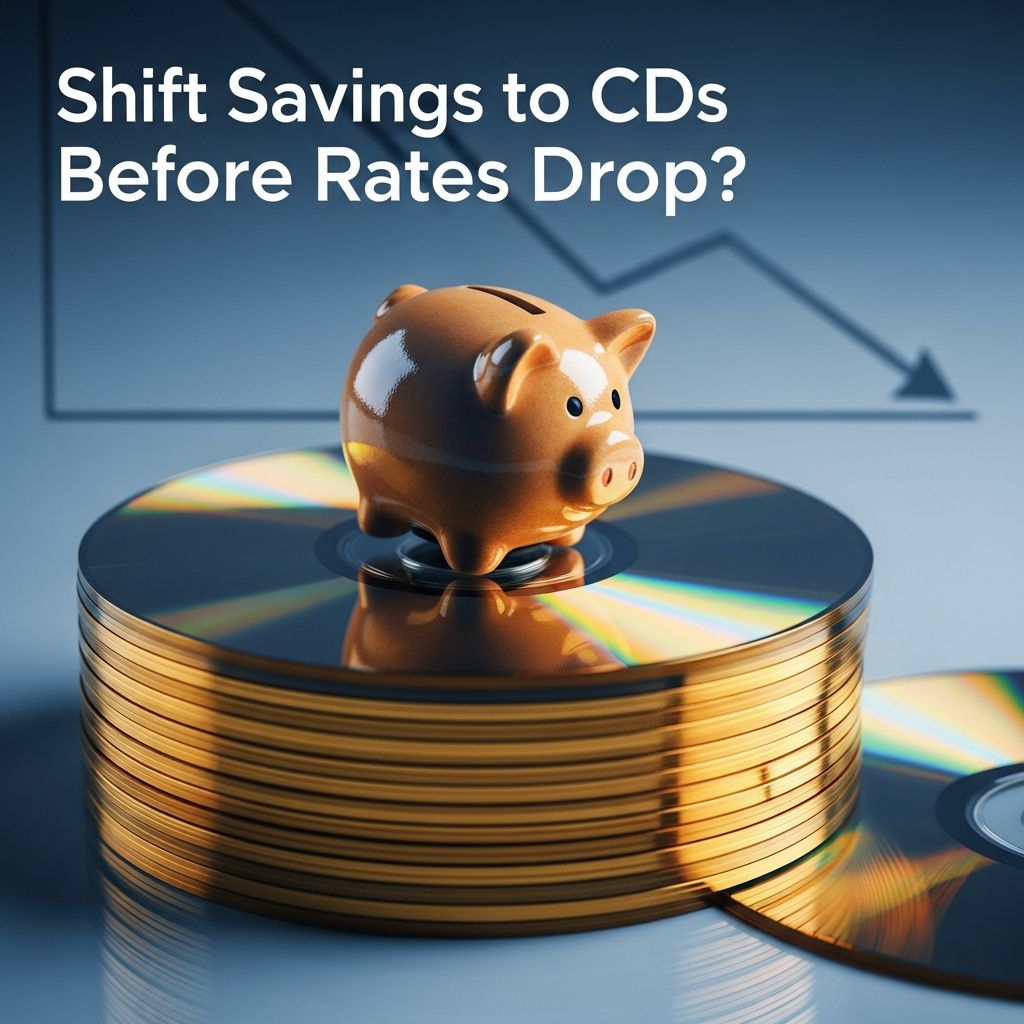
In 2026, with the Federal Reserve signaling potential interest rate reductions, savers face a pivotal choice: stick with the flexibility of high-yield savings accounts (HYSAs) or shift funds into certificates of deposit (CDs) to secure current yields. Both options offer FDIC insurance up to $250,000 and rates far surpassing traditional savings accounts’ 0.40% average, but their structures differ significantly in a declining rate environment. This article breaks down the mechanics, compares potential earnings, weighs trade-offs, and outlines strategies to maximize returns.
Core Differences Between CDs and High-Yield Savings
CDs require committing funds for a fixed term, from 3 months to 5 years, in exchange for a guaranteed annual percentage yield (APY). This locks in the rate against future drops, ideal when banks anticipate lower borrowing costs. HYSAs, conversely, provide easy access with variable rates that fluctuate with market conditions, currently hovering around 4-5% at top online banks.
- Fixed vs. Variable Rates: CDs ensure predictability; HYSAs adapt but risk erosion if the Fed cuts rates.
- Liquidity: Withdraw HYSA funds anytime (with possible monthly limits); CDs impose early withdrawal penalties, often several months’ interest.
- Minimums and Fees: HYSAs may start at $100, CDs often $1,000+, both typically fee-free if terms are met.
Shorter-term CDs (3-12 months) currently yield 3.9-4.1%, closely matching top HYSAs at 4-4.2%, but longer terms dip lower, reflecting banks’ rate outlook.
Projecting Earnings in a Rate-Cut Scenario
Assuming $20,000 deposits and stable HYSA rates at 4.20% (unlikely amid cuts), CDs lag slightly short-term but gain certainty long-term. Realistically, HYSA rates could fall to 3-3.5% by mid-2026, boosting CD advantages.
| Term | CD APY | CD Earnings ($20K) | HYSA Earnings ($20K at 4.20%) | HYSA Edge (If Stable) |
|---|---|---|---|---|
| 3 months | 3.90% | $192 | $207 | +$15 |
| 6 months | 4.10% | $406 | $416 | +$10 |
| 9 months | 4.00% | $597 | $627 | +$30 |
| 12 months | 4.10% | $820 | $840 | +$20 |
Data adapted from current top rates; actual HYSA returns may decline, flipping the edge to CDs. For $40,000, scale doubles: a 6-month CD at 4.05% earns ~$802 vs. money market/HYSA at 4.00% (~$792 if stable), but CDs win on guarantee.
Advantages of Locking into CDs Now
As rates fall, CDs preserve today’s 4%+ yields. Banks price shorter/mid-term CDs highest (e.g., 6-18 months) to lure deposits without long-term exposure. This ‘sweet spot’ lets savers capture peaks before Fed easing impacts variable accounts swiftly. Penalty-free CDs exist for flexibility, though rates may be marginally lower.
In a falling rate world, a 1-year CD at 4.10% shields against HYSA drops to 3.50%, potentially adding $100+ on $20,000 annually.
Why High-Yield Savings Might Still Win
Liquidity trumps all for emergency funds or near-term needs. HYSAs allow instant access without penalties, crucial if unexpected expenses arise. If rates hold or rise unexpectedly, HYSAs could outperform locked CDs. They’re ideal for laddering strategies or parking cash short-term.
Risks and Penalties to Watch
- Opportunity Cost: CDs tie up funds; if rates spike, you’re stuck.
- Inflation Erosion: Both beat 2.7% inflation now, but monitor.
- Early Withdrawal: CDs charge 3-12 months’ interest; avoid unless no-penalty options.
- Rate Variability: HYSAs drop fast post-Fed cuts.
Smart Allocation Strategies for 2026
Diversify: Allocate 50-70% to a CD ladder (e.g., 3/6/12-month staggered maturities) for locked yields, 30-50% in HYSA for liquidity.
- Assess Needs: Emergency fund (3-6 months expenses) in HYSA; excess in CDs.
- Ladder CDs: Stagger terms to access funds quarterly without full penalty risk.
- Shop Rates: Online banks/credit unions offer best APYs; compare via aggregators.
- Reinvest at Maturity: Roll into new CDs or HYSAs based on then-current rates.
- Tax Considerations: Interest taxable; IRAs for CDs defer taxes.
For $100,000, a ladder might yield $4,000+ guaranteed vs. HYSA’s uncertain $4,200 (pre-cuts).
Current Rate Landscape and Fed Outlook
Top HYSAs: 4.00-4.50%; CDs: 3.90-4.20% short-term, inverting curve signals cuts. Fed’s 2026 path—likely 2-3 cuts—pressures variable rates downward. Act before banks adjust.
Alternatives to Consider
Money market accounts (MMAs) blend HYSA liquidity with CD-like rates (4.00%), check-writing perks, but variable. Treasury bills offer government-backed short terms, tax advantages on state level.
| Option | Rate Type | Liquidity | Insurance |
|---|---|---|---|
| HYSA | Variable | High | FDIC |
| CD | Fixed | Low | FDIC |
| MMA | Variable | High | FDIC |
| T-Bills | Fixed | Medium | Gov’t |
FAQs
Are CDs FDIC-insured?
Yes, up to $250,000 per depositor per bank, same as HYSAs.
What’s a CD ladder?
Multiple CDs with staggered maturities for regular access and reinvestment flexibility.
Will rates definitely fall in 2026?
Markets expect Fed cuts, but timing/scale uncertain; CDs hedge downside.
Best for emergency funds?
HYSA—avoid CD penalties.
How to find top rates?
Use bank comparison sites; online institutions lead.
Final Thoughts
No one-size-fits-all: Prioritize liquidity for short-term needs, lock rates for horizons matching CD terms. In 2026’s rate-drop forecast, blending both optimizes safety and yield. Review quarterly, shop competitively—small APY differences compound significantly.
References
- CD vs. Savings Account: Where Should You Park Cash in 2026? — Zacks Investment Research. 2026-01. https://www.zacks.com/personal-finance/article/2806615/cd-vs-savings-account-where-should-you-park-cash-in-2026
- $20,000 CD vs. $20,000 high-yield savings account: Which can earn more in 2026? — CBS News. 2026-01. https://www.cbsnews.com/news/20000-cd-vs-20000-high-yield-savings-account-which-can-earn-more-in-2026/
- Savings account vs CD (Certificate of Deposit): Which should I choose — Bank of America Better Money Habits. 2025. https://bettermoneyhabits.bankofamerica.com/en/saving-budgeting/money-market-vs-cd-vs-savings
- $40,000 money market account vs. $40,000 CD – Which will earn more interest in 2026? — CBS News. 2026-01. https://www.cbsnews.com/news/40000-money-market-account-vs-40000-cd-which-will-earn-more-interest-in-2026/
- CDs vs. High-Yield Savings | Which is Better When Rates Are Falling? — Bank5 Connect. 2026-01. https://www.bank5connect.com/blog/january-2026/cds-vs-high-yield-savings-which-is-better-when-rates-are-falling
Similar Articles








Read full bio of Sneha Tete