SG&A Expenses: Definition, Components, and Business Impact
Understanding SG&A expenses and their critical role in business profitability and operational efficiency.
Understanding SG&A Expenses: A Comprehensive Guide
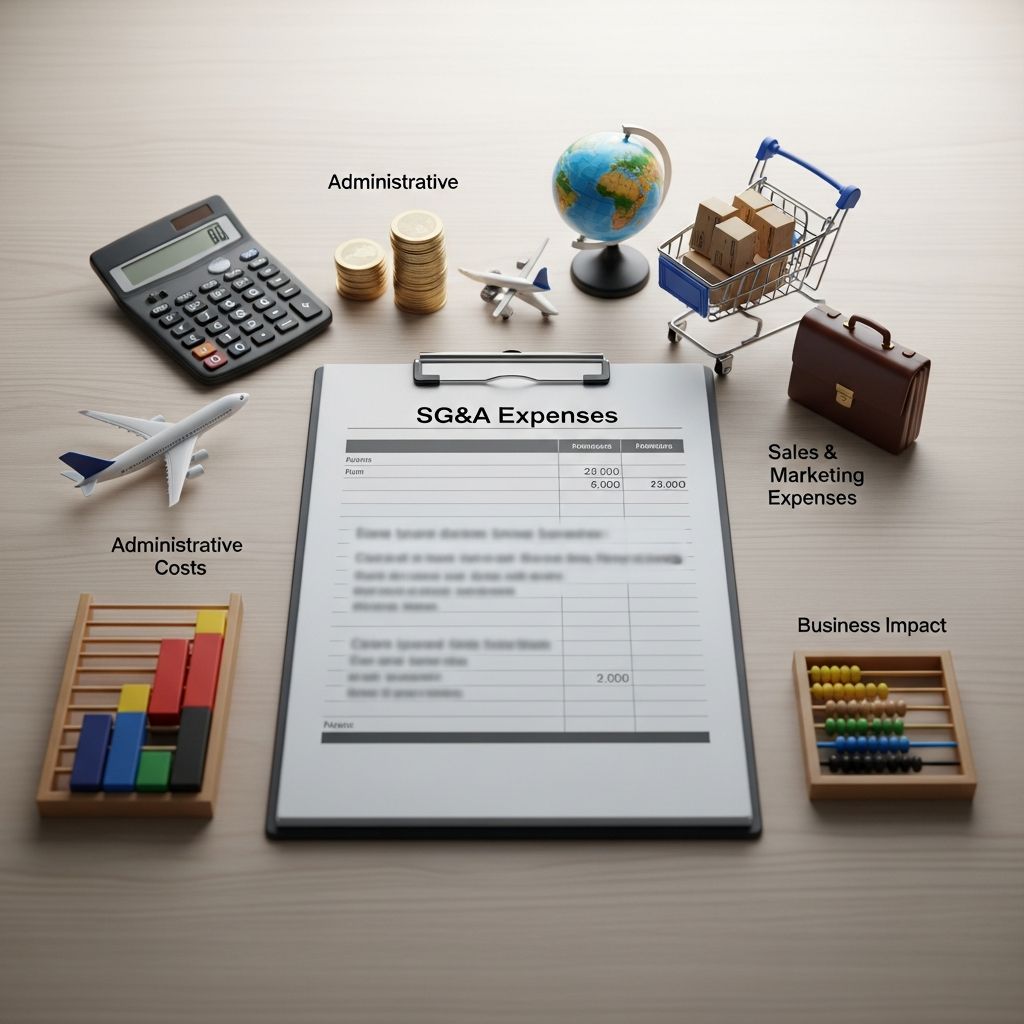
Selling, General, and Administrative (SG&A) expenses represent a critical component of a company’s financial structure and operational performance. These expenses, also known by alternative acronyms such as SGA, SAG, or G&A, encompass all non-production costs that a business incurs during its regular operations. Unlike direct production costs, SG&A expenses cannot be traced directly to the manufacturing or creation of specific products or services. Instead, they represent the overhead costs necessary to keep the business functioning, support sales efforts, and manage administrative operations.
Understanding and managing SG&A expenses is essential for business leaders, investors, and financial professionals who seek to optimize profitability, improve operational efficiency, and ensure sustainable growth. These expenses appear prominently on a company’s income statement and significantly impact the bottom line, making their careful analysis and management crucial for long-term financial success.
What Are SG&A Expenses?
SG&A expenses constitute all operating costs incurred outside of direct product production. These expenses include costs related to sales and marketing, corporate management, finance, human resources, legal services, information technology, facilities management, and various other support functions essential to business operations. The term itself breaks down into three primary categories: Selling expenses, General expenses, and Administrative expenses.
Organizations often refer to SG&A expenses as company overheads or operating expenses, as they represent the fundamental costs of maintaining business operations. These expenses must be incurred regardless of production volume or sales levels, and they form a substantial portion of most companies’ total operating costs. The management of these expenses directly influences a company’s profit margins and overall financial performance.
The Three Components of SG&A Expenses
Selling Expenses
Selling expenses encompass all direct and indirect costs associated with marketing, promoting, and selling the company’s products or services. These expenses can be directly linked to sales activities or proportionally allocated across sales operations. Direct selling expenses include advertising costs, promotional materials, sales commissions, and customer acquisition expenses. For example, a restaurant’s selling expenses might include the cost of producing television advertisements for new menu items or printing and distributing discount coupons to nearby households.
Indirect selling expenses include costs such as sales salaries (excluding production workers whose wages fall under cost of goods sold), telephone charges, postage, and delivery costs. While these expenses cannot be traced to individual sales transactions, they are essential to the selling process and must be allocated across all units sold during an accounting period.
General Expenses
General expenses include all operating costs directly related to the overall operation of the company that do not fall specifically into selling or administrative categories. These expenses support the company’s general functions and infrastructure. Common general expenses include utilities, rent for office and warehouse spaces, insurance premiums, property maintenance, and general facility costs.
General expenses also encompass professional services and supplies necessary for daily operations. For instance, a restaurant’s general expenses might include building insurance to help rebuild facilities in case of disaster, utility charges for electricity and water, and internet connectivity. These costs are essential to maintaining operations but cannot be directly attributed to any single product or service line.
Administrative Expenses
Administrative expenses cover all costs associated with managing and administering the company’s operations. This category includes executive and management salaries, clerical and administrative staff compensation, human resources functions, accounting and finance operations, legal services, and all associated taxes and benefits. Administrative expenses also encompass costs for office equipment, supplies, software licenses, and technology infrastructure necessary to support administrative functions.
These expenses represent the managerial and bureaucratic infrastructure required to coordinate company operations, ensure compliance with regulations, manage finances, and oversee human resources. Effective management of administrative expenses is crucial, as these costs can quickly escalate without proper oversight and control.
How SG&A Expenses Impact Financial Statements
SG&A expenses appear on the company’s income statement as operating expenses, positioned after the cost of goods sold (COGS) but before operating income calculations. The placement and treatment of these expenses on financial statements make them highly visible to investors, creditors, and other stakeholders analyzing company performance.
The relationship between SG&A expenses and revenue is particularly important. Companies that maintain high SG&A expenses relative to revenue may indicate inefficient management or excessive spending. Conversely, companies that successfully minimize SG&A while maintaining sales levels demonstrate operational excellence and strong management discipline. This ratio, often expressed as a percentage of revenue, becomes a key metric for assessing management efficiency and operational performance.
Calculating and Analyzing SG&A Ratios
Financial analysts frequently calculate SG&A as a percentage of revenue to assess whether a company is spending excessively on overhead. The formula is straightforward: divide total SG&A expenses by total revenue and multiply by 100 to obtain the percentage. A lower percentage generally indicates more efficient cost management, while a higher percentage suggests potential inefficiencies.
Industry benchmarking provides valuable context for these calculations. Companies should compare their SG&A ratios to those of competitors and industry averages to determine if their spending levels are appropriate. For example, a retail company might spend 15-20% of revenue on SG&A, while a technology company might operate with a 30-40% ratio. Understanding industry norms helps management identify whether spending levels are competitive or require adjustment.
Companies can also analyze SG&A expenses as a percentage of net income to understand how these costs affect bottom-line profitability. This metric provides insight into whether management is spending efficiently or unnecessarily consuming valuable cash flow that could be directed to growth initiatives, debt reduction, or shareholder returns.
SG&A vs. Cost of Goods Sold (COGS)
A critical distinction exists between SG&A expenses and cost of goods sold, a distinction that significantly impacts financial analysis and business decision-making. COGS includes only direct costs of producing goods: raw materials, direct labor, and manufacturing overhead directly attributable to production. These costs vary directly with production volume and can be traced to specific products.
SG&A expenses, conversely, represent indirect costs necessary for business operations but not directly related to product production. These costs typically remain relatively stable regardless of production volume, at least within relevant production ranges. Understanding this distinction helps managers make accurate decisions about pricing, production levels, and cost control strategies.
Strategies for Managing and Reducing SG&A Expenses
Cost Control and Monitoring
Effective management of SG&A expenses requires establishing clear targets and monitoring actual spending against budgeted amounts. Management teams that maintain tight control over SG&A expenses typically establish SG&A budgets as a specific percentage of projected revenue, requiring departments to justify any spending that would exceed allocated amounts.
Process Automation and Technology
Organizations increasingly use technology and automation to reduce SG&A expenses. Implementing enterprise resource planning (ERP) systems, automating routine administrative tasks, and utilizing digital communication tools can significantly reduce labor and overhead costs. Automation particularly benefits administrative and general expense categories where manual processes can consume substantial resources.
Shared Services and Outsourcing
Many organizations establish shared services centers or outsource non-core administrative functions to reduce costs while maintaining service quality. Human resources, accounting, payroll processing, and IT support are commonly consolidated into shared services models that leverage economies of scale and reduce redundancy.
Corporate Overhead Reduction
Strategic decisions to reduce corporate overhead, such as consolidating office locations, implementing remote work policies, and streamlining management hierarchies, can significantly impact SG&A expenses. These structural changes require careful planning but often yield substantial long-term cost savings.
Industry-Specific Considerations for SG&A Management
Different industries face unique challenges in managing SG&A expenses based on their business models and operational requirements. In the television and broadcasting industry, businesses dependent on significant advertising spending must carefully monitor marketing expenses as a portion of SG&A. Retail companies must balance store operations and staffing costs against sales volumes. Technology companies often invest heavily in research and development, which, while not technically SG&A, competes for resources in similar ways.
Understanding these industry-specific dynamics helps management establish appropriate benchmarks and develop targeted strategies for cost optimization without compromising operational effectiveness or competitive position.
The Role of SG&A in Business Scalability
Efficient management of SG&A expenses directly supports business scalability. Companies that can maintain relatively stable SG&A costs while growing revenue achieve improving profit margins and demonstrate operational leverage. This capability makes companies more attractive to investors and positions them for sustainable growth.
However, growth often necessitates increased SG&A spending. Expanding into new markets, hiring additional management staff, and upgrading technology infrastructure all increase SG&A costs. Successful companies anticipate these increased expenses and plan investments strategically to ensure that growth generates sufficient additional revenue to justify the increased overhead.
Frequently Asked Questions
Q: What expenses are included in SG&A?
A: SG&A includes selling expenses (advertising, sales commissions, promotional costs), general expenses (utilities, rent, insurance), and administrative expenses (executive salaries, HR, accounting, legal services). It excludes direct production costs like raw materials and direct labor.
Q: How do I calculate SG&A as a percentage of revenue?
A: Divide total SG&A expenses by total revenue and multiply by 100. For example, if a company has $500,000 in SG&A expenses and $5,000,000 in revenue, the SG&A ratio is 10% (500,000 ÷ 5,000,000 × 100).
Q: Why do companies try to keep SG&A expenses low?
A: Lower SG&A expenses as a percentage of revenue indicate more efficient operations and higher profit margins. Excessive SG&A spending reduces profitability and suggests wasteful management of company resources.
Q: How does SG&A differ from COGS?
A: COGS includes direct production costs (materials, direct labor) traceable to specific products, while SG&A encompasses indirect operating costs necessary for business operations but not directly linked to product production.
Q: What is a healthy SG&A ratio?
A: Appropriate SG&A ratios vary by industry. Retail typically ranges from 15-20% of revenue, while technology companies might operate at 30-40%. Companies should compare their ratios to industry benchmarks to assess efficiency.
Q: Can SG&A expenses be reduced without harming business operations?
A: Yes, through automation, process optimization, shared services models, and strategic overhead reduction. However, cuts must be balanced carefully to maintain operational effectiveness and competitive position.
References
- SG&A (Selling, General and Administrative Expenses) — Wikipedia. Accessed November 2025. https://en.wikipedia.org/wiki/SG%26A
- Sales, General and Administrative (SG&A) Expenses — The Hackett Group. Accessed November 2025. https://www.thehackettgroup.com/glossary/sales-general-and-administrative-sga-expenses/
- Selling, General & Administrative Expense (SG&A) Definition — Investopedia. February 26, 2014. https://www.investopedia.com/terms/s/sga.asp
Similar Articles








Read full bio of medha deb