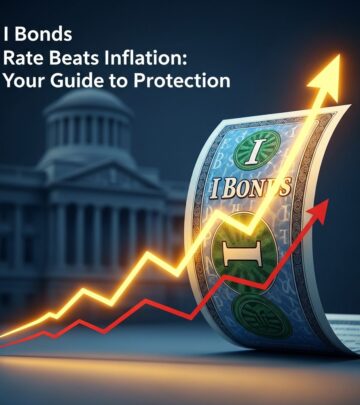
Series I Savings Bonds: Complete Guide to Inflation-Protected Investing
Master Series I Bonds: Your shield against inflation with government-backed security and competitive returns.

Series I Savings Bonds: Your Complete Investment Guide
Series I savings bonds represent a unique investment opportunity for individuals seeking to protect their wealth against inflation while earning competitive returns backed by the full faith and credit of the U.S. government. Unlike traditional savings vehicles that suffer from purchasing power erosion during inflationary periods, I bonds automatically adjust their interest rates every six months based on inflation metrics. This innovative approach to savings has attracted millions of Americans looking for safe, government-backed investments that preserve wealth in uncertain economic times.
What Are Series I Savings Bonds?
Series I savings bonds are debt securities issued by the United States Treasury Department that combine elements of fixed-rate and variable-rate investments. When you purchase an I bond, you are essentially loaning money to the federal government and receiving interest in return. The unique characteristic that distinguishes I bonds from other Treasury securities is their dual-rate interest structure, which provides both stability through a fixed component and inflation protection through an adjustable variable component.
The fundamental appeal of Series I bonds lies in their safety and purchasing power protection. Your principal investment is guaranteed by the U.S. government, meaning your bond value will never decline below your initial investment. This zero-loss guarantee combined with inflation adjustment makes I bonds particularly attractive during periods of economic uncertainty or rising prices.
How Series I Savings Bonds Work
The Dual Interest Rate Structure
The interest earned on Series I bonds comprises two distinct components that work together to determine your overall return. The fixed rate is established when you purchase your bond and remains constant throughout the entire 30-year life of the security. Currently, the fixed rate for I bonds issued November 1, 2025 through April 30, 2026 is 0.90%.
The inflation rate, by contrast, resets every six months on May 1 and November 1, based on the Consumer Price Index for All Urban Consumers (CPI-U). This rate reflects actual inflation trends in the economy and adjusts accordingly. When inflation rises, the variable-rate component increases, boosting your overall return. Conversely, during periods of low inflation or deflation, the variable rate decreases. However, I bonds have a protective floor—the combined rate will never fall below zero percent, ensuring your investment never produces negative returns.
For I bonds issued November 1, 2025 through April 30, 2026, the combined composite rate is 4.03%, representing a blend of the 0.90% fixed rate plus the current inflation-adjusted variable component.
Interest Accrual and Compounding
Interest on Series I bonds accrues monthly, yet compounds semiannually. This means that every six months, the earned interest is added to your bond’s principal value, and subsequent interest calculations are performed on this larger amount. This compound interest mechanism ensures that your investment grows exponentially rather than linearly, accelerating wealth accumulation over time.
Because I bonds are zero-coupon securities, you do not receive periodic interest payments. Instead, all accumulated interest remains embedded within the bond’s increasing value. When you eventually redeem the bond, you receive the full accumulated value including all compounded interest.
Purchasing Series I Savings Bonds
Where and How to Buy
As of January 1, 2025, Series I bonds are available exclusively through electronic purchase via TreasuryDirect, the official U.S. Treasury platform for direct securities purchases. Paper I bonds are no longer issued. To establish a TreasuryDirect account and purchase I bonds, you will need:
– A taxpayer identification number (Social Security Number or Employer Identification Number)
– A valid U.S. address of record
– An active checking or savings account with routing number
– A verified email address
– Personal information including name and date of birth
The minimum purchase amount for Series I bonds is just $25, with the flexibility to purchase in penny increments above that threshold. For example, you could invest $36.73 or $100.50 if desired.
Purchase Limits
The U.S. Treasury imposes annual purchase limits on Series I bonds to ensure broad access across the population. In any calendar year, a single Social Security Number or Employer Identification Number may purchase up to $10,000 in I bonds through TreasuryDirect. For individual accounts, this limit applies to the Social Security Number of the first-named account holder.
These restrictions prevent large institutional investors from dominating I bond markets and ensure retail investors maintain reasonable access to this inflation-protected savings vehicle.
Ownership and Registration Options
Series I bonds offer flexible ownership structures to accommodate different personal and family circumstances. You may register bonds under:
– A single owner in their sole name
– A single owner with a designated beneficiary
– Two co-owners with equal ownership rights
– A business entity or organization
This flexibility allows parents to purchase bonds for children, spouses to hold bonds jointly, or business owners to invest in I bonds under their EIN.
Redemption and Holding Periods
Redemption Timeline
While I bonds are designed as long-term investments, you maintain flexibility regarding when you can access your funds. The earliest you can redeem an I bond is 12 months after purchase. This mandatory holding period ensures investors demonstrate true commitment to the security.
However, if you redeem your I bond before five years have elapsed, you forfeit the final three months of interest earned. For instance, if you cash in an I bond after 18 months, you receive only 15 months of interest rather than the full 18 months earned. This redemption penalty encourages longer-term holding strategies.
Extended Maturity Periods
Series I bonds earn interest for up to 30 years, comprising an initial 20-year maturity period followed by an automatic 10-year extended maturity if the bond has not already been redeemed. For electronic I bonds, TreasuryDirect automatically deposits the redemption value into your account upon maturity. Paper I bonds require manual submission to receive the redemption proceeds.
Tax Considerations and Advantages
Tax Treatment
The tax implications of Series I bonds offer significant advantages compared to many alternative investments. Interest earned is completely exempt from state and local income taxes, a substantial benefit for residents of high-tax jurisdictions. However, the interest remains subject to federal income tax as well as federal estate, gift, and inheritance taxes.
Tax Payment Flexibility
Series I bonds offer remarkable flexibility in how you manage tax obligations. You may choose between two reporting methods:
Pay-as-you-go method: Report and pay taxes on interest earned each calendar year, even though you haven’t received the actual funds.
Deferred method: Postpone all tax reporting and payments until the year you redeem the bond, at which point you report the accumulated interest.
You can even switch between methods during your bond ownership, though such changes require completing IRS Form 3115 to document the accounting method change.
Education Savings Tax Exclusion
A particularly valuable tax benefit applies when I bond proceeds fund qualified higher education expenses. If you redeem I bonds in the same calendar year you incur eligible education costs—including tuition, fees, and room and board—the interest portion of your redemption may be entirely excluded from federal income tax. This provision makes I bonds especially attractive for funding college expenses, effectively converting them into a tax-free savings vehicle for educational purposes.
Series I Bonds vs. Alternative Investments
Comparison with Other Treasury Securities
Series I bonds differ fundamentally from Series EE bonds, which have guaranteed value doubling after 20 years regardless of interest rates. I bonds provide inflation protection rather than guaranteed growth rates. Series EE bonds pay fixed interest rates set at purchase, while I bonds’ rates adjust every six months based on actual inflation.
TIPS (Treasury Inflation-Protected Securities), the Treasury’s marketable inflation-protected securities, offer similar inflation protection but require minimum investments of $100 and trade in secondary markets like stocks, introducing price volatility. I bonds, by contrast, maintain stable principal values with no secondary market trading.
Comparison with Traditional Savings Accounts and CDs
High-yield savings accounts and certificates of deposit offer immediate accessibility and simplicity. However, I bonds currently offer more attractive real returns—returns exceeding inflation—due to their inflation-adjusted rates. Traditional savings vehicles typically earn fixed rates well below current inflation levels, meaning your purchasing power erodes over time. I bonds solve this problem through automatic rate adjustments.
Advantages of Series I Savings Bonds
Inflation Protection: The variable-rate component automatically adjusts every six months based on inflation data, ensuring your investment maintains purchasing power regardless of economic conditions.
Government Backing: Backed by the full faith and credit of the United States Treasury, I bonds carry zero default risk, making them among the safest investments available.
Principal Preservation: Your principal value will never decline, regardless of inflation or deflation conditions. The composite rate has a floor at zero percent.
State and Local Tax Exemption: Interest earned is completely exempt from state and local income taxes, providing significant tax savings for many investors.
Flexible Holding Periods: While designed for long-term holding, I bonds can be redeemed after just 12 months (with a reduced return if redeemed before 5 years).
Education Tax Benefits: Interest may be excluded from federal taxes if used for qualified education expenses.
Ease of Purchase: Buying I bonds directly through TreasuryDirect eliminates intermediaries, fees, and commissions.
Potential Drawbacks and Considerations
Limited Liquidity: The 12-month minimum holding period and 3-month interest penalty for early redemption limit your access to funds compared to savings accounts.
Low Fixed Rate Component: The current fixed rate of 0.90% is modest, meaning your returns depend heavily on inflation adjustments.
Inflation-Dependent Returns: During low-inflation periods, composite rates may decline substantially, potentially underperforming other fixed-income investments.
Purchase Limits: The $10,000 annual limit per SSN may be restrictive for investors seeking to allocate larger portfolio portions to inflation protection.
Zero-Coupon Structure: The lack of periodic interest payments may be problematic for investors seeking current income rather than long-term appreciation.
Current Interest Rates and Historical Context
For I bonds issued November 1, 2025 through April 30, 2026, the composite interest rate stands at 4.03%, comprising a 0.90% fixed rate and a variable inflation component. This represents a moderately attractive return in the current rate environment.
Historically, I bond rates have ranged dramatically based on inflation conditions. From May 2022 through October 2022, when inflation peaked, the composite rate reached 9.62%—its highest level in decades. Conversely, during the low-inflation environment of 2015, rates dropped to 0%. Over the past 25 years, rates have averaged substantially lower than recent peaks, reflecting the cyclical nature of inflation.
Frequently Asked Questions
Q: Can I lose money on Series I bonds?
A: No. Your principal is guaranteed by the U.S. government and never declines. The composite interest rate has a floor at zero percent, meaning your investment at worst earns no interest but suffers no losses.
Q: When do I receive interest payments from I bonds?
A: I bonds are zero-coupon securities, meaning you receive no periodic payments. All interest accrues within the bond and is paid upon redemption. Interest accrues monthly but compounds semiannually.
Q: Can I purchase I bonds for someone else?
A: Yes. You can register bonds under different ownership structures including a single owner with a beneficiary or two co-owners. This allows parents to purchase bonds for children or grandchildren.
Q: What happens if inflation becomes negative (deflation)?
A: If deflation occurs, the variable rate decreases. However, the composite rate cannot fall below zero percent, protecting your investment from negative returns.
Q: Are there penalties for redeeming I bonds early?
A: You can redeem after 12 months with no penalty. However, if you redeem before five years, you forfeit the last three months of interest earned.
Q: How do I calculate the value of my I bond?
A: For electronic I bonds in TreasuryDirect, you can view current value in your account. For paper bonds, the Treasury provides a Savings Bond Calculator on its website.
Q: Can I transfer I bonds to someone else?
A: I bonds cannot be transferred or sold to another person. You can only change ownership through registered beneficiary arrangements at purchase or through estate transfers upon death.
Is Series I Bond Investment Right for You?
Series I bonds represent an excellent inflation-hedging component of a diversified investment portfolio, particularly for conservative investors prioritizing safety and purchasing power preservation. They are especially suitable for individuals with time horizons exceeding five years who can accept limited liquidity in exchange for inflation protection and government backing.
The education tax exclusion makes them particularly attractive for parents and grandparents planning to fund higher education expenses. However, investors seeking current income, high yields, or maximum liquidity may find alternative investments more appropriate.
By combining Series I bonds with other investments, you create a balanced approach that protects core savings from inflation while pursuing growth through other asset classes.
References
- What are Series I savings bonds and how do they work? — Fortune. 2025. https://fortune.com/article/series-i-bonds-explained/
- I bonds — TreasuryDirect (U.S. Department of the Treasury). 2025. https://www.treasurydirect.gov/savings-bonds/i-bonds/
- I bonds interest rates — TreasuryDirect (U.S. Department of the Treasury). 2025. https://www.treasurydirect.gov/savings-bonds/i-bonds/i-bonds-interest-rates/
- Comparing EE and I bonds — TreasuryDirect (U.S. Department of the Treasury). 2025. https://treasurydirect.gov/savings-bonds/comparing-ee-and-i-bonds/
- The Current I-Bond Rate Is Mildly Attractive. Here’s Why. — Kiplinger. 2025-11-01. https://www.kiplinger.com/personal-finance/banking/savings/savings-bonds/603848/fight-inflation-with-series-i-bonds
- Investing in I Bonds — Britannica Money. 2025. https://www.britannica.com/money/investing-i-bonds
Similar Articles








Read full bio of Sneha Tete