Series B & C Funding: What It Means and How It Works
Complete guide to Series B and C funding rounds for startups seeking growth capital.
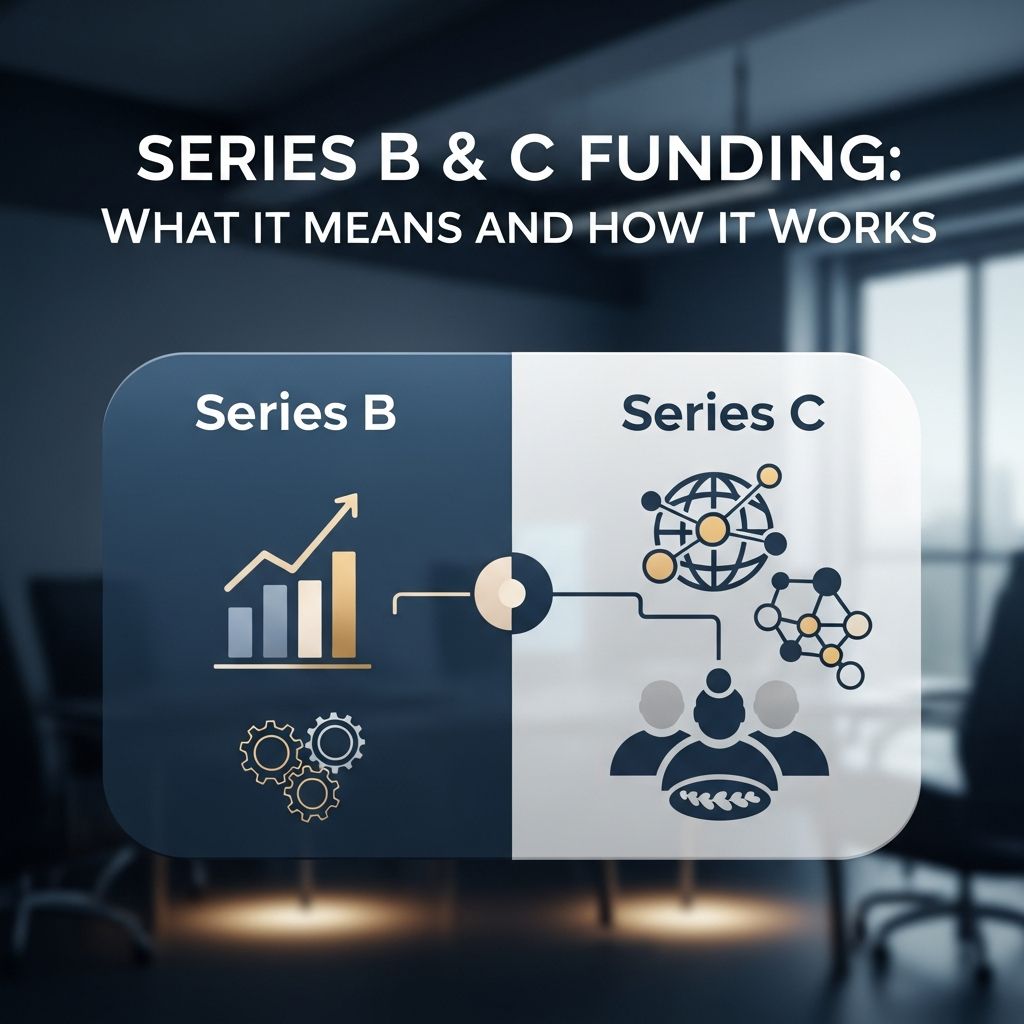
Series B and C Funding: Understanding Growth Capital for Startups
As startups mature beyond their initial seed and Series A funding rounds, they face critical decisions about raising additional capital to fuel growth. Series B and Series C funding rounds represent pivotal moments in a company’s lifecycle, each serving distinct purposes and attracting different types of investors. Understanding these funding stages is essential for entrepreneurs seeking to scale their businesses efficiently and maintain momentum in competitive markets.
Series B and C funding rounds provide established startups with the capital needed to expand operations, enter new markets, and solidify their market position. Unlike earlier funding rounds that focus on validating business concepts and achieving initial product-market fit, Series B and C rounds emphasize scaling proven business models and preparing companies for eventual acquisition or public offerings. This progression reflects the startup’s evolution from an experimental venture to an established business with predictable revenue streams and demonstrable growth potential.
Understanding Series B Funding
Series B funding represents the next logical step for companies that have successfully completed their Series A round and proven their business model in the marketplace. At this stage, a startup should have launched its product, accumulated early customers, and generated initial revenue. The company’s founders and existing investors now seek additional capital to accelerate growth and capitalize on market opportunities.
What Defines a Series B Company
By the time a company reaches Series B, it has moved beyond theoretical validation into practical execution. The business should demonstrate several key characteristics including an established product that resonates with customers, a customer base generating measurable revenue, and a proven business model that shows how the company will make money sustainably. The founding team has expanded, operations have become more structured, and the company possesses clear metrics demonstrating traction in its target market. Series B companies are typically 2-3 years old and have achieved enough success to justify larger investments while still requiring capital to scale further.
Series B Funding Amounts
Series B funding rounds typically range from $7 million to $10 million, though larger or well-positioned startups may raise significantly more. The variation depends on industry, market conditions, company performance, and geographic location. Tech companies in growth-heavy sectors like software-as-a-service (SaaS), artificial intelligence, and fintech often raise at the higher end of this range, while other industries may see smaller average rounds. The median Series B round hovers around $8-$9 million, providing sufficient capital for meaningful expansion without the astronomical valuations sometimes seen in later rounds.
Series B Investors and Their Motivations
Series B rounds primarily attract venture capital firms that specialize in growth-stage investments. Many Series B investors also led or participated in the company’s Series A round, creating continuity and leveraging their existing relationships and knowledge of the business. Institutional investors increasingly enter at the Series B stage, recognizing reduced risk compared to earlier rounds while maintaining significant upside potential. These investors bring not just capital but operational expertise, industry connections, and strategic guidance to help the company scale effectively. Series B investors typically take a more hands-on approach than seed investors, often securing board seats and regular reporting requirements to monitor their investment.
Company Valuations in Series B
Series B valuations typically range from $30 million to $60 million, reflecting the company’s proven traction and established market position. This represents a substantial increase from typical Series A valuations of $5 million to $24 million, but remains modest compared to Series C and beyond. Valuation in Series B rounds depends heavily on revenue growth rate, customer acquisition cost, customer retention metrics, competitive positioning, and market opportunity size. Companies demonstrating rapid revenue growth and expanding market share command premium valuations, while those with slower growth may face lower valuations or struggle to attract investors.
Strategic Uses for Series B Capital
Companies deploy Series B funding strategically to accelerate their trajectory toward market leadership. Primary uses include expanding the sales and marketing team to increase customer acquisition, building out product development capabilities to enhance offerings and maintain competitive advantages, and entering new geographic markets or customer segments. Series B funding also enables companies to improve operational infrastructure, hire experienced executives to strengthen leadership, and build strategic partnerships. Some companies use Series B capital to make small acquisitions that bolt on complementary technology or customer bases, though major acquisitions typically wait until later rounds.
Understanding Series C Funding
Series C funding represents a significant milestone, marking the transition from a growing startup to an established company approaching major inflection points. By this stage, the business has proven its model thoroughly, achieved substantial revenue scale, and demonstrated the ability to execute against ambitious growth plans. Series C companies are typically 4-5 years old with established market positions and clear paths to profitability or major exits.
What Defines a Series C Company
Series C companies have moved well beyond the startup phase into established business territory. These companies feature substantial and predictable revenue, proven profitability or a clear roadmap to profitability, significant market share in their target segments, and experienced management teams that have delivered consistently on previous growth targets. The company has typically expanded into multiple markets, built robust operational systems, and established itself as a credible competitor in its industry. Series C companies often command recognition across their industry and have attracted attention from potential acquirers or considered initial public offerings as strategic options.
Series C Funding Amounts
Series C funding typically ranges from $1 million to over $1 billion depending on industry and company circumstances, though the typical Series C round averages between $30 million and $100 million, with $50 million representing a common midpoint. Enterprise software and AI startups consistently raise larger Series C rounds, sometimes exceeding $100 million, while other sectors may raise in the $20-$50 million range. The dramatic increase from Series B reflects both the company’s reduced risk profile and the larger scale of capital required to execute on major expansion and acquisition strategies. Some exceptionally successful companies may raise multiple Series C rounds as they pursue increasingly ambitious growth objectives.
Series C Investor Diversity
Series C rounds attract a diverse range of investor types extending well beyond the traditional venture capital firms that dominated earlier rounds. Traditional venture capital firms continue participating, often alongside growth-equity specialists who focus specifically on scaling established companies. Private equity firms become meaningful participants at this stage, bringing acquisition expertise and operational improvement capabilities. Investment banks, hedge funds, sovereign wealth funds, and even corporate venture arms of large established companies may invest in Series C rounds. This investor diversity reflects the reduced risk and increased certainty characterizing this stage, making the opportunity attractive to financial institutions beyond traditional startup-focused venture capital.
Company Valuations in Series C
Series C valuations typically exceed $100 million, with many successful companies raising at valuations of $250 million to over $1 billion. The wide range reflects the diversity of companies reaching this stage—some are preparing for IPOs and command premium valuations, while others are more modestly valued. Valuation in Series C depends heavily on revenue scale, growth rate trajectories, path to profitability, market opportunity, competitive positioning, and likelihood of successful exit through acquisition or IPO. Companies demonstrating strong unit economics, expanding margins, and accelerating growth typically command significantly higher valuations than peers with slower growth or deteriorating metrics.
Strategic Uses for Series C Capital
Series C capital enables companies to execute transformational strategies impossible with earlier-stage funding. Strategic acquisitions represent a primary use, with companies acquiring complementary businesses, technology, or talent to strengthen competitive positions or enter adjacent markets more quickly. International expansion becomes realistic at this stage, with companies expanding into major international markets and establishing regional headquarters and support infrastructure. Series C funding also supports major product development initiatives, transition to new market segments or verticals, and preparation for eventual exit through acquisition or IPO. Some companies use Series C capital to invest in talent retention, brand building, and customer success infrastructure to support their growing customer base.
Series B vs. Series C: Key Differences
| Dimension | Series B | Series C |
|---|---|---|
| Typical Funding Amount | $7M – $10M | $30M – $100M+ |
| Company Valuation | $30M – $60M | $100M+ |
| Company Age | 2-3 years | 4-5 years |
| Primary Investor Types | Venture Capital Firms | VC, PE, Banks, Hedge Funds |
| Risk Profile | Higher Risk | Lower Risk |
| Revenue Status | Early Revenue Generation | Substantial, Predictable Revenue |
| Primary Focus | Scaling Operations | Market Expansion & Exits |
The Funding Process: From Series B to Series C
Preparing for Series B Fundraising
Companies should prepare thoroughly before approaching Series B investors. Essential preparations include developing detailed financial projections demonstrating clear paths to profitability or substantial revenue scale, documenting key metrics such as customer acquisition cost, lifetime value, churn rate, and growth trajectories, building a compelling narrative about market opportunity and competitive advantages, and establishing relationships with potential lead investors. Companies should also refine their operational metrics, ensure financial reporting accuracy, and prepare comprehensive decks addressing investor concerns about scalability, market risk, and competitive positioning. Early conversations with current investors and advisors help gauge investor appetite and identify the strongest potential investors.
Preparing for Series C Fundraising
Series C preparation differs significantly from Series B due to the diversity of potential investors and larger scale of capital being raised. Companies should develop detailed strategic plans addressing how capital will drive substantial growth, acquisition candidates representing strategic fits with the business, international expansion roadmaps, or specific positioning for eventual IPO or acquisition. Financial performance becomes paramount, with investors expecting accurate, audited financial statements and clear paths to sustainable profitability. Companies should cultivate relationships with a broader range of investors including private equity firms, growth equity specialists, and investment banks that focus on later-stage companies. Strong governance, experienced boards, and clear succession planning become increasingly important to sophisticated later-stage investors.
The Valuation and Investment Process
Once the company determines the funding amount needed and selects lead investors, both parties negotiate valuation. The company begins by proposing a valuation based on comparable transactions, growth metrics, and market conditions. Lead investors typically conduct extensive due diligence including financial review, customer reference calls, market analysis, and competitive assessment. Negotiations often span several months, with multiple rounds of discussions before reaching agreement. Once valuation is established, the company and investors finalize legal terms including preferred stock structure, liquidation preferences, anti-dilution protections, voting rights, and information rights. Other investors then invest at the negotiated valuation, usually within 30-90 days of finalizing legal terms.
Common Funding Challenges and Considerations
Avoiding Series D Downgrades
Series D funding, when necessary, often signals that a company failed to achieve targets through its Series C round. Series D rounds typically occur at lower valuations than the preceding Series C, resulting in significant dilution and signaling challenges to future investors. Companies should raise sufficient capital in Series C to execute their stated strategies without requiring additional rounds before exit. This requires conservative capital budgeting and careful market analysis to ensure projected returns are achievable. Companies that raise Series D rounds at lower valuations face challenges attracting quality employees through equity incentives and face increased skepticism from potential acquirers.
Equity Dilution and Founder Control
As companies progress through funding rounds, founders experience increasing equity dilution. A founder holding 100% pre-Series A might own only 40-50% by the end of Series C after accounting for employee equity pools, advisor grants, and investor ownership. Founders should carefully consider dilution implications when determining funding amounts and should negotiate terms protecting their ability to control strategic decisions. Many successful founders view some dilution as acceptable trade-off for capital enabling faster growth and better outcomes than slower self-funded growth. However, excessive dilution can misalign incentives or reduce founder motivation, so balance is essential.
Managing Investor Expectations
Series B and C investors expect regular communication, detailed financial reporting, and demonstrated progress against agreed objectives. Companies should establish clear reporting cadences, typically monthly board meetings for Series B rounds and quarterly for Series C rounds, ensuring investors receive timely updates on key metrics. When companies miss targets, transparency and clear remediation plans help maintain investor confidence. Surprising investors with bad news late in a quarter often damages relationships and makes future fundraising more difficult. Strong investor relations, proactive communication, and honest assessment of challenges and opportunities build trust essential for long-term success.
Beyond Series C: Future Funding Options
Companies that successfully execute Series C strategies may require additional capital before achieving exit. Series D rounds can occur when companies pivot strategies, require additional capital for unexpected opportunities, or pursue accelerated growth timelines. However, Series D rounds at lower valuations are often viewed negatively and should generally be avoided through sufficient Series C capitalization. Alternatively, companies may pursue debt financing including venture debt or traditional bank loans as they approach profitability. Some high-growth companies go directly from Series C to IPO, while others accept acquisition offers from strategic buyers or private equity firms seeking to own profitable, growing businesses.
Key Takeaways for Entrepreneurs
Series B and C funding rounds represent critical milestones enabling startups to scale from promising ventures into market-leading businesses. Series B funding, typically $7-10 million at $30-60 million valuations, provides capital to accelerate growth and expand market reach. Series C funding, averaging $30-100 million at $100 million+ valuations, enables strategic acquisitions, international expansion, and preparation for exit. Understanding investor expectations, raising sufficient capital for planned strategies, and maintaining transparent communication with investors throughout the process increases the likelihood of successful fundraising and business growth. Entrepreneurs should carefully consider their capital needs, valuation implications, and strategic priorities before entering each funding round, ensuring that investor dilution and obligations align with their long-term vision.
Frequently Asked Questions (FAQs)
Q: What is the main difference between Series B and Series C funding?
A: Series B funding ($7-10M) targets earlier-stage growth companies with proven models but still scaling, while Series C funding ($30-100M+) funds established companies expanding into new markets, making acquisitions, or preparing for exit. Series B valuations typically range $30-60M, while Series C valuations exceed $100M.
Q: How long does a Series B or C fundraising process typically take?
A: Series B rounds typically take 3-6 months from initial investor outreach to funding completion, while Series C rounds often take 4-8 months due to more extensive due diligence and multiple investor involvement. The timeline varies based on market conditions, company readiness, and investor availability.
Q: Can a company skip Series B and go directly to Series C?
A: While rare, some exceptionally successful companies with substantial revenue and strong metrics have gone directly to Series C. However, this is uncommon because most companies need the progression through Series B to establish operational capabilities and hit growth milestones expected by later-stage investors.
Q: What happens if a company cannot raise Series B funding?
A: Companies unable to raise Series B can pursue alternative strategies including venture debt, bank financing, strategic partnerships, revenue-based financing, or bootstrapping through operational cash flow. Some companies remain private and profitable, while others may pivot their business model or seek acquisition.
Q: How diluted will my ownership be after Series B and C?
A: Founder dilution depends on employee equity pools, advisor grants, and previous funding. Typically, founders might own 50-60% after Series A, 30-45% after Series B, and 20-35% after Series C. Exact percentages vary based on negotiated terms and capital raises.
References
- Series Funding Types A, B, & C Explained — Britannica Money. 2024. https://www.britannica.com/money/series-funding-explained
- Understanding Series A, B, C, D, and E Funding Rounds — Dealroom. 2024. https://dealroom.net/faq/funding-stages
- The Ultimate Guide to Startup Funding Stages — Visible.vc. 2024. https://visible.vc/blog/startup-funding-stages/
- Series A, B, C, D, and E Funding: How It Works — Startups.com. 2024. https://www.startups.com/articles/series-funding-a-b-c-d-e
Similar Articles








Read full bio of Sneha Tete