Self-Employed Mortgage Guide: 2025 Expert Steps To Qualify
Master the home loan process as a self-employed professional with proven strategies for approval and essential documentation tips.

Securing a mortgage as a self-employed individual presents unique challenges compared to traditional W-2 employees, primarily due to the need for extensive income verification. Lenders focus on demonstrating stable cash flow and business viability through detailed financial records spanning at least two years. This guide explores qualification criteria, essential paperwork, application strategies, and specialized loan products to help entrepreneurs, freelancers, and business owners achieve homeownership.
Defining Self-Employment for Mortgage Purposes
Lenders classify borrowers as self-employed based on specific ownership and income structures. This designation triggers additional scrutiny to ensure repayment capacity despite income variability. Key indicators include owning 25% or more of a business, relying on it as the primary income source, filing 1099 forms, or reporting income via Schedule C on tax returns.
Sole proprietors, independent contractors, gig workers, and partners in entities like LLCs or S-Corps fall into this category. Even those with side hustles alongside full-time work may qualify if self-employment income exceeds a threshold. Understanding this classification early allows borrowers to anticipate documentation demands.
Core Qualification Requirements
Approval hinges on proving consistent income over time, typically two years in the same field. Lenders average net business income from tax returns, excluding one-time expenses or deductions that might understate true earning power. Credit scores, down payment amounts (often 10-20% for conventional loans), and debt-to-income ratios under 43-50% remain standard.
- Two-Year History Rule: Most programs demand two full years of self-employment records; exceptions exist for those with prior related W-2 experience or formal training.
- Income Stability: Rising or steady earnings strengthen applications; seasonal dips require explanation via supporting docs.
- Credit and Reserves: Strong credit (680+ FICO) and 6-12 months of reserves in liquid assets mitigate perceived risk.
Business debt, such as equipment loans, factors into debt calculations, potentially limiting borrowing power if leveraged heavily.
Essential Documentation Checklist
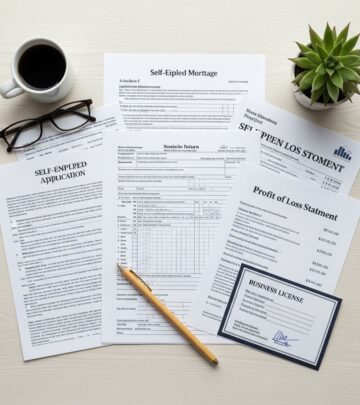
Self-employed applicants must compile a robust packet beyond basic ID and asset statements. Personal tax returns alone suffice for some, but business filings provide deeper insight. Expect requests for 12-24 months of records to trace cash flow patterns.
| Document Type | Purpose | Typical Timeframe |
|---|---|---|
| Personal & Business Tax Returns | Calculate average net income | 2 years (all schedules, 1099s, K-1s, Schedule C/E) |
| Profit & Loss Statements | Detail revenue vs. expenses | Current year + prior period |
| Balance Sheets | Show assets/liabilities | Most recent quarter |
| Bank Statements | Verify deposits and cash flow | 12-24 months (personal/business) |
| Business Licenses/Contracts | Prove legitimacy and continuity | Current + samples |
Additional items like CPA letters, client contracts, or insurance proofs bolster cases, especially for newer ventures. Year-over-year growth in gross receipts signals sustainability.
Strategies to Strengthen Your Application
Proactive preparation separates approved borrowers from rejections. Minimize aggressive tax deductions in application years, as they reduce qualifying income—consult a CPA to balance savings with loan goals.
- Organize records digitally for quick lender access.
- Obtain a CPA verification letter affirming income trends.
- Highlight non-taxable income like rentals or investments.
- Reduce debt pre-application to improve ratios.
- Shop multiple lenders, as policies vary.
For fluctuating income, emphasize average earnings over peaks/troughs. Large deposits need tracing to legitimate sources to avoid fraud flags. Pre-approval from a specialist familiar with self-employed cases accelerates the process.
Loan Options Tailored for Self-Employed Borrowers
Conventional loans backed by Fannie Mae or Freddie Mac dominate, relying on two-year tax returns for income. FHA and VA options offer flexibility with lower down payments but similar doc requirements.
Bank statement loans shine for those with strong deposits but modest taxable income. Lenders qualify based on 12-24 months of statements, often accepting 10-20% of deposits as gross income. These carry higher rates (0.5-1% above conventional) but bypass tax scrutiny.
- Non-QM Loans: Asset-based or DSCR (debt service coverage ratio) products for investors using rental income.
- One-Year Self-Employment: Possible with strong prior career history.
Government programs like USDA may apply in rural areas, prioritizing cash flow over perfect history. Compare rates and terms across 3-5 lenders for optimal deals.
Overcoming Common Hurdles
Income variability tops challenges, addressed by supplemental proofs like ongoing contracts. Recent business startups (under two years) succeed via education credentials or industry experience documentation. Multi-member businesses require partnership agreements and K-1s.
Lenders may question add-backs—legitimate business expenses reversed for income calculation, such as depreciation or one-time costs. Provide detailed ledgers. Multi-source income (e.g., gig + investments) combines favorably if documented.
Step-by-Step Application Timeline
- Month 1-2: Gather docs, check credit, save for down payment/reserves.
- Pre-Approval: Submit initial taxes/banks to a self-employed specialist.
- House Hunt: Lock rate once under contract.
- Underwriting: Expect 30-60 days for full review; respond promptly to requests.
- Closing: Verify no business changes; final docs due 3 days prior.
Timeline extends 2-4 weeks longer than W-2 apps due to verification.
FAQs
Can I qualify with less than two years self-employed?
Yes, if prior W-2 work aligns and totals strong history; provide training proofs.
What if my taxes show losses?
Average profitable years; explain via P&Ls showing cash positives.
Do freelancers qualify?
Absolutely—1099s and Schedule C suffice with steady client base.
How do bank statement loans work?
Use deposits (often 10-20% as income) instead of taxes; ideal for high earners low deductions.
Impact of business debt?
Included in DTI; pay down for better terms.
Final Preparation Tips
Engage a loan officer experienced in self-employed cases early. Simulate underwriting by reviewing your own files critically. Consistent record-keeping year-round prevents last-minute scrambles. With thorough prep, self-employed borrowers secure financing at rates comparable to salaried peers. Homeownership remains attainable—focus on transparency and stability proofs.
References
- What Documents do Self-Employed Need for a Mortgage? — Chase. 2023. https://www.chase.com/personal/mortgage/education/buying-a-home/what-documents-do-self-employed-need-for-mortgage
- Getting a mortgage if you’re self-employed — Wells Fargo. 2024. https://www.wellsfargo.com/mortgage/learn/mortgage-self-employed/
- Self-Employed Mortgage Loan | Requirements 2026 — The Mortgage Reports. 2026-01-15. https://themortgagereports.com/18303/mortgage-self-employed-1099-business-get-approved
- Navigating the Mortgage Process as a Self-Employed Individual — Motto Mortgage. 2024. https://mottomortgage.com/blog/navigating-the-mortgage-process-self-employed/
- How to Get Approved for a Home Loan if Self-Employed — NASB. 2024. https://www.nasb.com/blog/detail/how-to-get-approved-for-a-home-loan-if-self-employed
- Qualifying for a Mortgage When You’re Self-Employed — Freddie Mac. 2024-06-12. https://myhome.freddiemac.com/blog/homebuying/qualifying-mortgage-when-youre-self-employed
Similar Articles








Read full bio of medha deb