Undefined Self-Employed Mortgage Documents: 6-Point Checklist
Essential paperwork and strategies for self-employed individuals to secure home financing successfully.
Self-employed individuals face unique hurdles when applying for a mortgage due to variable income patterns, but with proper preparation, approval is achievable. Lenders scrutinize business financials closely to confirm repayment ability, often requiring extensive records beyond standard W-2 wages.
Defining Self-Employment in Mortgage Terms
Lenders classify borrowers as self-employed if they hold 25% or greater ownership in a business, report income via 1099 forms, or list earnings on Schedule C of personal taxes. This category encompasses sole proprietors, freelancers, partners in firms, LLC members, and corporate shareholders whose primary income derives from business activities.
Understanding this definition helps anticipate documentation demands. For instance, even long-term contractors with one steady client may qualify as self-employed if compensated via 1099 rather than W-2.
Core Eligibility Criteria for Self-Employed Borrowers
Approval hinges on demonstrating financial stability. Key benchmarks include:
- Employment History: At least two years of continuous self-employment in the same field; one year suffices if preceded by two years of related W-2 work or relevant education.
- Credit Score: Minimum 620 for conventional loans, 580 for FHA; higher scores like 720+ yield better rates.
- Debt-to-Income Ratio (DTI): Preferably under 43%, calculated using net business income after deductions.
- Down Payment: 3% for conventional, 3.5% for FHA, 0% for USDA in eligible areas.
These standards ensure borrowers can sustain payments amid business fluctuations.
Essential Financial Documents to Compile
Gathering comprehensive records proves income consistency and business viability. Prioritize these items:
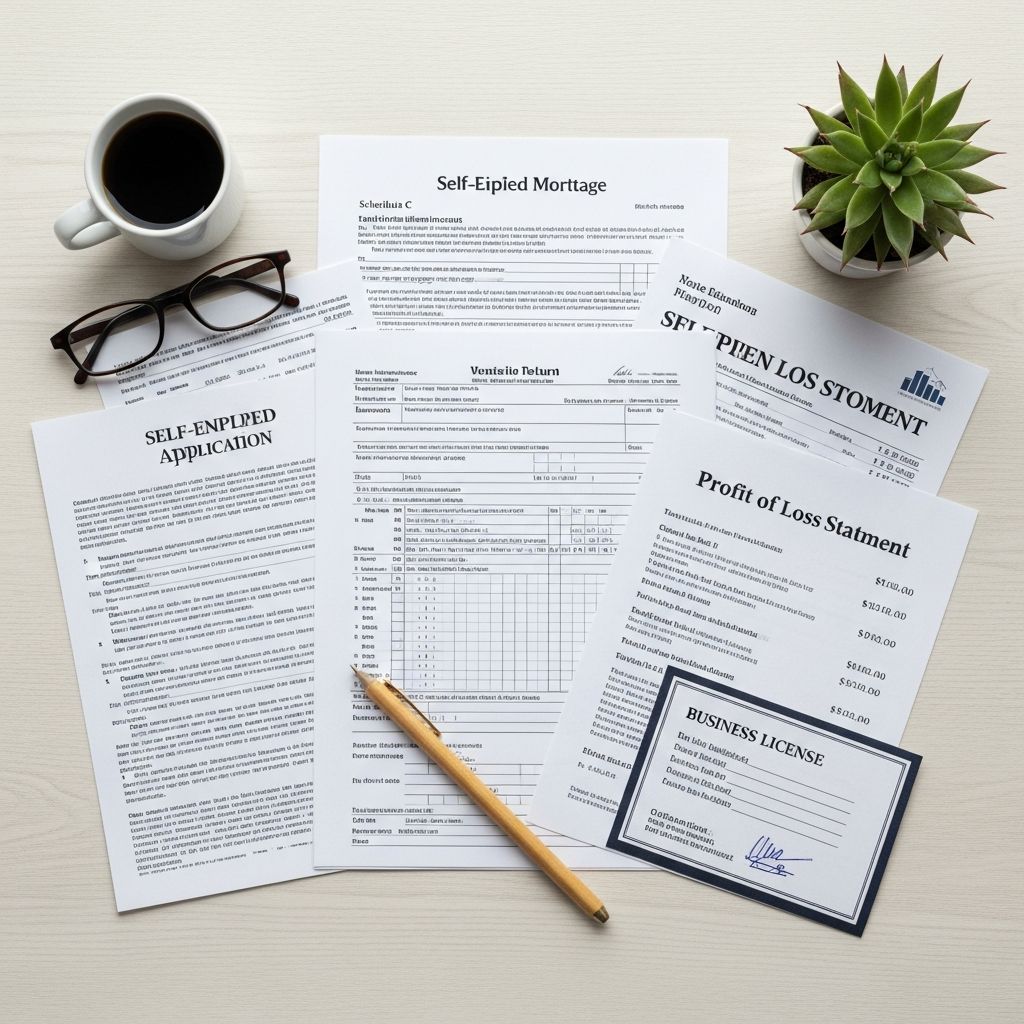
- Tax Returns: Two years of personal and business filings, including Schedule C for sole proprietors, K-1 for partnerships, 1099s for contractors, and full schedules.
- Profit and Loss (P&L) Statements: Year-to-date P&L plus balance sheets detailing revenue, expenses, assets, and liabilities.
- Bank Statements: 12-24 months of personal and business accounts to verify cash flow deposits and management.
- Business Verification: Licenses, client contracts, or CPA letters affirming operations.
Lenders average net income from these over two years, excluding one-time deductions that inflate qualifying amounts.
Impact of Business Structure on Documentation
| Business Type | Key Documents | Income Calculation Notes |
|---|---|---|
| Sole Proprietorship | Schedule C, personal taxes, 1099s | Net profit after expenses |
| Partnership/LLC | K-1 forms, partnership returns | Share of profits per agreement |
| Corporation (S-Corp/C-Corp) | 1120/1120S returns, salary draws | Salary + distributions, adjusted |
Different structures demand tailored paperwork; corporations often emphasize owner salary over total profits.
Loan Program Options Tailored for Self-Employed
Various programs accommodate self-employed applicants:
- Conventional Loans: Strictest standards—620+ credit, <43% DTI, 3% down; ideal for strong profiles.
- FHA Loans: Forgiving on credit (580 min), up to 50% DTI, 3.5% down with insurance.
- USDA Loans: No down payment for rural buyers, 640 credit, income caps at 115% area median; two-year history required.
- Bank Statement Loans: Qualify via 12-24 months deposits (no tax returns), higher rates, 660+ credit.
Choosing aligns with your financial snapshot; bank statement options bypass tax complexities.
Strategies to Strengthen Your Application
Proactive steps boost odds:
- Minimize deductions on taxes to maximize reported net income.
- Maintain separate business/personal accounts for clear tracking.
- Secure a CPA letter verifying sustained earnings.
- Reduce DTI by paying debts pre-application.
- Shop multiple lenders for self-employed specialists.
For example, a borrower with $6,000 monthly gross but $4,000 taxable after deductions sees buying power drop from $334,500 to $205,000 at 7% rate, 36% DTI max, $40k down.
Common Pitfalls and Avoidance Tips
Avoid these errors:
- Inconsistent Records: Digitize all transactions yearly.
- Short History: Build with related experience proof.
- High DTI: Delay purchase until debts lower.
- Poor Credit: Dispute errors, pay on time for 720+ score.
Net income focus means aggressive deductions hurt qualification; balance tax savings with mortgage goals.
Step-by-Step Application Process
- Assess eligibility: Verify two-year history, credit, DTI.
- Collect documents: Taxes, P&L, statements.
- Pre-qualify with lenders experienced in self-employed cases.
- Submit full package; respond promptly to requests.
- Lock rate upon conditional approval.
This roadmap minimizes delays.
Frequently Asked Questions
Can I get a mortgage with one year of self-employment?
Yes, if supported by two prior years in a similar role.
What if my income declined last year?
Lenders average two years; explain with P&L if temporary.
Do I need business debt records?
Yes, balance sheets show overall health.
Are gig workers eligible?
Absolutely, via 1099s and bank deposits.
How do bank statement loans work?
Average deposits over 12-24 months as income proxy.
Final Preparation Checklist
- Two years taxes (personal/business).
- P&L and balance sheets (YTD).
- 24 months bank statements.
- Credit report review.
- DTI calculation.
- Business licenses/contracts.
Organize in digital folders for efficiency.
References
- Self-Employed Mortgage Loan | Requirements 2026 — The Mortgage Reports. 2026. https://themortgagereports.com/18303/mortgage-self-employed-1099-business-get-approved
- How To Calculate Self-Employment Income for a Mortgage | 2026 — My Mortgage Insider. 2026. https://mymortgageinsider.com/calculating-self-employed-income-for-mortgage/
- Qualifying for a Mortgage When You’re Self-Employed — Freddie Mac. 2026. https://myhome.freddiemac.com/blog/homebuying/qualifying-mortgage-when-youre-self-employed
- Home Loans for Self-Employed: 2026 Guide — Truss Financial Group. 2026. https://trussfinancialgroup.com/blog/home-loans-for-self-employed-individuals
- Getting a mortgage if you’re self-employed — Wells Fargo. 2026. https://www.wellsfargo.com/mortgage/learn/mortgage-self-employed/
Similar Articles








Read full bio of medha deb