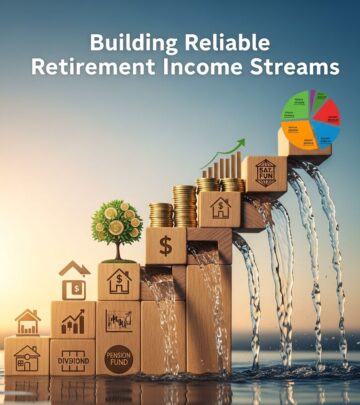
Secure 4% Returns on Retirement Funds Safely
Discover reliable strategies to achieve 4% yields on your retirement savings without undue risk in today's economic landscape.

In an era of fluctuating markets and economic uncertainty, retirees seek dependable income streams that preserve capital while delivering consistent yields. Achieving a 4% return on retirement savings without exposing funds to significant volatility is feasible through time-tested, low-risk instruments. This approach prioritizes capital protection alongside modest growth, ideal for those in or nearing retirement who cannot afford principal erosion.
Why Target 4% Yields in Retirement Planning?
A 4% annual yield strikes a balance between inflation hedging and safety. Historical data shows inflation averaging around 3% long-term, making 4% a threshold for real growth. For a $1 million portfolio, this equates to $40,000 yearly income—sufficient for supplemental expenses without depleting the principal. Unlike equities, which can swing wildly, these options offer predictability.
Current interest rate environments in 2026 favor savers, with Federal Reserve policies sustaining elevated rates post-pandemic recovery. Retirees benefit from FDIC-insured products and government-backed securities, minimizing default risk to near zero.
High-Yield Savings Accounts: Effortless Liquidity and Security
High-yield savings accounts (HYSAs) provide the simplest entry to 4% returns. Online banks, unburdened by physical branches, pass savings to depositors via competitive APYs often exceeding 4%. These accounts maintain full liquidity—funds accessible anytime without penalty—crucial for emergency needs.
- FDIC Insurance: Up to $250,000 per depositor per bank safeguards principal.
- Competitive Rates: As of 2026, top HYSAs yield 4.1-4.5%, outpacing traditional bank savings at under 0.5%.
- No Minimums: Many require zero balance to earn full rates.
Strategy tip: Ladder accounts across multiple FDIC-insured institutions to extend coverage beyond $250,000. Automate transfers from checking for disciplined saving. Rates are variable, so monitor quarterly via bank rate trackers.
Certificates of Deposit: Lock in Rates for Predictable Gains
Certificates of Deposit (CDs) allow retirees to secure today’s high rates for fixed terms, shielding against future rate drops. A 1-year CD at 4.2% guarantees that yield regardless of market shifts. Brokered CDs from brokerage platforms offer additional flexibility, tradable on secondary markets if early access is needed.
| CD Term | Average APY (2026) | Best For |
|---|---|---|
| 6 Months | 4.0% | Short-term parking |
| 1 Year | 4.2% | Balanced liquidity |
| 5 Years | 3.8% | Long-term lock-in |
CD laddering diversifies maturities: Divide funds into equal parts across 1-5 year terms. As each matures, reinvest at prevailing rates or withdraw. This maintains steady income while averaging yields. Penalty-free options like no-penalty CDs from certain banks add flexibility for retirees.
U.S. Treasury Securities: Government-Backed Stability
U.S. Treasuries represent the gold standard of safety, exempt from state/local taxes and backed by the full faith of the U.S. government. Treasury bills (T-bills, under 1 year), notes (2-10 years), and bonds (20-30 years) yield around 4% across maturities in 2026, with short-term T-bills hitting 4.3%.
- T-Bills: Discount issuance; ideal for cash equivalents.
- T-Notes: Semi-annual interest payments suit income needs.
- I-Bonds: Inflation-protected, composite rate blending fixed and inflation components.
Purchase via TreasuryDirect.gov for zero fees. For retirees, short-to-intermediate Treasuries balance yield and interest rate risk. Pair with tax-efficient placement in taxable accounts, as interest is federally taxable but state-tax-free.
Money Market Funds: Enhanced Yields with Check-Writing
Money market funds (MMFs) invest in short-term, high-quality debt, offering check-writing and debit card access akin to savings accounts. Prime MMFs yield 4.2-4.5% in 2026, slightly above HYSAs, though not FDIC-insured—protected by SEC rules limiting holdings to safe assets.
Government MMFs, investing solely in Treasuries/agency debt, provide near-equivalent safety. Expense ratios under 0.4% ensure most yield reaches investors. Use for 1-2 years’ expenses, providing liquidity superior to CDs.
Building a Diversified Low-Risk Portfolio
Combine these for optimal results:
- 40% HYSA/MMFs: Emergency fund/liquidity.
- 30% CD Ladder: Predictable mid-term income.
- 30% Treasuries: Inflation hedge/long-term stability.
This allocation targets 4% average yield with negligible risk. Rebalance annually, using new contributions to adjust.
Tax Strategies to Maximize Net Returns
Placement matters: Hold Treasuries and MMFs in taxable accounts for state tax exemption. Use tax-deferred IRAs for corporate bonds if venturing slightly riskier. Roth conversions can shift funds tax-free for future yields.
2026 limits boost contributions: 401(k) to $24,500, IRA to $7,500, enhancing tax-sheltered high-yield placements.
Risks and Mitigation Tactics
Primary risks: Interest rate changes (mitigate via ladders/shorts), inflation (I-Bonds/TIPS), opportunity cost (accept for safety). Inflation-protected securities ensure real returns.
Common Questions on Safe 4% Retirement Yields
FAQs
Are these options truly risk-free?
FDIC/NCUA insurance covers principal up to limits; Treasuries have zero credit risk.
How do current rates compare historically?
2026 rates (4%+) surpass the 2010s’ near-zero era, rewarding conservative savers.
Can I access funds anytime?
HYSAs/MMFs yes; CDs/Treasuries via ladders or secondary markets.
Best for inflation protection?
I-Bonds and TIPS adjust principal/interest dynamically.
Minimum investment required?
Often $0-$1,000; scale to portfolio size.
Actionable Steps to Implement Today
- Inventory current savings; calculate 4% target income.
- Compare rates on Bankrate/NerdWallet.
- Open accounts at Ally, Marcus, TreasuryDirect.
- Ladder CDs/Treasuries over 12 months.
- Automate monthly reallocations.
- Review quarterly amid rate changes.
Consult a fiduciary advisor for personalized tax/portfolio integration.
References
- 10 Advanced Strategies for Retirement Planning in 2026 — Commonwell LLC. 2026. https://www.commonsllc.com/insights/strategies-for-retirement-planning
- How to Make 2026 Your Best Year Yet for Retirement Savings — Kiplinger. 2026. https://www.kiplinger.com/retirement/how-to-make-2026-your-best-year-yet-for-retirement-savings
- Retirement in 2026: 7 Smart Moves — Empowering Retirement. 2026. https://empoweringretirement.com/weekly-newsletter/retirement-in-2026-7-smart-moves-to-turn-savings-into-a-paycheck-and-sleep-better-doing-it/
- Six Ways to Plan for Financial Success in 2026 — Morningstar. 2026. https://www.morningstar.com/news/accesswire/1145683msn/six-ways-to-plan-for-financial-success-in-2026
- U.S. Department of the Treasury: Resource Center — U.S. Treasury (gov). 2026-03-01. https://home.treasury.gov/resource-center/data-chart-center/interest-rates
Similar Articles








Read full bio of medha deb