Secondary Market: Definition, Function, and Examples
Understanding secondary markets: Where investors trade previously issued securities daily.
What Is the Secondary Market?
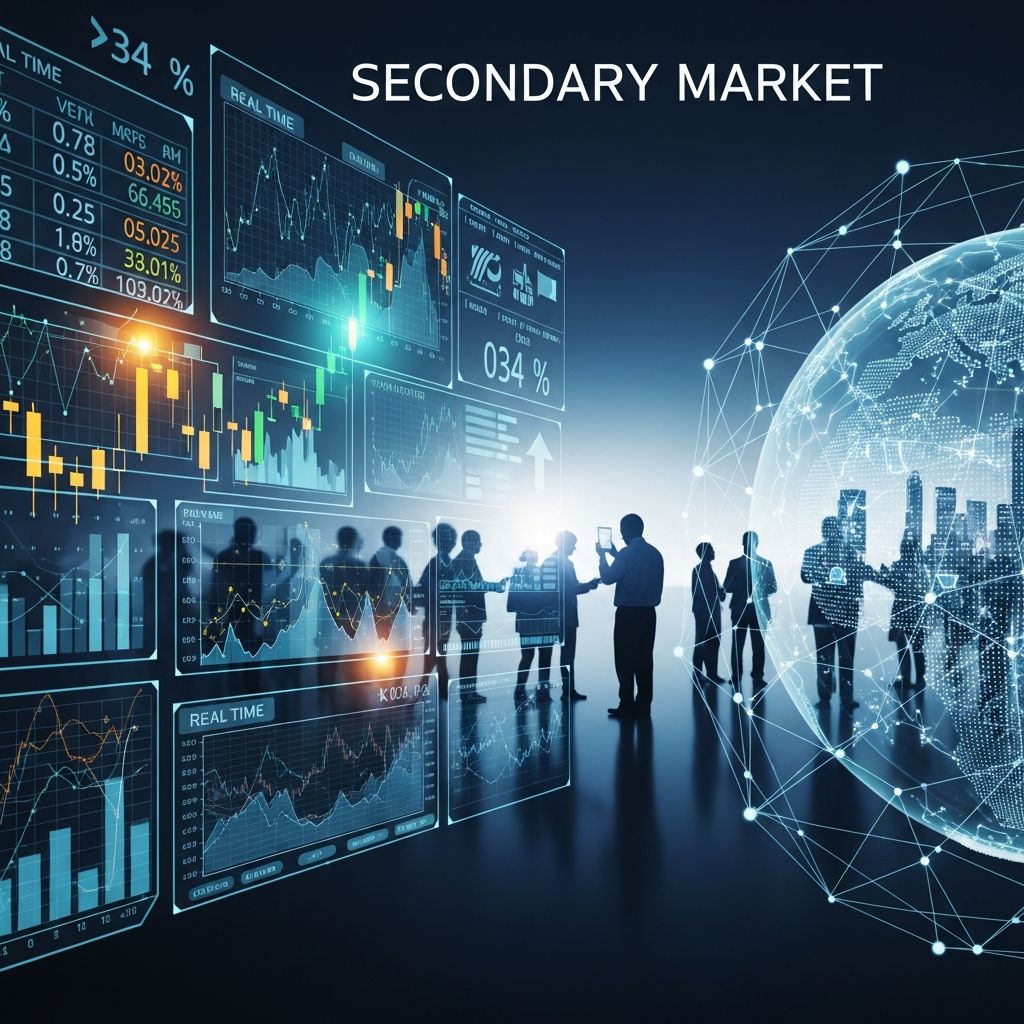
The secondary market, also known as the aftermarket, is the financial marketplace where investors buy and sell previously issued financial instruments. These instruments include stocks, bonds, options, futures, and other securities that have already been issued and sold initially. Unlike the primary market, where new securities are issued directly by companies or governments, the secondary market facilitates the trading of existing securities between investors.
When a company goes public through an initial public offering (IPO) or when a government issues treasury bonds, these transactions occur in the primary market. Once these securities are issued and sold to initial buyers, all subsequent trading happens in the secondary market. The proceeds from secondary market transactions go to the selling investor, not to the original issuer of the security.
The secondary market is essential to the functioning of modern financial systems. It provides liquidity, allows price discovery, enables risk transfer, and facilitates capital allocation across the economy. Without well-functioning secondary markets, investors would be reluctant to purchase securities in the primary market, as they would lack the ability to sell these investments later if needed.
Primary Market vs. Secondary Market
Understanding the distinction between primary and secondary markets is fundamental to grasping how financial markets operate. These two markets serve different but complementary functions in the financial system.
Key Differences
| Characteristic | Primary Market | Secondary Market |
|---|---|---|
| Issuance | New securities issued for the first time | Previously issued securities traded among investors |
| Proceeds | Go directly to the issuer | Go to the selling investor, not the issuer |
| Participants | Issuers, underwriters, and initial investors | Any investor or financial institution |
| Frequency | Limited by new issuances | Continuous trading throughout business hours |
| Price Discovery | Determined through underwriting process | Determined by supply and demand |
| Liquidity | Lower liquidity | Higher liquidity, especially for major securities |
In the primary market, when a corporation decides to raise capital, it typically works with an underwriter who purchases the securities directly from the issuer and then resells them to investors. This process generates funds for the company to use for business operations, expansion, or other strategic purposes. Similarly, when the federal government issues treasury bills, notes, or bonds, it does so in the primary market to finance government operations.
The secondary market emerges after these initial offerings. It allows investors who purchased securities in the primary market to sell them to other investors. This creates continuous liquidity and establishes market prices that reflect current economic conditions and investor sentiment.
How Secondary Markets Function
Secondary markets operate through various mechanisms and venues, each designed to facilitate efficient trading of previously issued securities. The functionality of secondary markets depends on several critical factors that maintain their effectiveness.
Liquidity and Market Efficiency
Liquidity is the cornerstone of secondary market functionality. A liquid market is one where securities can be quickly bought or sold without significantly affecting their price. The greater the number of participants in a marketplace and the more centralized that marketplace, the more liquid it becomes. High liquidity ensures that investors can enter and exit positions relatively easily, which is essential for maintaining confidence in the financial system.
Market efficiency in secondary markets allows prices to reflect all available information. When many investors participate in trading, their collective actions help establish prices that accurately represent the value of securities based on current market conditions, economic outlook, and company performance.
Trading Venues
Secondary markets operate through different types of venues, each serving specific purposes:
Stock Exchanges: Centralized physical or electronic marketplaces where standardized securities trade. The New York Stock Exchange (NYSE), NASDAQ, London Stock Exchange, and Tokyo Stock Exchange are examples of major stock exchanges. These exchanges provide transparent pricing, standardized rules, and regulatory oversight.
Over-the-Counter (OTC) Markets: Decentralized markets where securities trade directly between buyers and sellers, often through broker-dealers. Many bonds, options, and less-liquid stocks trade OTC. Participants typically communicate via telephone or electronic systems.
Electronic Communication Networks (ECNs): Computerized systems that match buy and sell orders automatically. ECNs have increased market efficiency and reduced trading costs in recent decades.
Types of Secondary Markets
Secondary markets encompass various asset classes and specialized markets serving different investor needs and trading preferences.
Stock Markets
Stock markets are the most visible and widely recognized secondary markets. Major exchanges like NYSE and NASDAQ facilitate the trading of publicly traded company shares. These markets are highly liquid, with millions of shares trading daily. Stock exchanges provide investors with real-time pricing information, ensuring price transparency and market efficiency.
Bond Markets
The secondary bond market is significantly larger than the stock market by trading volume. Most bonds trade over-the-counter through broker-dealers rather than on centralized exchanges. This market includes government bonds, corporate bonds, municipal bonds, and other debt instruments. Bond traders communicate through electronic systems or direct telephone contact with bond dealers.
Options and Futures Markets
Secondary markets also exist for derivatives like options and futures contracts. These markets allow investors to hedge risks or speculate on price movements. Specialized exchanges like the Chicago Board Options Exchange (CBOE) and CME Group facilitate derivatives trading with standardized contracts and centralized clearing.
Private Secondary Markets
Private secondary markets have emerged for trading pre-existing investor commitments to private-equity funds and unregistered securities. Platforms like SecondMarket and SecondaryLink facilitate trading in private company shares and fund interests. These markets are typically available only to institutional investors or accredited individuals due to regulatory restrictions and the higher risks associated with illiquid, unregistered securities.
Other Assets Trading in Secondary Markets
While securities form the primary focus of secondary markets, the concept extends to other valuable assets. Intellectual property such as patents and music composition rights can be bought and sold in secondary markets, allowing original creators or holders to monetize their assets. Real estate also functions within secondary market frameworks, particularly with time-share properties and fractional ownership interests traded outside official exchange systems.
These alternative secondary markets serve similar functions to securities markets: they provide liquidity, enable price discovery, facilitate risk transfer, and allow owners to resell their interests freely.
Functions of Secondary Markets
Secondary markets serve multiple critical functions that support the broader financial system and economy.
Providing Liquidity
The primary function of secondary markets is providing liquidity. Investors are more willing to purchase securities in primary markets when they know they can sell those securities later in liquid secondary markets. Without this liquidity, the primary market would suffer significantly as investors would demand higher returns to compensate for the risk of being unable to exit their positions.
Price Discovery
Secondary markets establish market prices through the collective actions of millions of investors. These prices reflect current information about companies, economic conditions, interest rates, and investor sentiment. Price discovery enables efficient capital allocation, as investors direct their money toward the most promising opportunities based on market valuations.
Risk Transfer and Hedging
Secondary markets allow investors to transfer risks to other parties. An investor concerned about market downturns can sell securities to someone more bullish. Options and futures markets provide specialized mechanisms for hedging specific risks without necessarily liquidating underlying positions.
Capital Allocation
By continuously repricing securities based on new information, secondary markets help direct capital toward its most productive uses. Companies with strong growth prospects typically command higher valuations, attracting investment capital, while struggling companies face lower valuations, making it more difficult for them to raise capital.
The History of Secondary Markets
Secondary markets have evolved significantly over centuries. Originally, investors and speculators met at fixed locations on regular schedules to trade securities. This led to the formation of organized stock exchanges, beginning with the Amsterdam Stock Exchange in the 17th century and the New York Stock Exchange in 1817.
Throughout the 20th century, secondary markets grew in size and sophistication. The development of telephone systems, computer technology, and electronic trading systems dramatically increased market efficiency and reduced transaction costs. Today’s markets operate 24 hours a day across global financial centers, with electronic systems enabling instantaneous trade execution.
Secondary Markets and Economic Impact
Well-functioning secondary markets are vital to economic growth. They encourage investment by providing investors with exit strategies. They facilitate efficient capital allocation by ensuring that investment capital flows to the most productive uses. They also provide important economic data and signals that help policymakers and businesses make decisions.
During financial crises, secondary market liquidity can dry up, creating significant challenges for investors and the broader economy. Regulatory bodies carefully monitor secondary markets to maintain stability and protect investors from fraud and manipulation.
Frequently Asked Questions
Q: What is the main difference between primary and secondary markets?
A: The primary market is where new securities are first issued, with proceeds going to the issuer. The secondary market is where previously issued securities trade among investors, with proceeds going to the selling investor rather than the original issuer.
Q: Is the stock exchange a secondary market?
A: Yes, stock exchanges like NYSE and NASDAQ are examples of secondary markets. They facilitate the trading of previously issued stocks among investors. These exchanges are among the most visible and liquid secondary markets.
Q: Why is the secondary market important?
A: The secondary market is important because it provides liquidity, enables price discovery, facilitates risk transfer, and helps allocate capital efficiently. Without secondary markets, investors would be reluctant to purchase securities, reducing capital formation and economic growth.
Q: Can bonds be traded in secondary markets?
A: Yes, bonds trade extensively in secondary markets. In fact, the secondary bond market is larger than the secondary stock market by trading volume. Most bonds trade over-the-counter through broker-dealers.
Q: What are private secondary markets?
A: Private secondary markets are platforms where investors can buy and sell unregistered securities and pre-existing private equity fund commitments. These markets are typically restricted to institutional investors and accredited individuals.
Q: How does liquidity affect secondary market prices?
A: Higher liquidity means securities can be traded quickly without significantly affecting prices. Lower liquidity markets may require larger price concessions to find buyers or sellers, resulting in wider bid-ask spreads and potentially larger price movements.
Q: Are over-the-counter markets considered secondary markets?
A: Yes, over-the-counter (OTC) markets are secondary markets. Many bonds, derivatives, and less-liquid stocks trade OTC through decentralized networks of broker-dealers rather than on centralized exchanges.
References
- Secondary Market — Wikipedia. https://en.wikipedia.org/wiki/Secondary_market
- U.S. Securities and Exchange Commission – What We Do — SEC.gov. https://www.sec.gov/about/what-we-do.html
- Financial Markets Overview — Federal Reserve. https://www.federalreserve.gov/
Similar Articles








Read full bio of Sneha Tete