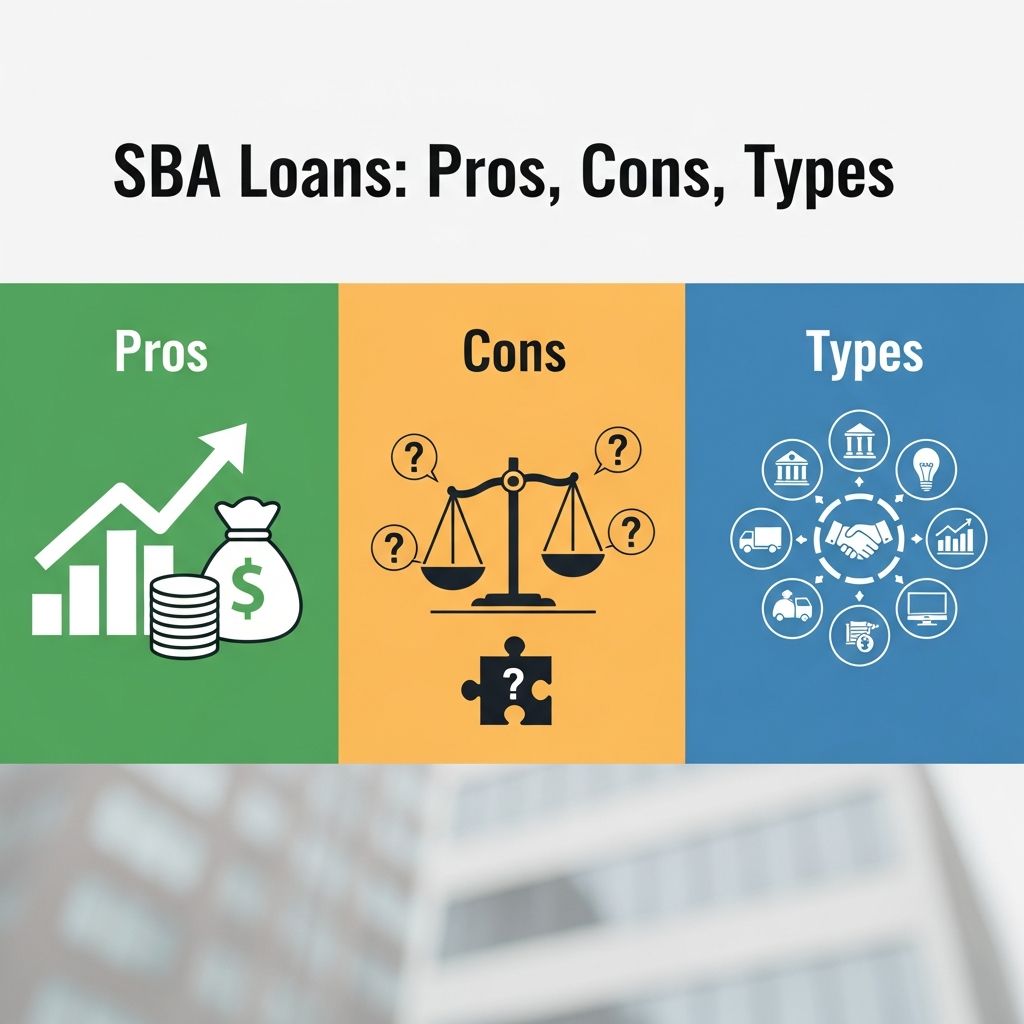
SBA Loans: Pros, Cons, Types
Discover the advantages and drawbacks of SBA loans, explore key types, and learn how they can fuel your business growth effectively.
SBA loans provide government-backed financing to small businesses through the U.S. Small Business Administration, offering lower interest rates and extended repayment periods compared to traditional bank loans. These programs reduce lender risk via guarantees, making capital more accessible for startups, expansions, and operations.
Understanding SBA Loan Fundamentals
The Small Business Administration partners with lenders to guarantee a portion of loans, typically 75-85%, encouraging banks to finance businesses that might otherwise be overlooked. Funds support diverse needs like equipment purchases, real estate, working capital, and disaster recovery, with maximum amounts reaching $5 million in primary programs.
Unlike direct government loans, SBA programs involve private lenders handling origination, underwriting, and servicing, while the agency provides the guarantee. This structure ensures competitive terms: interest rates negotiated but capped by SBA maximums, often variable based on prime rate plus a spread, and terms up to 25 years for real estate.[10]
Key Advantages of Pursuing SBA Financing
SBA loans stand out for their borrower-friendly features. Government guarantees lower lender risk, translating to reduced rates—typically 4-8%—versus 10-15% for conventional alternatives. Longer maturities, such as 10-25 years, ease monthly cash flow burdens, ideal for capital-intensive projects.
- Lower Costs: Backed guarantees enable competitive rates and fees.
- Flexible Uses: Cover working capital, fixed assets, exports, and more.
- High Limits: Up to $5 million for major programs like 7(a) and 504.
- Support for Underserved: Options like microloans aid startups and nonprofits.
- Counseling Perks: Many include training or mentorship.
These benefits particularly help businesses with limited collateral or credit history, as SBA policies prioritize cash flow over assets.
Potential Drawbacks and Challenges
Despite attractions, SBA loans demand patience and preparation. Approval processes involve extensive documentation—financial statements, tax returns, business plans—often taking 30-90 days, far longer than online lenders’ same-day decisions.
- Lengthy Approvals: Multi-step reviews delay funding.
- Strict Criteria: Require good credit (typically 680+ FICO), positive cash flow, and U.S. operations.
- Fees Involved: Guarantee (2-3.75%), packaging, and closing costs add up.
- Collateral Mandates: Most programs secure loans with business assets or personal guarantees.
- Limited Availability: Not for debt payoff in some cases or speculative ventures.
Personal guarantees from owners with 20%+ equity further heighten risk, potentially exposing personal assets.[10]
Overview of Major SBA Loan Programs
SBA offers targeted programs matching specific needs. The flagship 7(a) provides versatile funding, while 504 focuses on real estate and equipment.
| Program | Max Amount | Primary Use | Term Length |
|---|---|---|---|
| SBA 7(a) | $5 million | Working capital, equipment, debt refinance | Up to 25 years |
| SBA 504 | $5.5 million (select) | Real estate, machinery | 10-20 years |
| SBA Express | $500,000 | Quick needs like expansion | Up to 10 years |
| Microloans | $50,000 | Inventory, supplies for small ops | Up to 6 years |
| CAPLines | $5 million | Seasonal/contract working capital | 5-10 years |
Deep Dive: SBA 7(a) Program
The 7(a) suite dominates, funding 80%+ of SBA loans for broad purposes excluding speculation or nonprofits primarily. Subtypes include Standard (over $350k, 75% guarantee), Small (up to $350k, faster processing), and variations like Veterans Advantage.
Express delivers SBA response in 36 hours up to $500k, suiting urgent scenarios despite higher rates. CAPLines offer revolving lines for cyclical needs: seasonal, contract, builders, or asset-based.
Real Estate and Equipment Focus: SBA 504
504 loans fund fixed assets via CDC-lender-borrower partnerships: lender 50%, CDC/SBA 40%, borrower 10-20% down. Fixed rates around 4-5%, terms 10 years (equipment) or 20 (property), ineligible for working capital.
Entry-Level and Specialized Options
Microloans, averaging $13k, target underserved via nonprofits, pairing funds with training; rates 8-13%. Export programs like Working Capital and Express aid international sales up to $5M. Disaster loans cap at $2M for recovery.
Comparing SBA Loans Side-by-Side
| Feature | 7(a) | 504 | Express | Microloan |
|---|---|---|---|---|
| Best For | General purpose | Fixed assets | Speed | Small needs |
| Interest Range | 5-8% | 4.7-5% | Higher | 8-13% |
| Approval Time | 5-10 days (small) | 45+ days | 36 hours | Varies |
| Guarantee | 75-85% | Up to 40% | 50% | N/A |
Who Qualifies for SBA Loans?
Eligibility centers on for-profit U.S. businesses unable to secure reasonable terms elsewhere. Key tests: size standards (e.g., revenue/employees by NAICS), credit score 680+, debt service coverage 1.25x, and equity injection for startups. Exclusions: gambling, lending firms, passive real estate.[10]
Veterans, exporters, and rural businesses gain advantages via set-asides or relaxed rules.
Navigating the Application Journey
Steps include assessing fit, gathering docs (projections, statements, collateral appraisals), selecting SBA-preferred lenders via Lender Match tool, submitting with SBA Form 1919, and awaiting review. Prepare for possible site visits or interviews.
- Verify eligibility on SBA.gov.
- Build business plan and financials.
- Contact lenders (banks, CDFIs).
- Submit full package.
- Close with legal review.
Interest Rates and Repayment Details
Rates tie to prime (8.5% as of 2024) plus 2.25-4.75%, fixed or variable. Fees: 0.5% for loans <$150k, up to 3.75% over $1M, plus annual servicing. Prepayment penalties apply to longer terms.
Alternatives When SBA Isn’t Ideal
For speed, consider term loans or lines from online platforms (higher rates). Equipment financing skips SBA bureaucracy. Grants via Grants.gov suit nonprofits; bootstrapping or equity crowdfunding avoids debt.
Frequently Asked Questions
Can startups get SBA loans?
Yes, with strong plans and owner equity injection, though established firms with cash flow history fare better.
What’s the current max for 7(a) loans?
$5 million, covering diverse needs.[10]
Do SBA loans require collateral?
Generally yes, business assets first, personal for smaller loans.
How long until funds arrive?
30-90 days typically; Express faster.
Are rates fixed or variable?
Negotiable, often variable; 504 fixed.
Strategic Tips for SBA Success
Boost odds by maintaining 680+ credit, organizing 2-3 years financials, and consulting SBA resource partners like SCORE. Multiple lender quotes ensure best terms. Post-approval, monitor covenants to avoid default.
In summary, SBA loans balance accessibility with rigor, empowering small businesses via structured support. Weigh pros against process demands for optimal fit.
References
- SBA Loan Types, Pros and Cons & How to Apply — NerdWallet. 2024. https://www.nerdwallet.com/business/loans/learn/sba-loans
- SBA Loan Types Guide: Expert Insights — Sunward. 2024. https://gosunward.org/articles/sba-loan-types/
- Types of SBA loans — BILL. 2024. https://www.bill.com/blog/types-of-sba-loans
- Types of 7(a) loans — U.S. Small Business Administration. 2025-03-01. https://www.sba.gov/partners/lenders/7a-loan-program/types-7a-loans
- Loans — U.S. Small Business Administration. 2025-03-01. https://www.sba.gov/funding-programs/loans
- 7(a) loans — U.S. Small Business Administration. 2025-03-01. https://www.sba.gov/funding-programs/loans/7a-loans
Similar Articles








Read full bio of medha deb