Savings Account Taxes Explained
Discover how interest from savings accounts is taxed, reporting rules, exceptions, and 2026 updates to help optimize your finances.

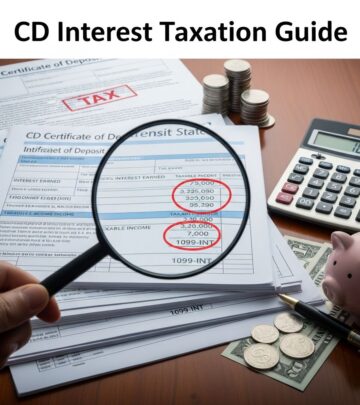
Interest earned on savings accounts is generally subject to federal income tax as ordinary income, reported via Form 1099-INT when it reaches $10 or more. Banks and financial institutions must issue this form by January 31 each year, helping the IRS track reportable earnings.
Understanding Taxable Interest from Savings
Savings accounts generate interest as a return on deposited funds, treated by the IRS as taxable income in the year it is credited, regardless of withdrawal. This applies to traditional savings, high-yield options, and money market accounts with similar features. For 2026, with inflation-adjusted brackets, more earners may fall into lower effective rates on this income.
The tax rate matches your marginal federal bracket, which for 2026 ranges from 10% on income up to $12,400 (single filers) to 37% above $640,600. State taxes may also apply, varying by location—some states like Florida and Texas impose none, while others tax at 3-13%.
How Banks Report Your Earnings
Financial institutions monitor interest and send Form 1099-INT for amounts of $10+. This form details total interest, early withdrawal penalties if applicable, and federal tax withheld (rare for savings). You must include this on your Form 1040, even if not received—check online portals or contact your bank.
- Payer details: Bank name, address, and EIN.
- Box 1: Taxable interest amount.
- Box 3: Early penalty, deductible on Schedule A.
- Box 4: Federal withholding, credited against liability.
Multiple accounts mean multiple forms; aggregate all on your return. Digital banks often provide e-delivery for convenience.
Exceptions: When Savings Interest Escapes Tax
Not all interest is taxable. Certain accounts offer deferral or exemption, ideal for tax planning.
Tax-Deferred Retirement Vehicles
IRAs and 401(k)s shelter savings interest. For 2026, IRA contributions rise to $7,500, with $1,100 catch-up for those 50+, growing tax-deferred until withdrawal. Roth versions use after-tax dollars for tax-free qualified distributions. Employer plans like 403(b) follow suit, with higher-income workers (over $150,000 prior wages) required to make catch-up as Roth in 2026.
Health and Education Savings Options
Health Savings Accounts (HSAs) for 2026 allow $4,400 individual/$8,750 family contributions, triple tax-free: deductible contributions, tax-free growth, qualified medical withdrawals. 529 plans for education offer state tax breaks, federal tax-free growth for qualified expenses. Flexible Spending Accounts (FSAs) cap at $3,400, with $680 rollover.
New Trump Savings Accounts for Families
Under the One Big Beautiful Bill Act, Trump Accounts for children under 18 provide tax-deferred growth. Newborns 2025-2028 get $1,000 government seed; annual family/employer contributions up to $5,000 ($2,500 employer max), non-deductible until 18, then flexible rules apply. No earned income needed, excess contributions penalized.
Reporting Interest on Your Tax Return
Enter 1099-INT Box 1 on Schedule B if over $1,500 total interest/dividends, or directly on Form 1040 line for lesser amounts. Use tax software for accuracy; penalties apply for underreporting due to IRS matching.
| Form/Line | Purpose | 2026 Notes |
|---|---|---|
| Form 1040, Line 2b | Taxable interest summary | Aggregate all sources |
| Schedule B | Itemizes payers if >$1,500 | List each 1099-INT |
| Schedule 1, Line 8b | Penalties (Box 3) | Deductible adjustment |
Foreign accounts over $10,000 require FBAR; high earners watch FATCA Form 8938.
Strategies to Lower Your Tax Burden
Maximize tax-advantaged accounts first. For 2026 standard deductions: $16,100 single/$32,200 joint, plus $2,050/$1,650 age 65+. Itemizers note SALT cap changes and vehicle interest deductions up to $10,000.
- Shift to high-yield savings in Roth IRA.
- Use HSAs for medical costs.
- Open 529s for kids’ education.
- Consider municipal bond funds for state-tax-free interest (federal taxable).
Gift up to $19,000/person ($38,000 couple) tax-free in 2026; 5-year acceleration to $95,000.
2026 Tax Landscape Impacts on Savings
IRS adjustments widen brackets: 22% over $50,400 single/$100,800 joint; 24% over $105,700/$211,400. AMT exemptions rise to $90,100 single (phaseout $500,000), affecting high savers. Phase-in for itemized deductions expands.
Frequently Asked Questions
Is all savings interest taxable?
Yes, unless in tax-advantaged accounts like IRAs, HSAs, or 529s.
What if I earn less than $10 interest?
No 1099-INT required, but report accurately to avoid audits.
Do states tax savings interest?
Most do, at income tax rates; check residency rules.
Can I deduct savings account fees?
Yes, as adjustment to interest if itemizing pre-2018; now limited.
How does compound interest affect taxes?
Taxed annually on credited amount, not just withdrawn.
Are CDs taxed differently?
No, same as savings—report annual accrual.
What about online banks?
Identical rules; ensure FDIC insurance.
Planning Ahead for Tax Efficiency
Review accounts yearly, prioritize contributions to sheltered vehicles. With 2026’s higher limits, act early—deadlines like April 15 for IRAs. Consult professionals for complex situations like self-employment or high net worth.
References
- IRS Releases 2026 Tax Brackets, Contribution Limits, Other Tax Updates — Copera.org. 2026-01-15. https://copera.org/pera-on-the-issues/irs-releases-2026-tax-brackets-contribution-limits-other-tax-updates
- 2026 Tax Law Changes You Need to Know About — SSB-CPA. 2025-12-01. https://blog.ssb-cpa.com/news/2026-tax-law-changes-you-need-to-know-about-1
- IRS releases tax inflation adjustments for tax year 2026 — IRS.gov. 2025-11-01. https://www.irs.gov/newsroom/irs-releases-tax-inflation-adjustments-for-tax-year-2026-including-amendments-from-the-one-big-beautiful-bill
- 2026 Trump savings accounts — H&R Block. 2025-10-20. https://www.hrblock.com/tax-center/irs/tax-law-and-policy/one-big-beautiful-bill-trump-accounts/
- Key tax moves for 2026 — Fidelity Investments. 2026-01-10. https://www.fidelity.com/learning-center/personal-finance/tax-moves
- One Big Beautiful Bill Act Tax Law Changes — TurboTax/Intuit. 2025-09-15. https://turbotax.intuit.com/tax-tips/general/taxes-2021-7-upcoming-tax-law-changes/L3xFucBvV
Similar Articles








Read full bio of Sneha Tete