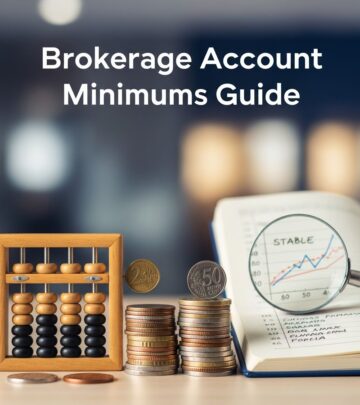
Savings Account Minimum Deposits Explained
Discover the real minimum amounts needed to start a savings account and how to pick options that maximize your financial growth without hidden fees.

Many savings accounts require little to no initial deposit, often ranging from $0 to $100, allowing easy entry into saving habits. This flexibility helps beginners build emergency funds or short-term goals without large upfront costs.
Why Minimum Deposits Vary Across Banks
Banks set minimum deposits to cover administrative costs and encourage active use. Online banks frequently waive these entirely to attract customers, while traditional branches might ask for $25-$100. High-yield options prioritize competitive rates over strict minimums, making them ideal for growth-focused savers.
Factors influencing these amounts include institution type, account features, and promotional offers. Credit unions and fintechs often compete with zero minimums, but balance requirements post-opening can trigger fees if not met.
Required Documents and Eligibility Basics
Opening any savings account demands standard identification to comply with federal regulations. Prepare these essentials to streamline the process:
- Government-issued photo ID, such as a driver’s license or passport.
- Social Security Number (SSN) or Individual Taxpayer Identification Number (ITIN).
- Proof of address via utility bill, lease, or bank statement.
- Date of birth and contact details, including phone and email.
- Funding source info, like another account’s routing and account numbers.
Most applicants must be 18 or older for solo accounts; minors need joint or custodial setups with guardians.
Step-by-Step Guide to Launching Your Savings Account
Selecting and opening a savings account takes under 15 minutes online when prepared. Follow these steps for success:
- Research Options: Compare APYs, fees, and minimums. Prioritize FDIC-insured accounts with no monthly charges.
- Gather Docs: Digitize IDs and proofs for uploads.
- Choose Account Type: Individual for solo use, joint for shared access.
- Apply: Online forms auto-verify info; approval comes in 1-2 days.
- Fund It: Transfer from checking, use Zelle, or mobile deposit checks.
Post-opening, link external accounts for seamless transfers and monitor balances to dodge fees.
Comparing Minimum Deposits: Banks vs. Online Options
Minimums differ significantly. Use this table to evaluate popular choices based on recent data:
| Institution Type | Typical Minimum Deposit | Monthly Fee Waiver | Key Perk |
|---|---|---|---|
| Traditional Banks (e.g., Wells Fargo, Bank of America) | $25-$100 | Minimum balance or linked checking | Branch access |
| Online/High-Yield (e.g., Bask, Bread Savings) | $0-$100 | Often none | Higher APYs (up to 5%+) |
| Credit Unions/Local Banks (e.g., Bank of Texas) | $50 | Small transfers from checking | Personalized service |
High-yield accounts shine for $10,000 balances, potentially earning $400 yearly vs. $4 in standard ones.
Navigating Fees and Balance Requirements
Even with low opening minimums, ongoing balances matter. Monthly fees ($5-$15) apply if balances dip below thresholds like $100-$500. Waivers come via direct deposits, linked accounts, or e-statements.
Proactive strategies include:
- Automating transfers to stay above minimums.
- Opting for no-fee high-yield accounts.
- Monitoring via apps for alerts.
Avoiding fees preserves earnings, especially as rates fluctuate in 2026.
High-Yield Savings: Maximizing Returns from Day One
Shift to high-yield savings accounts (HYSAs) for superior growth. These offer APYs far above traditional 0.01%, often 4-5% or more, with minimal deposits.
Benefits include:
- Compounding interest on everyday savings.
- Liquidity for emergencies without penalties.
- FDIC protection up to $250,000.
For promotional boosts, like 0.25% extra APY on $10,000+ balances, check eligibility periods.
Special Accounts: Joint, Kids, and Business
Tailor accounts to needs:
- Joint Accounts: Require docs for all holders; ideal for couples.
- Kids’ Accounts: Custodial options for under-18s, often $0 minimum.
- Business Savings: Higher minimums, need EIN; for company funds.
Each maintains core requirements but adds ownership specifics.
Online vs. In-Branch Opening: Pros and Cons
| Method | Pros | Cons | Best For |
|---|---|---|---|
| Online | Fast (15 mins), anytime access, higher rates | No immediate cash deposits | Tech-savvy users |
| In-Branch | Cash/check funding, personal help | Hours limited, travel needed | Complex needs or minors |
Online dominates for simplicity, with 99% approval for qualified applicants.
Building Savings Habits Beyond the Minimum
Starting small fosters discipline. Aim for 3-6 months’ expenses in emergencies. Use apps for round-ups or goals tracking to grow beyond minimums organically.
Track progress quarterly, reallocating as rates change. Diversify into CDs for locked higher yields if funds stabilize.
Frequently Asked Questions
Can I open a savings account with no money?
Yes, numerous online banks and credit unions have $0 minimums. Focus on those without balance fees.
What’s the fastest way to open one?
Online applications take 15 minutes with docs ready. Instant funding via transfers.
Do all savings accounts earn interest?
Yes, but rates vary. HYSAs pay the most; check current APYs.
Are savings accounts safe?
FDIC/NCUA insurance covers up to $250,000 per depositor per bank.
How old must I be?
18+ for individuals; minors via joint/custodial.
Final Thoughts on Starting Smart
Low barriers make savings accessible. Prioritize high-yield, no-fee options to compound wealth effortlessly. Regular contributions turn minimum starts into substantial nests over time.
References
- Savings account checklist: Documents you need to open an account — Bankrate. 2026. https://www.bankrate.com/banking/savings/savings-account-checklist/
- How to open a savings account: 5 steps to take — Bankrate. 2026. https://www.bankrate.com/banking/savings/how-to-open-a-savings-account/
- Open a Savings Account Online | Wells Fargo — Wells Fargo. 2026. https://www.wellsfargo.com/savings-cds/
- Best high-yield savings accounts of 2026: What you need to know — Fortune. 2026-01-15. https://fortune.com/article/best-high-yield-savings-accounts/
- Open a personal savings account today with a low … – Bank of Texas — Bank of Texas. 2026. https://www.bankoftexas.com/personal/products-and-services/personal-banking/savings/savings-accounts
- Open a Bank of America Advantage Savings Account Online — Bank of America. 2026. https://www.bankofamerica.com/deposits/savings/savings-accounts/
- 2026 guide: How to choose the right savings account — U.S. Bank. 2026. https://www.usbank.com/financialiq/goals/choose-savings-account.html
Similar Articles








Read full bio of medha deb