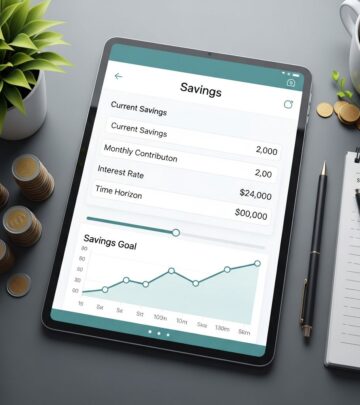
Save Money Calculator: Plan Your Financial Goals
Create a realistic savings plan with our calculator to reach your financial goals faster.

Save Money Calculator: Reach Your Financial Goals
Achieving your financial goals doesn’t have to feel overwhelming. Whether you’re saving for an emergency fund, down payment on a house, college education, wedding expenses, or retirement, having a clear roadmap makes all the difference. A savings calculator is a powerful tool that takes the guesswork out of financial planning by showing you exactly how much you need to save each month to reach your target amount within your desired timeframe.
Many people struggle with saving because they don’t have a concrete plan. Without knowing how much to set aside each month, it’s easy to fall behind or give up entirely. A savings calculator eliminates this uncertainty by providing personalized calculations based on your specific situation, including your current savings, timeline, and the interest rate you expect to earn on your savings.
How to Use a Savings Calculator
Using a savings calculator is straightforward and requires just a few pieces of information. By entering your specific details, you can generate a customized savings plan that works for your unique financial situation.
Here’s what you need to do:
- Enter how much you’ve already saved: Start by inputting the amount you’ve already accumulated toward your goal. This could be zero if you’re starting fresh, or it might be several thousand dollars if you’ve been saving for a while.
- Input your savings goal: Specify the total amount you want to save. Common goals include an emergency fund (typically $3,000 to $6,000), a down payment on a house (often 10-20% of the home price), college education costs, wedding expenses, or retirement savings.
- Enter your timeframe: Decide how many months or years you have to reach your goal. Be realistic with this timeline—giving yourself more time means lower required monthly savings, but it also means waiting longer to achieve your goal.
- Check current interest rates: Look at current rates for savings accounts, certificates of deposit (CDs), or other investment accounts depending on your timeline and risk tolerance. The interest rate you earn significantly impacts how much you need to contribute each month.
Once you’ve entered this information, the calculator will show you the exact amount you need to save each month to reach your goal.
Understanding Interest Rates and Their Impact
The interest rate you earn on your savings plays a crucial role in determining your monthly contribution amount. Higher interest rates mean your money works harder for you, reducing the amount you need to contribute each month.
Consider this comparison: If you’re saving $10,000 with no additional contributions, earning just 1% APY over five years will grow your money to $11,046.22. However, the same $10,000 at 4.5% APY grows to $15,529.69—nearly $4,500 more in interest earnings. This demonstrates why selecting the right savings account is essential to your financial plan.
Currently, the national average yield for a traditional savings account is quite low, but high-yield savings accounts offered by online banks can provide significantly better rates. Shopping around for the best rates can make a substantial difference in how quickly you reach your goals.
Reaching Your Savings Goal: Actionable Steps
Once you’ve determined how much you need to save monthly using the calculator, the next step is to actually achieve your goal. Here are proven strategies to make your savings plan work:
Choose the Right Place to Store Your Money
The first critical decision is selecting where to keep your savings. You have several options, each with different benefits:
- High-yield savings accounts: These accounts offer competitive interest rates while keeping your money easily accessible for emergencies. They’re ideal for short-term savings goals and emergency funds.
- Certificates of deposit (CDs): CDs typically offer higher interest rates than savings accounts but require you to lock your money away for a specific period. Early withdrawals usually incur penalties.
- Money market accounts: These accounts combine features of both checking and savings accounts, often offering higher interest rates than traditional savings accounts.
Consider your timeline when choosing an account. For goals you want to reach within one to five years, a high-yield savings account offers the best combination of safety and accessibility. For longer-term goals, CDs or investment accounts might be more appropriate.
Automate Your Savings
One of the most effective strategies for reaching your savings goal is to automate the process. Set up automatic transfers from your checking account to your savings account on payday. This removes the temptation to spend the money and ensures you consistently meet your monthly savings target.
Many banks allow you to create separate savings accounts for different goals. For example, you might have one account for your emergency fund, another for a down payment, and a third for vacation savings. This visual separation makes it easier to track progress toward each specific goal.
Find Ways to Increase Your Savings Rate
If the calculator shows you need to save more than you currently can afford, consider these strategies:
- Cut back on nonessential expenses like dining out, subscriptions you don’t use, or impulse purchases
- Pursue a side hustle or freelance work for additional income
- Redirect bonuses, tax refunds, or unexpected money directly to your savings account
- Negotiate better rates on insurance, phone plans, or other recurring bills
- Use cashback or rewards programs to generate extra savings
Making Your Savings Plan Manageable
One powerful psychological strategy is breaking down large goals into manageable pieces. Instead of focusing on saving $12,000 per year, think about it as $1,000 monthly, $231 weekly, or $33 daily. When you frame your goal in smaller increments, it feels more achievable and less overwhelming.
This approach works particularly well for major goals like saving a down payment or building an emergency fund. By focusing on the daily or weekly amount rather than the annual total, you’re more likely to stay motivated and consistent with your savings plan.
Common Savings Goals and Benchmarks
Different life milestones require different savings targets. Here’s what financial experts recommend for various goals:
| Savings Goal | Target Amount | Typical Timeline | Monthly Savings Example |
|---|---|---|---|
| Emergency Fund | $3,000-$6,000 | 6-12 months | $250-$500 |
| House Down Payment | $20,000-$100,000+ | 3-7 years | $250-$3,000 |
| Vacation | $2,000-$5,000 | 6-12 months | $170-$415 |
| Vehicle Purchase | $10,000-$30,000 | 2-5 years | $170-$1,250 |
| College Education | $50,000-$200,000+ | 10-18 years | $230-$1,850 |
The Power of Consistency Over Time
Time and consistency are your biggest allies when saving money. While your starting amount matters, regular deposits make a significantly bigger difference over time. For example, starting with $1,000 and adding $200 monthly at a 4.5% APY will grow to $14,644.53 in five years. Without those monthly contributions, your ending balance would be only $1,246.18.
This demonstrates why even modest monthly contributions are crucial. You don’t need to save a large amount each month to reach significant goals—consistency matters far more than the size of individual deposits.
Understanding Compounding Interest
Compounding interest is the process where your interest earns interest, creating exponential growth over time. The longer you save, the more your money can grow thanks to compounding interest. This is why starting early is so important, even if you can only save small amounts initially.
When selecting an account, pay attention to how often interest is compounded. Daily compounding provides the most benefit, followed by monthly, quarterly, semi-annual, and annual compounding. The more frequently interest compounds, the more you’ll earn on your savings.
Savings Calculator FAQs
Q: What if I can’t save the full monthly amount recommended by the calculator?
A: You have several options. You can extend your timeline to reduce the monthly requirement, increase your interest rate by selecting a higher-yielding account, or work on increasing your income or reducing expenses to meet the target. Even saving something is better than saving nothing.
Q: How does interest compounding frequency affect my savings?
A: Daily compounding provides the most interest earnings, followed by monthly, quarterly, and annual compounding. While the difference might seem small in the short term, it compounds significantly over time, especially for large amounts or longer timeframes.
Q: Should I prioritize building an emergency fund before working on other savings goals?
A: Yes, most financial experts recommend having an emergency fund of 3-6 months of living expenses before aggressively saving for other goals. This provides a financial cushion for unexpected expenses and helps prevent you from going into debt.
Q: What’s the best type of account for my savings goals?
A: High-yield savings accounts are ideal for short-term goals (1-3 years) and emergency funds because they offer competitive rates with full accessibility. Certificates of deposit work well for goals with longer timeframes where you won’t need access to the money. Investment accounts are appropriate for very long-term goals like retirement.
Q: Can I adjust my savings plan if my circumstances change?
A: Absolutely. Life circumstances change, and your savings plan should be flexible enough to adapt. If you receive a raise, redirect some of that income to savings. If your timeline extends or compresses, recalculate your monthly savings requirement using the calculator.
Q: How do I stay motivated while saving over a long period?
A: Track your progress regularly, celebrate milestones (like reaching 25% of your goal), and visualize the benefit of reaching your goal. Breaking goals into smaller monthly or weekly targets also makes progress feel more tangible and rewarding.
Next Steps to Start Saving Today
Now that you understand how a savings calculator works and how to create an effective savings plan, it’s time to take action. Start by using the calculator to determine your specific monthly savings target based on your goals, timeline, and current savings. Next, research current interest rates for savings accounts and CDs to find the best account for your needs. Finally, set up automatic transfers on payday to ensure you consistently meet your monthly savings goal.
Remember, the journey to financial security begins with a single step. By using a savings calculator and committing to a realistic savings plan, you’re taking control of your financial future and moving closer to achieving your goals.
References
- Simple Savings Calculator — Bankrate. 2024. https://www.bankrate.com/banking/savings/simple-savings-calculator/
- These 8 Charts Show How Small Savings Can Add Up To … — Bankrate. 2024. https://www.bankrate.com/banking/savings/see-how-to-save-money-through-small-savings-over-time/
- Best High-Yield Savings Accounts — Bankrate. 2024. https://www.bankrate.com/banking/savings/best-high-yield-savings-accounts/
- How Much Should I Save Each Month? — Bankrate. 2024. https://www.bankrate.com/banking/savings/how-much-money-should-i-save-each-month/
- Savings Goal Calculator — Bankrate. 2024. https://www.bankrate.com/banking/savings/saving-goals-calculator/
Similar Articles








Read full bio of Sneha Tete