S&P Credit Ratings: Complete Guide For Investors
Understand S&P credit ratings: investment grades, risk assessment, and market impact.
Understanding S&P Credit Ratings and Scales
The Standard & Poor’s (S&P) rating scale represents one of the most influential credit rating systems in the global financial markets. As a widely recognized methodology for evaluating the creditworthiness of debt securities, the S&P system provides investors, corporations, and governments with critical information about financial risk and repayment capacity. This comprehensive guide explains how S&P ratings work, what the different grades mean, and why these assessments matter for financial decision-making.
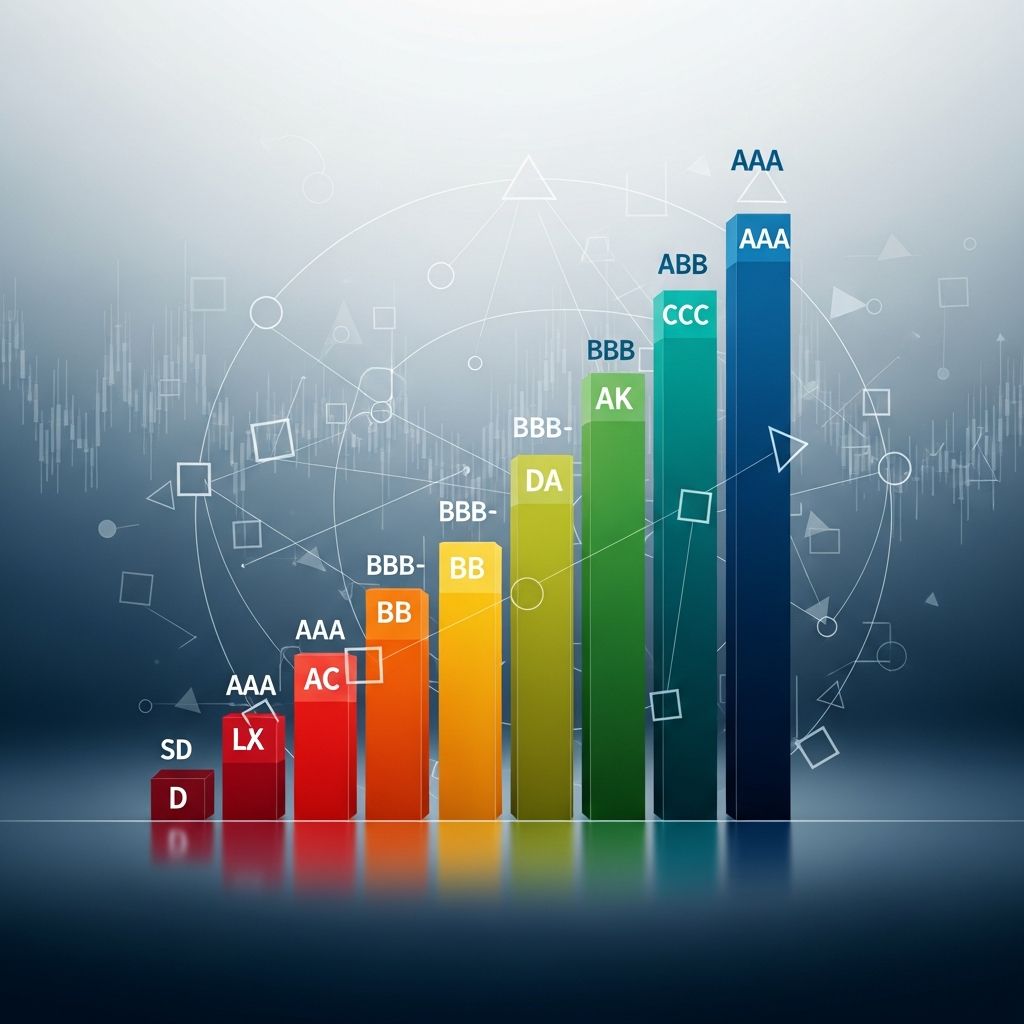
Credit ratings serve as a fundamental mechanism for pricing risk in financial markets. By assigning letter grades that range from AAA (the highest rating) down to D (indicating default), S&P helps market participants understand the likelihood that a borrower will meet its financial obligations. Understanding this rating system is essential for anyone involved in investing, lending, or financial planning.
What Is the S&P Rating Scale?
The S&P rating scale is a structured system that evaluates the creditworthiness of debt securities, including corporate bonds, government bonds, and other financial obligations. The scale assigns ratings based on a comprehensive analysis of an issuer’s financial health, payment history, and ability to generate future cash flows.
S&P ratings range from AAA, the highest possible rating indicating extremely strong financial capacity, down to D, which indicates that an issuer has defaulted on its financial obligations. Between these extremes lie multiple gradations that provide nuance in credit assessment. S&P analysts can further refine ratings by adding plus (+) or minus (−) signs to most letter grades, creating distinctions such as AA+, AA, and AA− that reflect subtle differences in creditworthiness.
The rating system divides all securities into two broad categories: investment grade ratings and non-investment grade (speculative) ratings. This fundamental distinction shapes investment decisions across the financial industry, influencing which securities institutional investors can hold and how much compensation investors demand for taking on additional risk.
Investment Grade Ratings: Lower Risk Securities
Investment grade ratings represent securities considered to have relatively low risk of default. These ratings indicate that the issuer possesses a strong capacity to meet its financial commitments and maintain debt service payments even during periods of economic stress.
The Investment Grade Categories
Investment grade ratings include four primary tiers:
| Rating | Description | Risk Level |
|---|---|---|
| AAA | Extremely strong capacity to meet financial commitments; the highest possible rating indicating minimal credit risk | Minimal |
| AA | Very strong capacity to meet financial commitments with only slight vulnerability to changing circumstances | Very Low |
| A | Strong capacity to meet financial commitments but somewhat more susceptible to economic changes and adverse conditions | Low |
| BBB | Adequate capacity to meet financial commitments; more likely to be negatively affected by adverse economic conditions | Moderate |
Investment grade securities attract conservative investors such as pension funds, insurance companies, and mutual funds that prioritize capital preservation and stable returns over yield enhancement. These institutional investors often operate under regulatory constraints that restrict them to holding only investment grade securities. The demand from these substantial investor pools helps keep borrowing costs lower for investment grade issuers.
Companies and governments with investment grade ratings benefit from lower borrowing costs in financial markets. An upgrade from BBB to A, for example, can meaningfully reduce a company’s cost of capital and improve its financial flexibility. Conversely, a downgrade from investment grade to speculative grade—sometimes called falling to “junk” status—can significantly increase borrowing costs and trigger forced selling by constrained investors.
Non-Investment Grade Ratings: Higher Risk Securities
Non-investment grade ratings, also known as speculative grade or “junk” ratings, indicate a higher risk of default. Securities in this category, ranging from BB down to D, are typically associated with companies facing financial uncertainties, limited operating histories, or unstable market positions.
The Speculative Grade Categories
| Rating | Description | Financial Condition |
|---|---|---|
| BB | Less vulnerable in the near term but faces ongoing uncertainties that could affect ability to meet commitments | Financial Uncertainty |
| B | More vulnerable to adverse conditions but currently has capacity to meet financial commitments | Vulnerable |
| CCC | Currently vulnerable and dependent on favorable business, financial, and economic conditions | Highly Vulnerable |
| CC | Highly vulnerable with strong likelihood of defaulting on financial commitments | Extremely Vulnerable |
| C | Extremely vulnerable to nonpayment with default near certainty | Near Default |
| D | Issuer has defaulted on financial obligations or filed for bankruptcy | In Default |
While non-investment grade securities carry higher default risk, they offer substantially higher yields to compensate investors for accepting additional risk. Investors willing to tolerate greater volatility and credit risk, such as hedge funds, high-yield bond specialists, and risk-tolerant individuals, seek these securities specifically for their superior potential returns. The higher yields reflect the market’s pricing of elevated default probability.
High-yield or junk bonds can play a valuable role in diversified portfolios for investors with appropriate risk tolerance. However, these securities require careful analysis and should represent only a portion of a well-constructed investment strategy. Economic downturns significantly increase default rates among speculative grade issuers, making these securities particularly sensitive to business cycle conditions.
How S&P Determines Credit Ratings
S&P’s methodology for assigning credit ratings involves comprehensive analysis of both quantitative and qualitative factors. The rating process goes far beyond simple financial ratio analysis to encompass a holistic evaluation of an issuer’s business fundamentals and market position.
Quantitative Analysis
S&P analysts begin by examining detailed financial metrics and historical performance data. This quantitative analysis includes:
- Leverage ratios measuring debt relative to earnings and cash flow
- Profitability metrics and trend analysis
- Liquidity ratios assessing short-term financial flexibility
- Interest coverage ratios indicating ability to service debt
- Historical payment performance and credit history
- Cash flow generation capacity and sustainability
Qualitative Factors
Beyond numerical analysis, S&P evaluators assess qualitative business factors that influence creditworthiness:
- Management quality and track record in executing strategy
- Competitive position within the industry
- Business model stability and revenue predictability
- Strategic positioning and barriers to entry
- Organizational structure and governance practices
- Quality of financial reporting and transparency
Industry and Economic Considerations
S&P analysts also evaluate the broader context in which an issuer operates. This includes analysis of industry trends, competitive dynamics, regulatory environment, and macroeconomic conditions. An issuer’s credit rating reflects not only its individual financial strength but also the health of its industry and economic sector. A company with solid fundamentals may still face a rating downgrade if its entire industry faces structural decline.
Debt Structure and Collateral
The specific characteristics of the debt security itself influence the rating. S&P considers the legal structure of the obligation, any collateral backing the security, the subordination level of the debt, and covenants protecting creditors. Senior secured debt typically receives a higher rating than junior unsecured debt from the same issuer because secured debt has priority claim on assets in bankruptcy proceedings.
Why S&P Credit Ratings Matter
S&P ratings carry substantial weight in financial markets and influence numerous critical outcomes for both issuers and investors.
Impact on Borrowing Costs
Perhaps most importantly, S&P ratings directly affect the interest rates that borrowers must pay to access capital markets. Higher-rated issuers enjoy lower borrowing costs because investors demand lower yields for lower-risk securities. An upgrade in S&P rating can lower a company’s borrowing costs by hundreds of basis points, generating millions in annual interest savings. Conversely, a downgrade increases borrowing costs, potentially making debt financing prohibitively expensive.
Portfolio Risk Management
Financial institutions use S&P ratings to construct and manage portfolio risk profiles. Banks, insurance companies, and investment managers rely on ratings to ensure their portfolios maintain appropriate risk-return characteristics. Regulatory capital requirements often depend on the ratings of securities held, making rating changes directly impact financial institutions’ regulatory capital positions.
Investment Eligibility and Mandates
Many investors operate under mandates or regulatory constraints limiting them to investment grade securities. When an issuer is downgraded from BBB (investment grade) to BB (speculative grade), constrained investors must sell their holdings, often triggering price declines. This “fallen angel” dynamic can create significant market disruption and amplify credit stress for recently downgraded issuers.
Market Signaling and Confidence
S&P rating changes provide important signals to financial markets about credit trends. An announcement of a rating upgrade or downgrade can move an issuer’s stock price and affect its competitive standing. The rating announcement conveys S&P’s assessment of the issuer’s future trajectory, influencing how the business community, customers, and employees perceive the company.
Short-Term vs. Long-Term Ratings
S&P provides both short-term and long-term credit ratings that serve different analytical purposes.
Long-Term Ratings
Long-term ratings assess an issuer’s capacity to meet financial obligations for maturities exceeding one year. These ratings provide a forward-looking opinion about credit risk and represent the vast majority of S&P’s rating activity. Long-term ratings include all the standard grades from AAA to D and permit the addition of plus and minus modifiers.
Short-Term Ratings
Short-term ratings evaluate an issuer’s ability to meet obligations due within one year. These ratings use different symbols, including categories such as A-1 (highest), A-2, A-3, and B, reflecting the different risk profile of very near-term obligations. Short-term ratings typically do not include plus or minus modifiers.
An issuer might hold different ratings for short-term and long-term obligations. For example, a company might maintain an A long-term rating while holding an A-1 short-term rating, indicating that while its long-term creditworthiness shows some vulnerability to economic change, its near-term liquidity position remains very strong.
Enhancing Ratings With Modifiers and Outlooks
S&P employs additional tools beyond base letter ratings to communicate nuance and forward-looking perspectives on credit trends.
Plus and Minus Modifiers
Most S&P ratings include optional plus (+) or minus (−) modifiers that rank issuers within each rating category. For example, AAA ratings do not include modifiers since this is the highest category, but AA ratings can appear as AA+, AA, or AA−. These modifiers allow S&P to distinguish among issuers with materially different credit profiles while maintaining the same base rating category. An AA+ issuer demonstrates somewhat stronger creditworthiness than an AA issuer but falls short of AAA status.
Rating Outlooks and Credit Watch
S&P supplements ratings with outlooks and credit watch designations that indicate the likely direction of future rating changes. A stable outlook suggests the rating will likely remain unchanged, while a positive outlook indicates upward rating pressure and a negative outlook signals downward pressure. Credit watch designations indicate that S&P is actively reviewing a rating with a specific likely outcome—positive (potential upgrade), negative (potential downgrade), or developing (outcome uncertain).
The Financial Market Impact of Rating Changes
Rating upgrades and downgrades trigger immediate market reactions that can be measured in billions of dollars. When a major corporation receives a rating downgrade, its bond prices typically decline, its stock price often falls, and its cost of issuing new debt immediately increases. These cascading effects illustrate the centrality of S&P ratings to financial market functioning.
Rating agencies bear significant responsibility for maintaining rating accuracy and integrity. The financial crisis of 2008-2009 revealed weaknesses in rating agency models and processes, leading to regulatory reforms designed to enhance rating quality and reduce conflicts of interest. Today, S&P and other rating agencies operate under enhanced regulatory oversight and internal quality controls aimed at improving rating accuracy.
Frequently Asked Questions About S&P Credit Ratings
Q: What does an AAA rating mean?
A: AAA is the highest possible S&P credit rating, indicating an issuer has an extremely strong capacity to meet financial commitments and faces minimal credit risk. Companies and governments with AAA ratings can typically borrow at the lowest available interest rates.
Q: Can a rating change affect my investment portfolio?
A: Yes, rating changes can significantly impact your portfolio. If you hold bonds that are downgraded, the bonds’ value typically declines. Additionally, if holdings fall from investment grade to speculative grade, some investors may be forced to sell due to investment restrictions, potentially causing further price pressure.
Q: What is the difference between investment grade and speculative grade?
A: Investment grade (AAA through BBB) ratings indicate lower default risk and attract conservative institutional investors. Speculative grade (BB through D) ratings indicate higher default risk and typically offer higher yields to compensate for increased risk. Many institutional investors cannot hold speculative grade securities due to regulatory restrictions.
Q: How often do companies receive rating reviews?
A: S&P reviews ratings on an ongoing basis as new financial information becomes available. While formal review cycles vary, S&P analysts monitor issuer developments continuously and can initiate rating reviews at any time if material developments occur.
Q: Why does S&P add plus and minus signs to ratings?
A: Plus and minus modifiers allow S&P to distinguish among issuers within the same rating category. For example, an AA+ issuer shows stronger creditworthiness than an AA− issuer, helping investors make more granular risk assessments among similarly-rated securities.
Q: What factors most influence S&P rating decisions?
A: S&P evaluates issuer financial metrics including leverage, profitability, and liquidity; qualitative factors such as management quality and competitive position; industry conditions; and macroeconomic outlook. The specific weight given to each factor varies by industry and issuer circumstances.
Conclusion
The S&P credit rating scale represents a critical mechanism for pricing risk in global financial markets. By providing structured assessments of creditworthiness ranging from AAA to D, S&P helps investors evaluate risk, informs borrowing cost decisions, and shapes capital allocation across the economy. Understanding these ratings—the meaning of each grade, the distinction between investment and speculative grades, and the factors influencing rating determinations—empowers investors and financial professionals to make more informed decisions. Whether you are evaluating bond investments, monitoring portfolio risk, or assessing a company’s financial health, S&P ratings provide valuable reference points for understanding credit risk in a complex financial world.
References
- What Is the Standard & Poor’s (S&P) Rating Scale? — Nasdaq. 2025. https://www.nasdaq.com/articles/what-standard-poors-sp-rating-scale
- What are Standard & Poor’s (S&P) Ratings? — Bankrate. https://www.bankrate.com/insurance/s-and-p/
- What Is the Standard & Poor’s (S&P) Rating Scale? — SmartAsset. https://smartasset.com/investing/standard-poors-rating-scale
- Understanding Credit Ratings — S&P Global. https://www.spglobal.com/ratings/en/credit-ratings/about/understanding-credit-ratings
- S&P Global Ratings Definitions — S&P Maalot. 2016-08-23. https://www.maalot.co.il/Publications/GMT20160823145849.pdf
- Corporate credit ratings: a quick guide — Association of Corporate Treasurers. https://www.treasurers.org/ACTmedia/ITCCMFcorpcreditguide.pdf
Similar Articles








Read full bio of medha deb