S Corp Vs. LLC: Complete Guide To Choosing The Right Structure
Compare S Corps and LLCs to determine the best business structure for your needs.
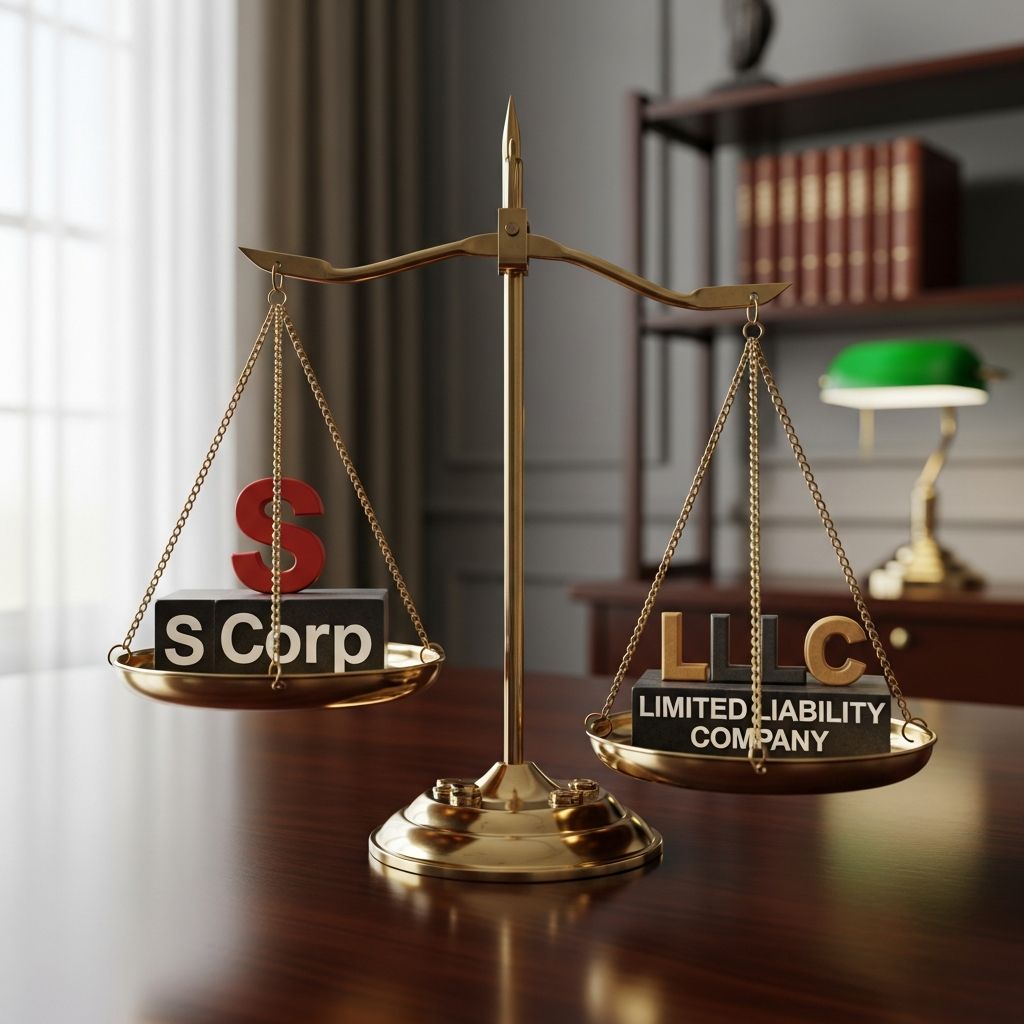
S Corp vs. LLC: Which Should I Choose?
Choosing the right business structure is one of the most important decisions you’ll make as an entrepreneur. Two popular options for small business owners are S corporations (S corps) and limited liability companies (LLCs). While both offer liability protection and favorable tax treatment, they differ significantly in taxation, management structure, ownership restrictions, and ongoing compliance requirements. Understanding these differences will help you determine which structure best aligns with your business goals, financial situation, and long-term vision.
Understanding the Basics: S Corp vs. LLC
Before diving into the specific differences, it’s important to understand what each structure represents. An LLC is a business structure—a legal entity you form with your state. An S corp, on the other hand, is a tax status or tax classification, not a business structure itself. This fundamental distinction is crucial: you cannot form an S corp directly with your state. Instead, you first form a business entity (such as an LLC or a C corporation) and then elect to be taxed as an S corporation by filing the appropriate IRS forms.
Both structures offer limited liability protection, meaning owners’ personal assets are generally protected from business debts and legal judgments. However, they achieve this protection through different mechanisms and require different levels of formality to maintain that protection.
Key Differences Between S Corps and LLCs
Taxation: The Primary Distinction
The taxation differences between S corps and LLCs represent the most significant consideration for many business owners. By default, LLCs are pass-through entities, meaning the business itself does not pay income taxes. Instead, profits and losses pass through to the owners’ personal tax returns, where they are taxed at individual rates. Single-member LLCs are taxed as sole proprietorships, while multimember LLCs are taxed as partnerships by default. However, LLC owners have the flexibility to elect different tax treatments—they can choose to be taxed as a corporation (either C corp or S corp) if that arrangement proves more advantageous.
S corporations also utilize pass-through taxation, avoiding the double taxation that C corporations face. However, there’s a critical difference in how S corp income is treated. In an S corp, owner-employees must take a reasonable salary, which is subject to payroll taxes (Social Security and Medicare). Any additional profits distributed to shareholders beyond their salary are not subject to these self-employment taxes. This creates a potential tax advantage for S corp owners.
Self-Employment Taxes: A Significant Advantage
The self-employment tax treatment represents perhaps the most compelling reason many business owners choose an S corp structure. LLC owners must pay self-employment taxes on all net profits of the business. Self-employment tax currently stands at approximately 15.3% (12.4% for Social Security and 2.9% for Medicare), representing a substantial tax burden on business income.
With an S corp, only the reasonable salary paid to owner-employees is subject to payroll taxes. Any additional distributions of profits are not subject to self-employment tax. For example, if an S corp generates $100,000 in profit and the owner takes a $60,000 salary, only that $60,000 is subject to payroll taxes. The remaining $40,000 distributed as a dividend avoids the self-employment tax entirely. The IRS requirement that the salary be “reasonable” prevents owners from circumventing payroll taxes entirely by taking minimal salaries.
This tax advantage can result in significant savings for profitable businesses, making an S corp election particularly attractive for established, profitable ventures. However, the savings must be weighed against the additional administrative costs and complexity of maintaining S corp status.
Ownership Structure and Restrictions
S corporations have strict ownership requirements that limit their flexibility. An S corp can have no more than 100 shareholders, all of whom must be U.S. citizens or resident aliens. Additionally, S corporations can issue only one class of stock, meaning all shares carry identical rights and preferences. These restrictions exist by law and cannot be waived.
LLCs offer significantly more flexibility in ownership structure. There are no limits on the number of members (owners) an LLC can have. LLC members can include individuals, other business entities, foreign investors, and various types of trusts without restriction. Furthermore, LLCs can have multiple classes of membership interests with different rights, preferences, and profit-sharing arrangements. This flexibility makes LLCs more attractive for businesses seeking diverse investors or international ownership.
Management Structure
The management requirements differ substantially between these two structures. LLCs offer considerable flexibility in how they’re managed. An LLC can be member-managed, with owners directly participating in day-to-day business decisions, or manager-managed, with designated managers (who may or may not be members) handling operations. This flexibility allows LLC owners to maintain control over business decisions or delegate management responsibility as they see fit.
S corporations require a more formal management structure. An S corp must have a board of directors who are elected by shareholders to oversee the company. The board appoints corporate officers (such as president, secretary, and treasurer) who handle day-to-day operations. This structure necessitates holding regular board meetings, maintaining minutes, and following corporate formalities. The rigid structure, while providing clarity and potentially appealing to investors, requires more administrative effort and compliance.
Formalities and Compliance Requirements
LLCs generally have fewer formalities and compliance requirements than S corporations, making them easier and less expensive to maintain. Most states require annual LLC reports and basic compliance filings, but the requirements are typically minimal. LLCs can often operate more flexibly and with less paperwork.
S corporations require substantially more administrative work. They must file annual reports with the state, maintain corporate bylaws, hold regular board of directors meetings and shareholder meetings, keep detailed meeting minutes, maintain corporate records, and ensure proper payroll tax compliance for owner-employees. These requirements exist whether the business is profitable or not and require ongoing attention to maintain the corporation’s legal status and protections.
Similarities Between S Corps and LLCs
Despite their differences, S corps and LLCs share several important similarities. Both structures provide limited liability protection, shielding owners’ personal assets from business debts, judgments, and legal liabilities. Both utilize pass-through taxation at the federal level, meaning the business entity itself doesn’t pay income taxes; instead, income is reported on owners’ personal tax returns. Both structures can provide significant tax advantages compared to C corporations, which face double taxation. Additionally, both structures allow owners to be relatively hands-off if they choose, though S corps require owner-employees to take a salary.
Profit Distribution and Capital Raising
The ability to raise capital and distribute profits differs between these structures. In an S corp, profit distributions must be based strictly on each shareholder’s ownership percentage. If you own 25% of an S corp, you must receive 25% of distributions. This inflexibility can complicate investor arrangements.
LLCs offer more flexibility in profit distribution. Members can agree to distribute profits in any manner they choose, regardless of ownership percentages. This flexibility allows for creative investor arrangements and incentive structures. Additionally, LLCs may have limited options for raising capital compared to S corps. S corps can issue stock, which is familiar to investors and facilitates raising capital. However, S corp restrictions on shareholder number and nationality can limit investor options. LLCs may attract some investors but typically find it easier to work with private investors rather than institutional investors.
Continuity and Transferability
S corporations enjoy perpetual existence. The business continues to exist even if an owner leaves, retires, or passes away. This permanence appeals to owners seeking long-term business continuity. In contrast, some state LLC laws include provisions allowing the LLC to dissolve upon the death of an owner or when a member leaves, though this varies by state and can be modified in the operating agreement.
Transferability of ownership interests also differs. S corp ownership is transferred through stock sales and transfers, following clear processes established in corporate bylaws. This straightforward mechanism appeals to investors. LLC ownership transfers can be more complicated if the operating agreement doesn’t clearly specify procedures or if ownership percentages aren’t well-documented.
When to Choose an S Corp
An S corp may be the right choice if your business generates significant income and profits. The self-employment tax savings can exceed the additional administrative costs and complexity. S corps work well for established, profitable businesses where the tax advantages justify the compliance burden. Additionally, if you’re seeking to attract investors, the formal corporate structure and familiar stock ownership mechanism of an S corp may appeal to potential investors more than an LLC structure.
An S corp is also appropriate if you want your business to have perpetual existence beyond your involvement. If you’re planning for succession and want the business to continue operating regardless of changes in ownership, the S corp’s continuity provisions support this objective. S corps are also suitable if you have limited international ownership needs and your shareholders are exclusively U.S. citizens or residents.
When to Choose an LLC
An LLC is often the better choice for startups and early-stage businesses where profit may be limited or nonexistent. In such cases, the self-employment tax savings of an S corp are minimal, but the LLC’s simpler compliance requirements reduce costs. LLCs are ideal for businesses with multiple owners who want flexibility in profit distribution and management structure.
An LLC is particularly suitable if you anticipate needing international investors or investors who are entities rather than individuals. The ownership flexibility of LLCs accommodates these scenarios. LLCs are also appropriate if you want to minimize administrative burden and maintain maximum operational flexibility. If you prefer to manage your business without extensive formalities, corporate meetings, and compliance requirements, an LLC provides that freedom.
An LLC may also be better if you’re uncertain about your long-term business structure. The LLC can later elect S corp taxation if circumstances change and the tax benefits become worthwhile. This flexibility provides a valuable bridge as your business evolves.
Converting Between Structures
One important consideration is the possibility of changing your structure later. An LLC can elect S corp taxation by filing Form 2553 (Election by a Small Business Corporation) with the IRS once it meets all S corp requirements. This allows you to start as an LLC for simplicity and convert to S corp taxation when profitability reaches a level where self-employment tax savings justify the additional complexity.
Similarly, an S corp can elect to be taxed as a C corporation if circumstances warrant, or an S corp can revert to C corp taxation. However, these elections involve tax implications and should only be made after careful consideration and consultation with tax professionals.
Tax Considerations and Professional Guidance
The tax implications of choosing between an S corp and LLC are substantial and situation-specific. Your appropriate choice depends on factors including your projected income, business profitability, number of owners, ownership composition, your long-term business vision, and your state of operation. Tax laws vary by state, and some states impose additional taxes on certain business structures.
Given the complexity and financial significance of this decision, consulting with tax professionals and business attorneys is strongly recommended. They can analyze your specific situation, project potential tax liability under each structure, and provide recommendations tailored to your circumstances. This professional guidance can prevent costly mistakes and ensure you select the structure that optimizes your tax position while providing appropriate liability protection and operational flexibility.
Comparing S Corps and LLCs at a Glance
| Feature | S Corporation | LLC |
|---|---|---|
| Business Structure | Tax status/classification | Legal business entity |
| Liability Protection | Yes | Yes |
| Pass-Through Taxation | Yes | Yes (by default) |
| Self-Employment Tax on All Income | Only on salary | Yes, on all net income |
| Maximum Owners | 100 shareholders | Unlimited members |
| Ownership Restrictions | U.S. citizens/residents only | No restrictions |
| Stock Classes | One class only | Multiple interest classes allowed |
| Management Structure | Board of directors required | Member or manager-managed |
| Compliance Requirements | Extensive | Minimal to moderate |
| Profit Distribution Flexibility | Based on ownership percentage | As members agree |
| Perpetual Existence | Yes | Varies by state |
| Investor Appeal | Generally higher | Generally lower |
Frequently Asked Questions
Q: Can an LLC elect to be taxed as an S corp?
A: Yes, an LLC can elect S corp taxation by filing Form 2553 with the IRS, provided it meets all S corp eligibility requirements including having no more than 100 U.S. citizen or resident shareholders and issuing only one class of ownership interests.
Q: Is an S corp more expensive to maintain than an LLC?
A: Generally yes. S corps have higher administrative costs due to compliance requirements, payroll processing, corporate formalities, and professional fees. However, these costs may be justified by self-employment tax savings for profitable businesses.
Q: What happens to an S corp if an owner leaves?
A: An S corp continues to exist. The departing owner can sell their shares to another party (subject to any transfer restrictions in the bylaws), or the remaining owners can continue operating the business.
Q: Can I have foreign investors in my S corp?
A: No. S corps can only have U.S. citizens or resident aliens as shareholders. An LLC has no such restrictions and can accept foreign investors.
Q: How much can I save in taxes with an S corp?
A: Tax savings depend on business profitability and salary structure. The savings come from avoiding self-employment taxes on distributions beyond salary. You should consult a tax professional to calculate specific savings for your situation.
Q: Do both structures require registered agents?
A: Requirements vary by state, but most states require both S corps and LLCs to designate a registered agent for receiving legal documents. Check your specific state’s requirements.
Q: Can I change from LLC to S corp later?
A: Yes. An LLC can elect S corp tax status once it meets the requirements. This flexibility allows you to start simple and upgrade to S corp taxation as your business grows and profitability increases.
References
- S corporation vs. LLC: Differences and how to choose — Stripe. https://stripe.com/resources/more/s-corp-vs-llc
- Choose a business structure — U.S. Small Business Administration. https://www.sba.gov/business-guide/launch-your-business/choose-business-structure
- S Corp and LLC: Differences, Advantages, and Disadvantages — U.S. Chamber of Commerce. https://www.uschamber.com/co/start/strategy/differences-between-s-corp-and-llc
- S Corp vs. LLC: Key Differences, Tax Impacts, and How to Choose — LegalZoom. https://www.legalzoom.com/articles/s-corp-vs-llc
- LLC vs. S corporation: Advantages and disadvantages — Wolters Kluwer. https://www.wolterskluwer.com/en/expert-insights/llc-vs-s-corporation-advantages-and-disadvantages
Similar Articles








Read full bio of Sneha Tete