Roth IRA or 401(k): Which Is Right for You?
Compare Roth IRA vs. 401(k) to maximize retirement savings: contribution limits, tax benefits, employer matches, and strategies for both.
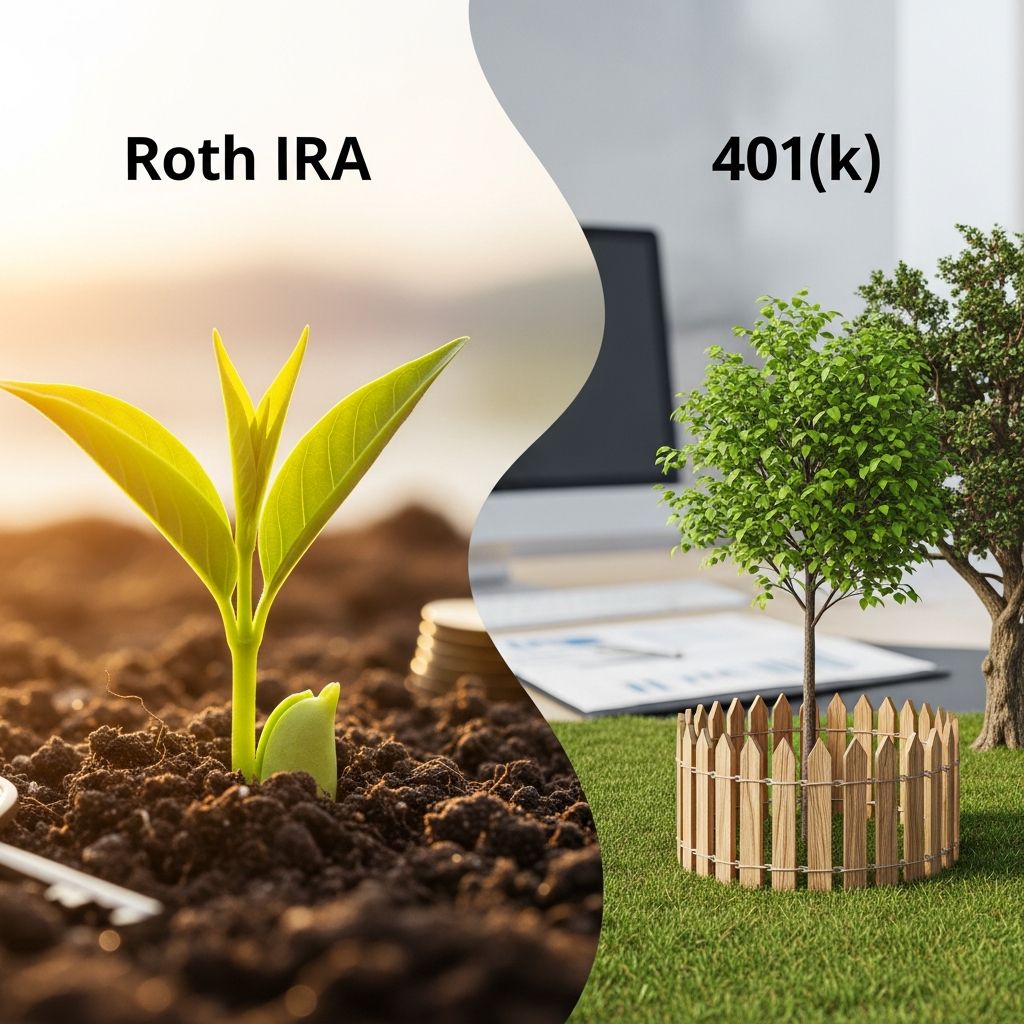
Choosing between a Roth IRA and a 401(k) is a pivotal decision for retirement planning. Both accounts offer tax advantages, but they differ in contribution limits, eligibility rules, employer benefits, and flexibility. Understanding these distinctions helps you build a diversified savings strategy tailored to your income, age, and goals.
Roth IRA vs. 401(k): At a Glance
Roth IRAs and 401(k)s serve as powerful tools for tax-advantaged retirement savings, yet they cater to different needs. A
Roth IRA
is an individual account funded with after-tax dollars, allowing tax-free growth and withdrawals in retirement. In contrast, a401(k)
is employer-sponsored, often with pre-tax contributions (traditional) or after-tax (Roth 401(k)), potentially including matching funds.Key benefits overlap in tax-free qualified withdrawals for Roth versions, but 401(k)s shine with higher limits and matches, while Roth IRAs offer broader investment choices and withdrawal flexibility.
What Is a Roth IRA?
A Roth IRA is a personal retirement account where contributions are made with after-tax income. Qualified withdrawals, including earnings, are tax-free after age 59½ and a five-year holding period. This structure benefits those expecting higher tax rates in retirement or wanting tax diversification.
Unlike traditional IRAs, Roth IRAs provide no upfront tax deduction, but their flexibility stands out: contributions (not earnings) can be withdrawn anytime tax- and penalty-free. There are no required minimum distributions (RMDs) during the account owner’s lifetime, preserving wealth for heirs.
Roth IRA Contribution Limits
For 2026, the Roth IRA limit is $7,500 for those under 50 and $8,600 for age 50+. These limits are shared across all IRAs. High earners face phase-outs: full contributions phase out at modified adjusted gross income (MAGI) of $153,000-$173,000 (single) or $242,000-$262,000 (married filing jointly).
Roth IRA Income Limits
| Filing Status | 2026 Full Contribution MAGI | Phase-Out Range |
|---|---|---|
| Single | < $153,000 | $153,000 – $173,000 |
| Married Filing Jointly | < $242,000 | $242,000 – $262,000 |
Ineligible direct contributors may use backdoor Roth conversions.
Roth IRA Withdrawal Rules
- Contributions: Tax- and penalty-free anytime.
- Earnings: Tax-free after age 59½ and five years; otherwise, 10% penalty plus taxes.
- No RMDs for owners (beneficiaries have rules).
This makes Roth IRAs ideal for emergency access or estate planning.
What Is a 401(k)?
A 401(k) is an employer-sponsored plan allowing pre-tax (traditional) or after-tax (Roth) contributions. Funds grow tax-deferred or tax-free (Roth), with withdrawals taxed as income (traditional) or tax-free if qualified (Roth).
Employer matches—often 50% up to 6% of salary—supercharge savings, though matches go into traditional 401(k)s even for Roth contributions. Automatic payroll deductions simplify saving.
401(k) Contribution Limits
In 2026, employee limits are $24,500 under 50, $32,500 (50+), and higher catch-ups ($11,250) for ages 60-63 under Secure 2.0. Total limits (employee + employer) reach $70,000+. No income limits apply.
| Age Group | 2026 Employee Limit |
|---|---|
| Under 50 | $24,500 |
| 50-59 or 64+ | $32,500 |
| 60-63 | $35,750 |
401(k) Withdrawal Rules
- Before 59½: 10% penalty + taxes (hardship exceptions limited).
- Roth 401(k): Tax-free qualified withdrawals; rollovers to Roth IRA avoid RMDs.
- RMDs start at 73 (waived for Roth 401(k) if rolled over).
Loans up to $50,000 are possible in some plans.
Roth IRA vs. Traditional 401(k) vs. Roth 401(k)
Traditional 401(k)s offer upfront tax breaks, Roth versions tax-free retirement income. Roth IRAs blend individual control with Roth benefits.
| Feature | Roth IRA | Traditional 401(k) | Roth 401(k) |
|---|---|---|---|
| Contributions | After-tax | Pre-tax | After-tax |
| 2026 Limit (under 50) | $7,500 | $24,500 | $24,500 |
| Income Limits | Yes | No | No |
| Employer Match | No | Yes (pre-tax) | Yes (pre-tax) |
| Investment Options | Unlimited | Plan-limited | Plan-limited |
| RMDs | No | Yes | No (post-rollover) |
| Early Withdrawal | Contributions OK | Penalty | Penalty |
Data from IRS and major providers.
Pros and Cons: Roth IRA
Pros
- Tax-free growth and withdrawals.
- Flexible investments (stocks, ETFs, etc.).
- Contribution withdrawals anytime.
- No lifetime RMDs.
- Inheritance tax-free for heirs.
Cons
- Low contribution limits.
- Income restrictions.
- No employer match.
- No upfront deduction.
Pros and Cons: 401(k)
Pros
- High limits and catch-ups.
- Employer matches free money.
- Automatic contributions.
- Roth option available.
- Creditor protection.
Cons
- Limited investments.
- Early withdrawal penalties.
- Plan fees vary.
- RMDs (traditional).
Should You Choose Roth IRA or 401(k)?
Prioritize 401(k) up to the match—it’s free money. Then max Roth IRA if eligible, or Roth 401(k). High earners favor 401(k)s; low earners expecting tax hikes prefer Roth.
| Scenario | Best Choice | Why |
|---|---|---|
| MAGI > $173,000 (single) | 401(k) | No Roth IRA eligibility. |
| Want to save > $7,500 | 401(k) | Higher limits. |
| Need flexibility | Roth IRA | Unlimited investments, easy access. |
| Young, low tax bracket | Roth IRA/401(k) | Lock in low rates. |
Can You Have Both a Roth IRA and 401(k)?
Yes—many do. Contribute to 401(k) for match, then Roth IRA. This diversifies tax treatment: pre-tax, Roth, and taxable accounts hedge future rates.
Next Steps
- Check employer 401(k) match and Roth option.
- Calculate MAGI for Roth IRA eligibility.
- Use calculators for tax projections.
- Consider backdoor Roth if high-income.
- Rebalance annually.
Frequently Asked Questions (FAQs)
What happens to 401(k) employer match in Roth 401(k)?
Matches go to traditional 401(k), pre-tax.
Can I roll over 401(k) to Roth IRA?
Yes, but pay taxes on pre-tax amounts.
Is Roth better if taxes rise?
Often yes, as withdrawals are tax-free.
Age limits for contributions?
No for Roth IRA/401(k); earned income required.
2026 catch-up for 60-63?
$11,250 super catch-up in 401(k)s.
References
- Roth 401(k) vs. Roth IRA: A Comparison — NerdWallet. 2026. https://www.nerdwallet.com/retirement/learn/roth-401k-vs-roth-ira-which-one-is-better-for-you
- Roth IRA vs. 401(k): What’s the difference? — Fidelity Investments. 2026. https://www.fidelity.com/learning-center/smart-money/roth-ira-vs-401k
- Roth comparison chart — Internal Revenue Service. 2025. https://www.irs.gov/retirement-plans/roth-comparison-chart
- Roth 401(k) vs. Roth IRA — Charles Schwab. 2024. https://www.schwab.com/learn/story/roth-401k-vs-roth-ira
- Traditional IRA vs. Roth IRA vs. 401(k): a simple rundown — Bankers Life. 2025. https://www.bankerslife.com/insights/personal-finance/traditional-ira-vs-roth-ira-vs-401k-a-simple-rundown/
Similar Articles








Read full bio of Sneha Tete