The Roots of Money: From Barter to Modern Currency
Explore the fascinating evolution of money from ancient barter systems to modern digital currencies and banking.
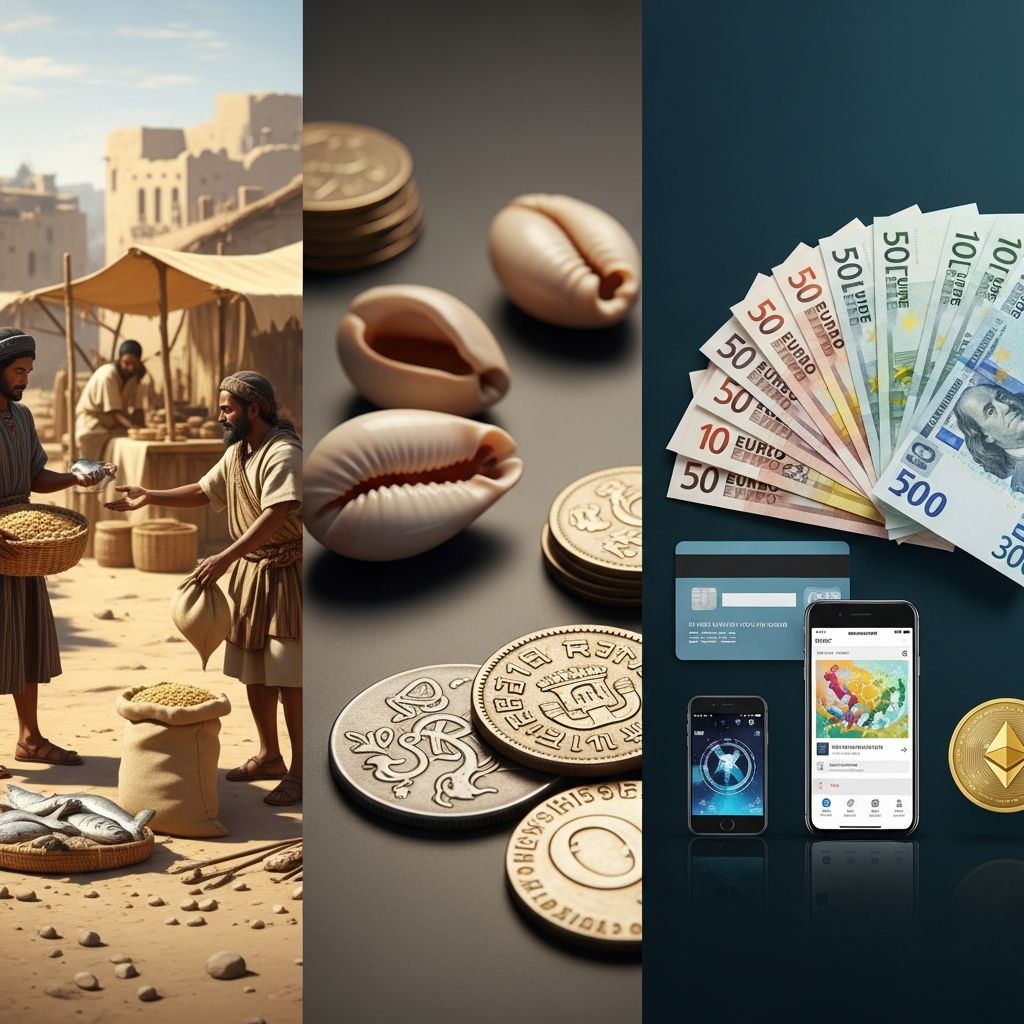
Money is one of humanity’s most significant inventions, fundamentally transforming how societies conduct commerce and accumulate wealth. Yet few people truly understand where money originated or how it evolved into the complex financial systems we rely on today. Before the advent of standardized currency, civilizations operated through barter—a direct exchange of goods and services that proved increasingly cumbersome as economies grew more sophisticated. The journey from simple barter to modern digital payments represents thousands of years of innovation, experimentation, and refinement that shaped human civilization itself.
Before Money: The Barter System
For most of human history, commerce operated through bartering, where individuals directly exchanged goods and services without any intermediary medium of exchange. A farmer with excess grain might trade with a blacksmith for tools, or a weaver could exchange cloth for livestock. While this system functioned adequately in small, localized communities, it presented significant challenges as societies grew larger and more complex.
The fundamental problem with barter lay in the “double coincidence of wants.” For a successful transaction to occur, two parties needed to have exactly what the other wanted, at the same time, in the right proportions. A baker needing a haircut had to find a barber who simultaneously wanted bread in the exact quantity the baker could provide. This inefficiency created waste, limited trade possibilities, and prevented economic growth. Additionally, many goods and services were difficult to divide or transport, making equitable exchanges problematic. The need for a universal medium of exchange became increasingly apparent as civilizations expanded their trade networks and commerce grew more sophisticated.
Ancient Egypt: Gold as the First Currency
The earliest standardized form of money that historians can document originated in ancient Egypt around the 3rd millennium BC. Rather than using coins as we know them today, Egyptians recognized the inherent value of gold and established it as a medium of exchange. The genius of this system lay in its standardization—gold was assigned fixed weights and values, creating consistency across transactions and regions.
Egyptian gold currency came in different denominations. Smaller amounts took the form of golden rings called “deben,” which served a similar function to modern coins. The measuring unit for this currency was called “shat,” equivalent to approximately 7.5 grams of gold. One deben equaled 12 shat, making it worth about 90 grams of gold. This hierarchical system allowed for both large and small transactions, accommodating the diverse needs of a complex economy.
The biblical reference to money in Deuteronomy 14:25 likely refers to this ancient Egyptian ring system, suggesting that Egyptian monetary innovation influenced broader cultural and religious practices across the ancient world. The establishment of standardized precious metal weights represented a revolutionary step in economic development, as it allowed for predictable value storage and easier long-distance trade.
Lydia and the Birth of Coined Currency
While Egyptians pioneered standardized precious metal exchange, the Kingdom of Lydia in what is now modern-day Turkey made the next major innovation around 600 BC by minting the world’s first official coins. This advancement represented a significant leap forward in monetary technology and commerce. The Lydians manufactured their coins from electrum, a naturally occurring mixture of silver and gold, and stamped each coin with distinctive motifs that served as denominations and authenticity markers.
The first Lydian coins bore the striking image of a roaring lion, creating an instantly recognizable symbol of value. These coins had irregular sizes and shapes, with inscriptions appearing only on one side. However, they were produced in standardized weights ranging from 0.15 grams to 14 grams, allowing for consistent valuation. This innovation proved revolutionary because the stamped image served multiple purposes: it indicated the coin’s value, guaranteed its weight and purity through the issuing authority’s seal, and made counterfeiting more difficult.
A century later, the legendary King Croesus of Lydia, whose name became synonymous with wealth throughout history, further refined the system by minting coins in pure gold and pure silver separately. His coins featured striking images of a lion and bull, and this separation of metals by purity represented an important step toward the modern monetary systems where different denominations contain different precious metal contents. Croesus’s coins became so renowned that “rich as Croesus” entered common usage as an expression of extraordinary wealth.
Coinage Spreads Across Ancient Civilizations
The Lydian innovation of minted coinage proved so effective that it rapidly spread throughout the ancient world. The Greek, Persian, Macedonian, and Roman empires all adopted and refined the minting techniques, each adapting the technology to their specific needs and resources. These civilizations produced coins from diverse metals including silver, bronze, and gold, with different metals assigned different values based on their rarity and utility.
The Romans particularly advanced coinage technology, developing sophisticated systems of denominations and maintaining strict standards of purity and weight. Roman coins facilitated commerce across their vast empire, enabling trade from Britain to North Africa and from Spain to the Middle East. The standardization imposed by coinage allowed for more efficient taxation, military payment, and commercial activity across geographically dispersed regions.
Independently from the Mediterranean civilizations, China also developed its own coinage system. Initially, Chinese coins took the form of miniaturized metallic reproductions of actual tools and agricultural implements, reflecting the practical economy from which they emerged. Later, Chinese innovators adopted rounded coins bearing inscriptions of Chinese characters. The term “cash,” now universally used to describe money, derives from these round bronze coins with square holes in the center, known as “kai-yuans,” which became standardized across Chinese commerce.
China’s Revolutionary Paper Money
As trade expanded and commercial activity intensified, merchants and travelers faced a new problem: the impracticality of transporting large quantities of heavy metal coins across long distances. China addressed this challenge with an innovation that would eventually transform global commerce—paper money. Initially, the Chinese used pieces of white deerskin, each one-foot-square in size with colorful decorative borders, as a portable alternative to metal coins. These leather notes represented the first documented banknotes, allowing merchants to conduct high-value transactions without physically carrying excessive weight.
Around the 9th Century AD, during the Tang Dynasty, China took this innovation further by introducing the first official paper currency. The government encouraged merchants to exchange their metal coins at the state treasury in exchange for paper notes. These revolutionary documents became known as “fei kian”—literally “flying money”—because the lightweight papers had a tendency to be literally blown away by the wind. Despite this poetic name and its whimsical origin, the system worked remarkably well.
Over a 500-year period of early paper money development, the system became increasingly sophisticated. However, this very success led to a critical problem: as paper money production expanded dramatically, the quantity of notes far exceeded the actual goods and services available in the economy. This unchecked expansion of the money supply created severe inflation that undermined the currency’s value and public confidence. Eventually, the Ming Dynasty was forced to completely abolish paper currency, temporarily reverting to metal coins until the monetary system could be restructured.
Despite this setback, the concept of paper money had proven its value. The Chinese had demonstrated that money need not be intrinsically valuable—that a symbol backed by government authority could facilitate commerce effectively. This principle would eventually become the foundation of all modern fiat currencies.
Marco Polo and Paper Money Reaches Europe
The Venetian merchant Marco Polo encountered paper money during his travels to China around 1200 AD, when the Chinese emperor maintained an efficient and well-developed paper currency system. Polo was astounded by the monetary sophistication he witnessed, famously observing that the emperor created so many notes annually that “he could buy the whole treasure of the world, though it costs him nothing.” This statement revealed Polo’s understanding of the fundamental principle underlying fiat currency: the power of monetary creation when backed by governmental authority.
When Marco Polo returned to Europe and reported his discoveries about paper money, he encountered widespread skepticism and disbelief. European merchants and authorities, accustomed to coins minted from precious metals, found the concept of currency without intrinsic value almost incomprehensible. The idea that a mere piece of paper could hold value based solely on governmental decree seemed preposterous to a society that had relied on precious metal coinage for centuries. Consequently, paper money did not gain acceptance in Europe for nearly a thousand years, despite Marco Polo’s detailed accounts of its functionality in Asia.
Modern Banking Emerges in Sweden and England
The introduction of paper money to Europe occurred relatively recently in historical terms, during the 17th century. In 1661, the Stockholm Banco became a pivotal institution in European monetary history by introducing the continent’s earliest modern-style banknotes. Unlike previous monetary experiments, Stockholm Banco’s notes were standardized, with each note assigned a fixed value. This innovation proved immensely popular, as merchants recognized the convenience of portable paper currency over heavy metal coins.
The success of Stockholm Banco’s banknotes was so immediate and dramatic that the bank overextended itself in an attempt to capitalize on the popularity of its new product. The bank issued far more notes than it could redeem with actual precious metal reserves, leading to its inevitable bankruptcy. Johan Palmstruch, the general manager of Stockholm Banco, faced severe consequences for this financial mismanagement. Initially charged with the death penalty due to irresponsible bookkeeping practices, Palmstruch’s sentence was ultimately reduced to imprisonment and expulsion from Sweden.
Despite this cautionary example of monetary mismanagement, European governments and financial institutions recognized the advantages of paper currency. Other nations rapidly adopted the Swedish model, improving upon it with better reserve management and regulatory oversight. The establishment of the Bank of England in 1694 marked the true beginning of the modern banking era in Europe. The Bank of England demonstrated how a central bank could issue currency, manage reserves responsibly, and facilitate commerce across an entire nation. This institutional model became the template for modern central banking systems worldwide.
Evolution of Money Through the Ages
The journey of money from barter to modern currency reflects humanity’s ongoing quest to solve the problems created by previous monetary systems. Each innovation addressed specific limitations while introducing new possibilities:
Precious Metal Standards: Guaranteed value through intrinsic worth and scarcity, but limited the money supply and made large transactions cumbersome.
Coined Currency: Added standardization, authentication, and divisibility, but still relied on the weight and purity of metal content.
Paper Money: Provided portability and flexibility, but required strict management to prevent inflation and maintain public confidence.
Modern Banking Systems: Integrated paper and electronic money with reserve requirements and central bank oversight, creating stability and enabling economic growth.
Key Milestones in Monetary History
| Period/Year | Innovation | Location | Significance |
|---|---|---|---|
| 3rd Millennium BC | Gold currency with standardized weights | Ancient Egypt | First documented standardized medium of exchange |
| 600 BC | Minted coins from electrum | Lydia (Turkey) | Birth of official coined currency |
| 9th Century AD | Official paper currency | China (Tang Dynasty) | First government-backed paper money |
| 1200 AD | Marco Polo encounters paper money | China | Knowledge of paper currency spreads westward |
| 1661 | Modern banknotes with fixed values | Stockholm Banco, Sweden | Introduction of standardized paper currency to Europe |
| 1694 | Establishment of central banking | Bank of England | Foundation of modern banking systems |
Lessons from Monetary History
The history of money teaches several important lessons about economics and human civilization. First, money is fundamentally a social technology—its value derives not from intrinsic properties alone but from collective agreement and trust. Second, monetary innovations respond to practical problems and limitations in existing systems. Each advancement in currency technology solved specific problems while sometimes creating new challenges requiring further innovation.
Third, the management of money supply is critical to economic stability. The Chinese experience with hyperinflation during the Ming Dynasty demonstrated that unlimited paper money creation destroys currency value. Modern central banks continue to grapple with balancing economic growth through monetary expansion against the inflation risks of excessive money creation.
Fourth, institutional frameworks matter enormously. The difference between Stockholm Banco’s failure and the Bank of England’s success demonstrates how proper regulation, reserve requirements, and oversight can stabilize currency systems. The institutional innovations that created modern banking proved as important as the innovations in currency itself.
Frequently Asked Questions (FAQs)
Q: What was the primary limitation of the barter system?
A: The barter system required a “double coincidence of wants,” meaning both parties had to want exactly what the other offered at the same time and in the right proportions. This made commerce inefficient, particularly as economies grew more complex and trade networks expanded.
Q: Why did ancient Egypt choose gold as currency?
A: Gold was chosen because it was rare, durable, easily divisible, universally desired, and could be standardized into consistent weights and values, making it ideal as a medium of exchange and store of value.
Q: How did stamped coins solve problems with precious metal currency?
A: Stamped coins solved several problems by guaranteeing weight and purity through the issuing authority’s seal, making authentication easier and counterfeiting more difficult. The standardized denominations also simplified transactions compared to weighing precious metals for each exchange.
Q: What challenges did early paper money face?
A: Early paper money faced acceptance challenges due to lack of intrinsic value, required stable government backing, and was vulnerable to overproduction leading to inflation, as demonstrated by the Ming Dynasty’s experience.
Q: How did the Bank of England differ from Stockholm Banco?
A: The Bank of England succeeded where Stockholm Banco failed by implementing responsible reserve management, regulatory oversight, and maintaining the integrity of its currency through prudent monetary policies rather than overextending its note issuance.
Q: What does the history of money reveal about economic systems?
A: The history of money shows that successful monetary systems require trust, proper institutional management, controlled money supply growth, and continuous innovation to address emerging economic challenges and facilitate commerce.
References
- Real Exchange Rates: What Money Can Buy — International Monetary Fund (IMF). 2024. https://www.imf.org/en/publications/fandd/issues/series/back-to-basics/real-exchange-rates
- The history of money – StrongPoint — StrongPoint. 2024. https://www.strongpoint.com/nl/blog/the-history-of-money/
- History of Money — PBS Learning Media. 2024. https://www.pbs.org/wgbh/nova/ancient/history-money.html
Similar Articles








Read full bio of medha deb