Robo-Advisors Guide In 2026: 10 Key Features To Compare
Automate your investments with robo-advisors: low-cost, algorithm-driven portfolios tailored to your risk tolerance and goals for 2026.

Robo-advisors have transformed personal investing by leveraging algorithms to build and manage diversified portfolios tailored to individual risk tolerance and financial goals. These digital platforms offer low-cost alternatives to traditional advisors, making professional-grade investing accessible to everyday investors. In 2026, with advancing technology and market volatility, robo-advisors continue to gain popularity by automating portfolio construction, rebalancing, and tax optimization.
Compare Online Robo-Advisors
Selecting the right robo-advisor involves comparing fees, account minimums, features, and performance. Platforms like Wealthfront, SoFi Automated Investing, Stash, and Acorns cater to different investor needs, from beginners with small balances to those seeking advanced tax strategies.
| Robo-Advisor | Management Fee | Account Minimum | Key Features |
|---|---|---|---|
| Wealthfront | 0.25% | $500 | Tax-loss harvesting, automated rebalancing, retirement planning tools |
| SoFi Automated Investing | 0.25% | $1 | No advisory fee for some accounts, goal-based portfolios, human support |
| Stash | 0.25% or flat | $0 | Micro-investing, educational tools, fractional shares |
| Acorns | $3-$5/month | $0 | Round-ups, automated savings to investing, beginner-friendly |
This comparison highlights how robo-advisors vary in cost structures and accessibility, allowing investors to match platforms to their balance sizes and objectives.
Is a Robo-Advisor Right for You?
Robo-advisors suit hands-off investors seeking simplicity and low fees, particularly those new to investing or with modest portfolios. They excel for long-term goals like retirement, where consistent, diversified strategies outperform emotional decision-making. However, they may fall short for complex needs requiring personalized human advice, such as estate planning or unique tax situations.
- Ideal for: Beginners, cost-conscious investors, passive strategies.
- Not ideal for: High-net-worth individuals needing bespoke advice, active traders.
How Robo-Advisors Work
Robo-advisors operate through a streamlined process: users complete an online questionnaire assessing risk tolerance, time horizon, and goals. Algorithms then construct a diversified portfolio using low-cost exchange-traded funds (ETFs) or mutual funds across asset classes like stocks, bonds, and alternatives. The platform automatically rebalances to maintain target allocations and implements tax-loss harvesting in taxable accounts to minimize taxes.
For retirement planning, many integrate calculators projecting required contributions based on target income and dates, recommending IRA or 401(k) adjustments. Portfolios shift conservatively as goals near, favoring bonds over stocks for capital preservation.
- Complete risk assessment questionnaire.
- Fund your account (deposits start from $0-$500).
- Portfolio is auto-built and invested.
- Ongoing monitoring, rebalancing, and optimization.
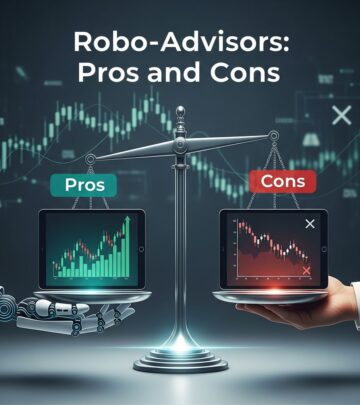
Robo-Advisor Pros and Cons
Robo-advisors democratize investing with automation, but they have limitations rooted in data-driven models.
Pros
- Lower Charges: Fees average 0.25%, far below 1%+ for human advisors, boosting net returns over time.
- Lower Risk of Emotional Bias: Algorithms avoid market timing pitfalls, maintaining discipline during volatility.
- Simplicity and Automation: Set-it-and-forget-it with automatic rebalancing and tax-loss harvesting.
- Accessibility: Low or no minimums, ideal for starting small[10].
Cons
- Limited by Historical Data: Models rely on past performance, which may not predict future anomalies like low bond yields or high stock valuations.
- No Human Intuition: Algorithms overlook momentum, geopolitics, or personal nuances.
- Customization Limits: Restricted to platform’s ETF selections and strategies.
Robo-Advisor Fees and Features
Understanding fees is crucial as they compound over time. Robo-advisors charge a management fee plus underlying ETF expense ratios (0.05%-0.35%). Total costs often stay under 0.50% annually.
1. The Base Fee
Typically 0.25%-0.35% of assets under management (AUM). For $10,000 invested, that’s $25-$35 yearly. Compare across providers, as some offer tiered reductions.
2. Expense Ratios
ETFs incur separate fees averaging 0.10%-0.20%, adding $10-$20 per $10,000. Opt for platforms with low-cost index funds.
3. Fee Reductions for Higher Balances
Accounts over $100,000 often see drops to 0.15%-0.20%. Confirm tiered structures for scalability.
Key Features to Evaluate
- Tax-loss harvesting for efficiency.
- Retirement and goal-planning tools.
- Access to human advisors (hybrid models).
- Account types: IRAs, taxable, 529 plans.
10 Things to Look for When Choosing a Robo-Advisor
Follow these steps for informed selection:
- Base Fee: Target under 0.30%.
- Account Minimum: Prefer $0-$100 for flexibility.
- Fee Tiers: Discounts for growth.
- Investment Options: Diverse ETFs, ESG if desired.
- Tax Features: Harvesting availability.
- Rebalancing Frequency: Automated and timely.
- Customer Support: 24/7 chat, phone.
- Security: SIPC/FDIC insurance, encryption.
- Performance Track: Historical returns adjusted for risk.
- Exit Fees: None for transfers.
Frequently Asked Questions
How much does a robo-advisor cost?
Robo-advisors charge 0.25%-0.35% AUM, plus ETF expenses. Tiers may reduce rates for balances over $100,000.
Can you lose money with a robo-advisor?
Yes, like any investment; markets fluctuate. Diversification mitigates but doesn’t eliminate risk.
What is the disadvantage of using a robo-advisor?
Reliance on algorithms ignores real-time events or personal context, lacking human adaptability.
Are robo-advisors safe?
Yes, regulated with SIPC protection up to $500,000; platforms use bank-level security.
Can I start with little money?
Many have $0 minimums, perfect for micro-investing[10].
References
- What Is A Robo-Advisor? | Bankrate — Bankrate. 2025. https://www.bankrate.com/investing/robo-advisors/
- Guide to Robo-Advisors for 2025: Automating Your Investments — MoneyRates. 2025. https://www.moneyrates.com/investment/robo-investing.htm
- Wealthfront Review 2025 – Robo Advisor — MoneyRates. 2025. https://www.moneyrates.com/reviews/wealthfront-review.htm
- SoFi® Auto Invest Review 2025: Pros, Cons, & Top Features — MoneyRates. 2025. https://www.moneyrates.com/reviews/sofi-auto-invest-review.htm
Similar Articles








Read full bio of medha deb