Risk Reversal: Definition, Strategy & Applications
Master risk reversal strategies to hedge positions and optimize returns in options trading.
What Is a Risk Reversal?
A risk reversal is a sophisticated options trading strategy designed to manage risk while capitalizing on directional market movements. In its essence, a risk reversal involves simultaneously buying and selling out-of-the-money options with the same expiration date. This dual-position approach creates a hedged strategy that allows traders to profit from anticipated price movements while offsetting potential losses.
The term “risk reversal” can refer to two distinct but related concepts in financial markets. First, it describes a specific options trading strategy used to hedge positions and manage risk exposure. Second, in forex and options markets, it represents the difference in implied volatility between similar call and put options, serving as a gauge for market sentiment and perceived directional risk.
Risk reversals are particularly popular among options traders, forex traders, and portfolio managers who seek to balance the potential for profit with the need to protect against adverse market movements. The strategy is sometimes referred to as a “conversion” when used as an investment strategy, and it can simulate the profit and loss behavior of owning an underlying security, earning it the nickname “synthetic long” position.
Understanding the Components of Risk Reversal
To effectively implement a risk reversal strategy, traders must understand its fundamental components and how they work together to create a balanced position.
Selling Out-of-the-Money Options
The first component of a risk reversal involves selling an out-of-the-money (OTM) option, which could be either a put or a call option. When an investor sells an OTM option, they assume an obligation to either buy the underlying asset (in the case of a put option) or sell it (in the case of a call option) at a predetermined price known as the strike price. This sale generates income for the investor in the form of a premium, which can be used to offset the cost of the second component of the strategy.
Buying Out-of-the-Money Options
The second component involves simultaneously purchasing an out-of-the-money option of the opposite type. If the investor sold a put option, they would buy a call option, and vice versa. Both options should have the same expiration date to ensure the strategy functions as intended. The premium received from selling the first option can significantly reduce or even eliminate the net cost of purchasing the second option, making this a relatively low-cost hedging approach.
Balancing Risk and Reward
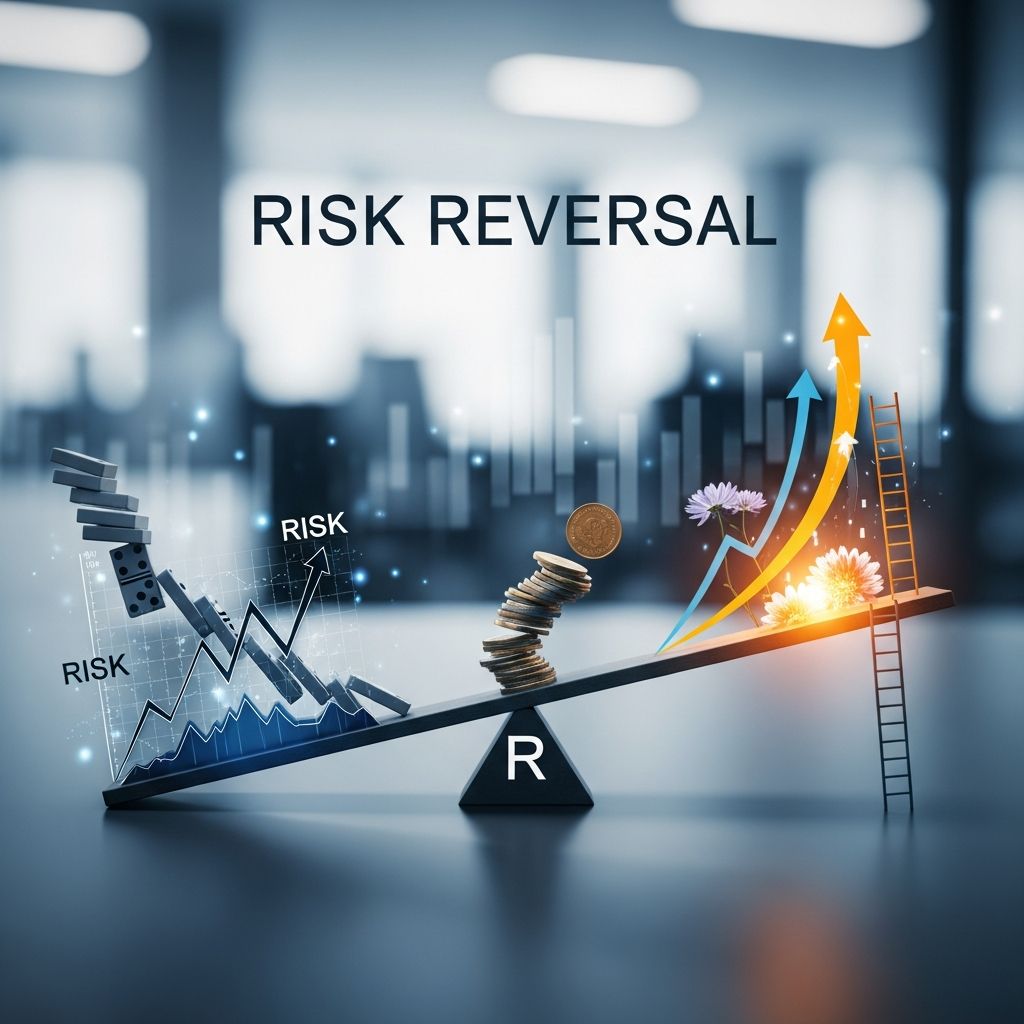
The fundamental principle underlying risk reversals is the balance between risk and reward. By combining a short position in one option with a long position in another, traders create a position that benefits from their anticipated market direction while simultaneously limiting downside risk. This equilibrium is crucial in navigating the volatile financial markets where prices constantly fluctuate.
How Risk Reversal Works: Different Applications
Risk Reversal in Options Trading
In options trading, a risk reversal strategy typically involves a bullish or bearish approach. For a bullish market view, a trader would sell an out-of-the-money put option and buy an out-of-the-money call option. If the underlying asset’s price rises as expected, the call option gains value while the put option loses value, creating profit. Conversely, for a bearish market view, a trader would sell an out-of-the-money call option and buy an out-of-the-money put option, profiting if the asset’s price declines.
Risk Reversal in Forex Markets
In forex markets, risk reversal takes on a slightly different meaning. It refers to the difference in implied volatility between similar call and put options for a currency pair. This volatility differential serves as a powerful indicator of market sentiment regarding the currency pair’s future direction. A positive risk reversal indicates that call options have higher implied volatility than put options, suggesting traders expect the currency to appreciate. Conversely, a negative risk reversal suggests expectations of currency depreciation. Forex traders use this information to assess perceived risk and make informed trading decisions.
Position Protection Strategies
For traders already holding positions in securities, risk reversals function as effective protection mechanisms. If an investor is long in an asset, they can write a call option and buy a put option. This “short risk reversal” strategy protects against price declines. Conversely, if an investor is short in an asset, they can buy a call option and write a put option, a “long risk reversal” strategy that protects against price increases.
Benefits and Advantages of Risk Reversal
Risk reversals offer several compelling advantages for options traders and portfolio managers seeking sophisticated risk management solutions.
Cost-Effective Hedging
One of the most significant advantages of risk reversals is their potential to reduce or eliminate hedging costs. Since the premium received from selling one option can offset the cost of purchasing another, traders can establish protective positions with minimal or even zero net cost. In some cases, the strategy can actually generate a net credit, meaning the trader receives money for establishing the hedge.
Defined Risk Parameters
Risk reversals allow traders to define their risk parameters precisely. The maximum loss is typically limited to the difference between the strike prices minus any net credit received, while the maximum profit is unlimited on the upside for bullish reversals. This defined risk structure makes position sizing and risk management more straightforward.
Market Sentiment Analysis
In forex markets, the risk reversal volatility skew provides valuable insights into market sentiment. By analyzing the difference in implied volatility between calls and puts, traders gain a clearer picture of market expectations regarding currency movements, enabling more informed trading decisions.
Portfolio Protection
Risk reversals serve as effective portfolio hedges. Companies expecting foreign currency payments can use risk reversals to protect against adverse currency fluctuations. For example, a company might sell a put option on a currency to profit if it depreciates while simultaneously buying a call option for protection if it appreciates. This comprehensive approach to hedging reduces portfolio volatility and protects against substantial losses.
Risks and Limitations of Risk Reversal
While risk reversals are powerful tools, they are not without limitations and potential drawbacks.
Does Not Eliminate Risk
Risk reversal does not fully eliminate risk. If the underlying asset’s price deviates significantly from the trader’s prediction, losses can still occur. When the sold option ends up in the money, the trader must meet their obligations under the option contract, potentially leading to substantial financial losses. The risk depends on how far the price moves against the trader’s expectations.
Prediction Dependency
The success of a risk reversal strategy heavily depends on accurate price prediction. Investors must correctly anticipate which direction an asset’s price will move. If the price moves in the opposite direction, the strategy can amplify losses rather than protect against them. This makes risk reversals more suitable for experienced traders with strong market analysis capabilities.
Limited Profit Potential on One Side
While risk reversals offer significant upside potential on one side, the profit is limited on the other side by the sold option. For a bullish risk reversal, as prices rise significantly, the sold put provides diminishing returns. This trade-off between protection and unlimited profit is an inherent characteristic of the strategy.
Complexity and Execution Risk
Risk reversals involve managing multiple options positions simultaneously, which requires sophisticated understanding of options mechanics and careful execution. Traders must ensure that both legs of the strategy are properly timed and priced to achieve the desired risk-reward balance. Poor execution can result in unfavorable outcomes.
Risk Reversal and Implied Volatility
Implied volatility plays a crucial role in risk reversal strategies and analysis. Implied volatility reflects the market’s expectation of future price fluctuations of an underlying asset. The difference in implied volatility between a call option and a put option—what’s known as the risk reversal—helps traders gauge market sentiment and anticipate potential price movements.
A positive risk reversal indicates that call options have higher implied volatility than put options, suggesting the market expects the underlying asset to appreciate. This positively skewed distribution reflects expectations of relatively large upside moves. Conversely, a negative risk reversal suggests higher implied volatility in put options, indicating expectations of potential downside moves.
Understanding implied volatility differentials is essential for options traders because it directly impacts option pricing and strategy outcomes. Greater demand for an options contract increases its price and implied volatility. Traders skilled in analyzing volatility skews can identify mispriced options and execute more profitable risk reversal strategies.
Practical Applications and Examples
Currency Hedging
Consider a multinational corporation expecting to receive a payment in euros in six months. The company faces currency risk, as a declining euro would reduce the dollar value of their payment. Using a risk reversal strategy, the company could sell a put option on the euro at a strike price below the current rate, allowing it to profit if the euro weakens. Simultaneously, the company could buy a call option above the current rate for protection if the euro strengthens. This approach protects the company’s cash flow while potentially enhancing returns through the premium received from selling the put option.
Portfolio Protection
An investor holding a long position in a particular stock expects continued appreciation but wants protection against unexpected downturns. Instead of simply buying a protective put option—which involves a direct cost—the investor could use a short risk reversal by selling an out-of-the-money call option and buying an out-of-the-money put option. The premium from the sold call helps offset the cost of the protective put, reducing the overall hedge cost.
Speculative Trading
An experienced trader with a strong bullish view on a commodity like crude oil might use a long risk reversal strategy. They would sell an out-of-the-money put option and use the proceeds to purchase an out-of-the-money call option. If the price of crude oil rises as expected, the trader profits from the appreciation while the sold put option expires worthless. This approach allows the trader to pursue their market view with leverage while managing risk through the protective put element of the strategy.
Risk Reversal Compared to Other Strategies
| Strategy | Structure | Best Used When | Risk Profile |
|---|---|---|---|
| Risk Reversal | Buy OTM call + Sell OTM put (or vice versa) | Strong directional view with hedging needs | Limited loss below sold strike; unlimited gain above bought strike |
| Protective Put | Own stock + Buy put option | Want downside protection on existing position | Direct cost of put premium; unlimited upside |
| Covered Call | Own stock + Sell call option | Generate income on existing position | Limited upside at call strike; full downside risk |
| Straddle | Buy call + Buy put at same strike | Expect significant move but uncertain direction | Limited loss at current price; unlimited gains both directions |
Combining Risk Reversals with Other Strategies
Risk reversals can be combined with other hedging and trading strategies to create more comprehensive risk management approaches. For example, traders managing large portfolios might combine risk reversals with protective puts for selected holdings, covered calls on other positions, and outright options trades on speculative views. This layered approach increases the chances of successful portfolio management by addressing different risk scenarios and market conditions.
The key to successful combination strategies is maintaining clear understanding of each component’s objective and how the overall portfolio risk is affected. Sophisticated traders use risk reversals as building blocks in more complex strategies designed to achieve specific risk-adjusted return targets.
Frequently Asked Questions
Q: What is the primary difference between a risk reversal in options trading and in forex markets?
A: In options trading, a risk reversal is an actual trading strategy involving buying and selling OTM options. In forex markets, a risk reversal is a measurement—the difference in implied volatility between call and put options—that reflects market sentiment about currency movements.
Q: Can a risk reversal completely eliminate trading risk?
A: No. While risk reversals effectively manage and hedge risk by offsetting potential losses in one direction, they do not eliminate risk entirely. If the underlying asset price moves significantly against expectations, losses can still occur on the sold option position.
Q: How is the cost of a risk reversal determined?
A: The net cost of a risk reversal is determined by the difference between the premium paid for the bought option and the premium received for the sold option. In many cases, these premiums offset completely or partially, resulting in zero or reduced cost.
Q: Who typically uses risk reversals most frequently?
A: Risk reversals are most commonly used by experienced options traders, forex traders, portfolio managers, and multinational corporations hedging currency exposure. They require solid understanding of options mechanics and market analysis.
Q: What role does implied volatility play in risk reversal profitability?
A: Implied volatility directly impacts option premiums and strategy outcomes. Changes in implied volatility can significantly affect both the cost of establishing the position and the potential profit or loss as market conditions evolve.
Q: Can risk reversals be used on any underlying asset?
A: Risk reversals can be applied to stocks, commodities, currencies, indices, and other underlying assets with liquid options markets. However, they are most effective with assets that have sufficient trading volume to ensure option liquidity.
References
- Risk Reversal: Definition, Components, & Applications — Finance Strategists. 2025. https://www.financestrategists.com/wealth-management/risk-profile/risk-reversal/
- Risk Reversal — Wikipedia. 2024. https://en.wikipedia.org/wiki/Risk_reversal
- Understanding How a Risk Reversal Works – Investing — SmartAsset. 2024. https://smartasset.com/investing/risk-reversal
- Options Industry Council – Risk Reversal Education — The Options Clearing Corporation. 2024. https://www.optionseducation.org/
- Understanding Implied Volatility and Market Sentiment — CBOE Learning Center. 2024. https://www.cboe.com/
Similar Articles








Read full bio of medha deb