Rich Mindset vs Poor Mindset: Key Differences Explained
Discover how changing your money mindset, habits, and daily choices can shift you from a poverty mentality to a mindset that builds lasting wealth.
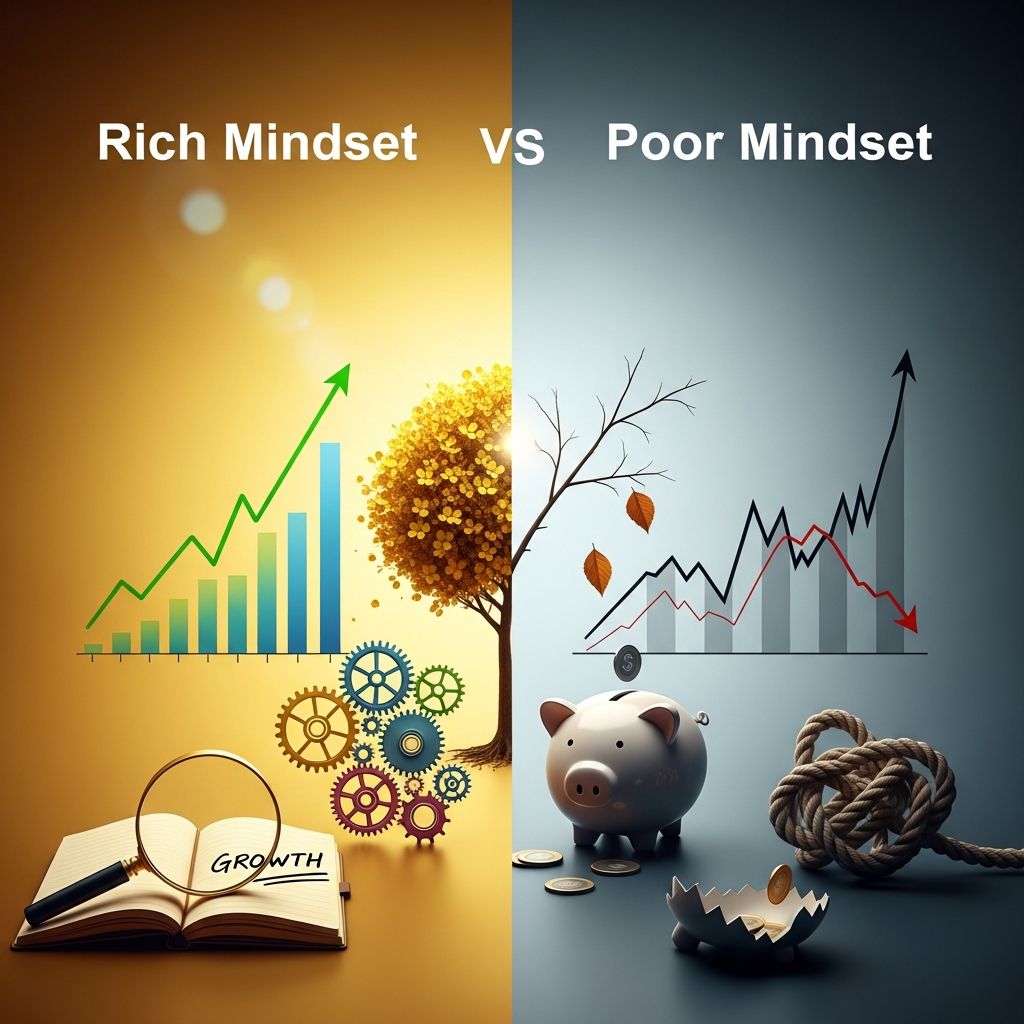
There is a major difference between a rich mindset and a poor mindset, and it goes far beyond the size of a person’s paycheck. Mindset shapes how you see opportunities, respond to challenges, and use money — and over time those choices can either trap you in financial stress or help you build real wealth.
This article breaks down the key differences between rich vs poor mindsets, common habits that keep people stuck, and practical ways you can begin to develop a wealth-building mindset starting today.
Rich Mindset vs Poor Mindset: The Big Picture
Your mindset is the lens through which you interpret your circumstances. In personal finance, mindset often matters as much as income because it affects saving, investing, risk-taking, and long-term planning. People with a rich mindset focus on growth and possibilities, while a poor mindset tends to focus on limitations and fear.
| Rich Mindset | Poor Mindset |
|---|---|
| Believes circumstances can change | Believes circumstances are fixed |
| Focuses on long-term results | Focuses on short-term comfort |
| Views challenges as problems to solve | Views challenges as impossible barriers |
| Works to learn and build assets | Works only for the next paycheck |
| Believes in abundance and opportunity | Believes resources are scarce |
Income, education, and social background do matter in wealth building, and structural barriers can make progress harder for many people. However, mindset is a powerful lever you can control, and shifting it can help you make the most of whatever resources you have.
A Poor Mindset Believes Things Will Not Change
A core trait of a poor mindset is the belief that “this is just how it is.” Someone may feel stuck living paycheck to paycheck and assume that is the best outcome they can expect.
This kind of thinking can show up as:
- Feeling that higher income or savings are “for other people”
- Assuming debt will always be part of life
- Believing that no action they take will make a real difference
Psychologists sometimes describe this as learned helplessness: after repeated setbacks, people may stop trying, even when options exist. When it comes to money, this can look like giving up on budgeting, saving, or building new skills because past efforts did not work out.
An Attitude of Poverty Sees Challenges as Impossible
Another hallmark of a poor mindset is the belief that personal challenges are uniquely unfair or impossible to overcome. When people think this way, they might:
- Compare themselves negatively to those who are wealthier
- Assume the rich never struggled or got “lucky”
- See every setback as confirmation that nothing can improve
Yet many well-known success stories show that people from difficult backgrounds have overcome serious obstacles through persistence, learning, and support. Research on resilience finds that skills like problem-solving, social support, and realistic optimism can significantly improve outcomes even in tough environments.
A rich mindset does not deny that challenges are real. Instead, it asks, “What can I control? What can I learn? What is my next step?”
Key Habits of a Rich Mindset
Mindset is not just about how you think — it shows up in what you do consistently. Over time, small daily choices add up to big differences in financial outcomes. Below are key habits that typically characterize a rich mindset.
1. A Rich Mindset Focuses on Growth and Learning
People with a rich mindset see skills and knowledge as something they can develop. They are willing to be beginners, make mistakes, and try again. This mirrors what psychologists call a growth mindset, the belief that abilities can be improved with effort and learning.
In practice, this often looks like:
- Actively learning about budgeting, saving, and investing
- Seeking mentors, books, and credible resources on money
- Taking courses or training to increase earning potential
By contrast, a poor mindset might avoid learning about money because it feels confusing or overwhelming, which keeps the person dependent on others’ decisions and advice.
2. Wealthy Thinkers Prioritize Long-Term Results
Rich mindsets are results-driven, not just focused on appearances or trends. The focus is on outcomes like paying off debt, growing net worth, and achieving financial independence — not on looking successful in the moment.
Typical behaviors include:
- Setting clear financial goals (e.g., 3–6 month emergency fund, retirement targets)
- Tracking progress periodically and adjusting strategies
- Choosing habits because they work, not because they are popular
For instance, waking up early or sticking to a strict routine is not about bragging rights; it is about having focused time to work on goals, side hustles, or education.
3. People with a Rich Mindset Don’t Work Just for Money
One of the biggest differences between rich vs poor mindset is why people work. Many people with a poor mindset work primarily to survive until the next paycheck. The priority is immediate income, not long-term growth.
People with a rich mindset still care about earning, but they also work to learn and create leverage. They ask questions like:
- “What skills can this job help me build?”
- “How can I turn this experience into a higher income later?”
- “Can this role open doors to better opportunities?”
Over time, focusing on skills, networks, and experience can significantly increase earning power, which research shows is strongly associated with higher lifetime wealth.
4. A Rich Mindset Seeks Improvement and Innovation
People with a rich mindset are often looking for ways to improve existing systems, products, or services. Many successful companies were created by people who spotted everyday problems and found better solutions.
Examples of this attitude can include:
- Asking how processes at work can be streamlined
- Looking for unmet needs that could become a business or side hustle
- Questioning “this is how it’s always been done” when it no longer works
By contrast, a poor mindset may be content to endure frustration without seeking change, assuming that nothing can be improved anyway.
5. Rich People Believe in Abundance, Not Scarcity
A scarcity mindset believes there is “never enough”: not enough money, opportunity, or success to go around. This can create jealousy, fear of sharing, and an “us vs. them” mentality.
Those with a rich mindset instead believe in abundance. They see other people’s success as proof that success is possible, not as a threat. This can lead to:
- Collaboration rather than competition
- Willingness to share knowledge, ideas, and connections
- Focus on creating value for others as a path to income
Economists note that over long periods, total economic output tends to grow, meaning that opportunities can expand rather than being a fixed pie — especially when innovation and productivity increase.
6. A Rich Mindset Learns to Manage Money Intentionally
No one is born knowing how to manage money. Financial capability is a learned skill, and people who develop a rich mindset take responsibility for learning it.
Common behaviors include:
- Budgeting: Tracking income and expenses and assigning every dollar a purpose
- Saving: Building an emergency fund to handle unexpected costs and reduce stress
- Investing: Using tools like retirement accounts and diversified portfolios for long-term growth
- Debt management: Avoiding high-interest consumer debt and paying it off aggressively when it exists
Studies show that people who consistently save and invest, even small amounts, can build significant wealth over time due to compound interest — where earnings themselves earn returns. This is a central part of a rich mindset: prioritizing long-term wealth over short-term consumption.
Habits That Reflect a Poor Mindset
While everyone’s situation is different, certain financial habits tend to reinforce a poor mindset and keep people stuck financially.
1. Living for Appearances and Consumption
One common poor-mindset habit is using money primarily to look successful rather than to become financially secure. This can show up as:
- Regularly buying the latest gadgets or fashion on credit
- Spending heavily on lifestyle to impress others
- Prioritizing luxury items over savings and debt repayment
Research on household finances finds that high consumption, especially when financed with high-interest debt, is a major barrier to building net worth. People with a rich mindset often practice “quiet wealth,” focusing on assets rather than outward displays.
2. Avoiding Financial Planning
A poor mindset might avoid looking closely at money out of fear, shame, or the belief that planning will not help. Signs of this include:
- Not knowing how much is spent each month or where it goes
- Ignoring bills or minimum payments until the last minute
- Not having any written goals for saving or debt reduction
On the other hand, people who engage in basic planning — even simple actions like writing down goals and creating a budget — are more likely to achieve better financial outcomes.
3. Treating Debt as Normal and Permanent
People with a poor mindset may see consumer debt (credit cards, store cards, personal loans) as just a typical part of life. They may prioritize monthly affordability (“Can I make the payment?”) over total cost.
This can lead to:
- Carrying high-interest balances month after month
- Using credit for non-essential spending
- Feeling trapped as interest charges grow
A rich mindset recognizes that while some types of debt can be strategic (such as a reasonable mortgage or education that increases earning potential), high-interest consumer debt is a drag on future wealth and should be minimized and paid down aggressively.
How to Develop a Rich Mindset
Shifting from a poor mindset to a rich mindset will not happen overnight, but it is absolutely possible. The process involves changing both your beliefs and your daily actions.
Step 1: Challenge Limiting Beliefs
Start by noticing recurring thoughts about money and success. When you catch beliefs like “I’ll always be broke” or “I’m just bad with money,” question them. Ask:
- “Is this always true?”
- “Where did this belief come from?”
- “What evidence do I have that change is possible?”
Replacing blanket negative statements with more accurate ones (such as “I have made mistakes with money, but I can learn new skills”) is a powerful step toward a rich mindset.
Step 2: Learn the Basics of Personal Finance
Financial education is a cornerstone of a rich mindset. Reliable resources from government, nonprofit, and educational institutions can help you understand topics like budgeting, credit, and investing in clear, practical terms. Focus on:
- Understanding your income, expenses, and net worth
- Creating a realistic budget that fits your life
- Building a starter emergency fund (even a small one)
- Learning how retirement accounts and compound interest work
Step 3: Set Clear, Actionable Goals
Rich mindsets are goal-oriented. Instead of vague wishes like “I want to be better with money,” define specific, measurable targets such as:
- “Save $500 in an emergency fund in the next three months”
- “Pay off one credit card within 12 months”
- “Increase retirement contributions by 2% of my income”
Break these goals into small actions you can take weekly or monthly. Consistency matters more than perfection.
Step 4: Shift from Consumption to Asset-Building
One of the most important mindset shifts is moving from spending mainly on consumption to prioritizing assets — things that can grow in value or generate income. Examples of assets include:
- Retirement investments (through employer plans or individual accounts)
- Savings and low-cost investment funds
- Education or training that significantly raises earning potential
Choosing to delay some purchases today so you can invest for tomorrow is a classic rich-mindset decision. Over time, the growth from those investments can far outweigh the short-term satisfaction of the latest phone or fashion trend.
Step 5: Surround Yourself with Growth-Oriented Influences
Mindsets are contagious. The people you spend time with, the content you consume, and the conversations you have all shape how you think about money and success.
To reinforce a rich mindset, consider:
- Connecting with people who are focused on financial stability and growth
- Following credible personal finance educators and experts
- Limiting exposure to messages that glorify constant consumption or quick fixes
Frequently Asked Questions (FAQs)
Q: Can mindset alone make you rich?
A: Mindset by itself will not automatically make you rich, but it strongly influences the choices you make about education, work, spending, saving, and risk. These choices, over time, have a major impact on your financial outcomes.
Q: What if I have a low income — can I still have a rich mindset?
A: Yes. A rich mindset is about how you think and act, not your current income. Even with a modest income, you can focus on learning, planning, reducing high-interest debt, and building small savings habits that grow over time.
Q: Is all debt bad in a rich mindset?
A: Not necessarily. A rich mindset treats high-interest consumer debt as something to avoid or pay down quickly, but may view certain debts (like reasonable student loans or a manageable mortgage) as strategic if they support long-term growth and stability.
Q: How long does it take to shift from a poor mindset to a rich mindset?
A: There is no fixed timeline. It is an ongoing process of learning, questioning old beliefs, and practicing new habits. Many people notice changes in how they feel about money within months once they start planning, tracking progress, and taking consistent action.
Q: Do I need to give up all enjoyment to have a rich mindset?
A: No. A rich mindset is about aligning spending with what truly matters to you and your long-term goals, not about deprivation. It encourages intentional choices so you can enjoy today while still building security for the future.
References
- Survey of Consumer Finances — Board of Governors of the Federal Reserve System. 2023-10-18. https://www.federalreserve.gov/econres/scfindex.htm
- Income and Wealth Distribution in the United States: An Overview of Data — Congressional Budget Office. 2022-09-08. https://www.cbo.gov/publication/57598
- Mindset: The New Psychology of Success — Carol S. Dweck. 2006-02-28. https://doi.org/10.1037/0003-066X.62.1.52
- Building Adult Resilience — American Psychological Association. 2020-01-01. https://www.apa.org/topics/resilience
- Financial Capability in the United States 2022 — FINRA Investor Education Foundation. 2022-11-15. https://finrafoundation.org/financial-capability-study
Similar Articles








Read full bio of medha deb