RevPAR: Revenue Per Available Room Explained
Master RevPAR calculations and optimize your hotel's revenue performance strategy.
What is RevPAR (Revenue Per Available Room)?
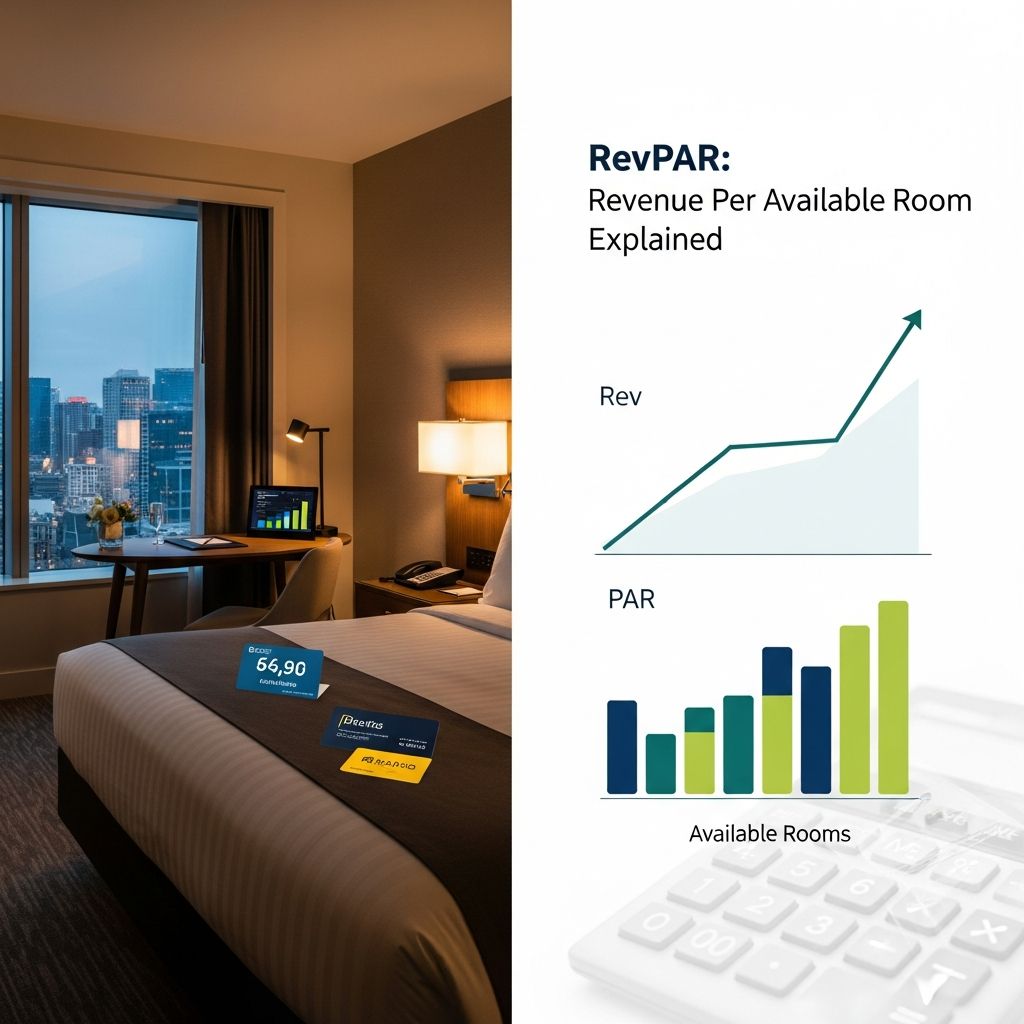
RevPAR, an acronym for Revenue Per Available Room, is a fundamental key performance indicator (KPI) in the hospitality industry that measures how effectively a hotel generates revenue from its available room inventory. This metric represents the average revenue earned from each available room during a specific period, regardless of whether the room is occupied or vacant. RevPAR serves as a comprehensive snapshot of a hotel’s financial performance, incorporating both pricing strategy and occupancy levels into a single measurable figure.
Unlike metrics that focus solely on occupancy or average daily rate independently, RevPAR provides a holistic view of a property’s revenue-generating capabilities. It demonstrates whether a hotel is successfully filling its rooms while maintaining optimal pricing, making it an essential tool for hotel managers, owners, and revenue management professionals. An increasing RevPAR indicates that either the average room rate, the occupancy rate, or both are moving in a positive direction, signaling improved hotel performance.
Why RevPAR Matters for Hotel Operations
RevPAR holds significant importance in the hospitality industry for several compelling reasons. First, it provides hotel managers with a clear understanding of how well their property is performing financially. By tracking RevPAR over time, hoteliers can identify trends, seasonal patterns, and areas requiring improvement.
Second, RevPAR enables effective competitive benchmarking. Hotel owners can compare their RevPAR against competitors in their market segment to determine whether they are capturing their fair market share. This comparison helps identify competitive positioning opportunities and strategic advantages or disadvantages relative to similar properties.
Third, RevPAR directly informs pricing strategy and room rate optimization. Understanding your hotel’s RevPAR helps determine optimal room pricing that balances occupancy rates with revenue maximization. Hotels can adjust pricing strategies to improve RevPAR, either by increasing rates during high-demand periods or lowering them to boost occupancy during slower seasons.
Finally, RevPAR provides insight into overall business sustainability and profitability potential. While RevPAR doesn’t directly measure profit—since it doesn’t account for operating expenses—it does indicate a hotel’s ability to generate top-line revenue, which is the foundation for profitability.
RevPAR Formulas: Two Methods for Calculation
There are two primary methods for calculating RevPAR, and both yield identical results when using accurate data. Hotel managers can choose the formula that best suits their available data and operational needs.
Method One: Total Revenue Divided by Available Rooms
The most straightforward RevPAR calculation divides a hotel’s total room revenue by the total number of available rooms during the measurement period:
RevPAR = Total Room Revenue ÷ Total Available Rooms
This formula works well when you have clear revenue figures and room inventory data. For example, if a hotel generated $10,000 in room revenue during a specific period and had 100 available rooms, the RevPAR would be $100 ($10,000 ÷ 100 = $100).
Method Two: Average Daily Rate Multiplied by Occupancy Rate
The second method calculates RevPAR by multiplying the Average Daily Rate (ADR) by the occupancy rate:
RevPAR = Average Daily Rate (ADR) × Occupancy Rate
This formula requires two key components: the ADR (calculated by dividing total room revenue by the number of rooms sold) and the occupancy rate (the percentage of available rooms that were occupied). For instance, if a hotel has an ADR of $100 and a 70% occupancy rate, the RevPAR would be $70 ($100 × 0.70 = $70).
Practical RevPAR Calculation Example
To illustrate how these formulas work in practice, consider the following scenario: A hotel with 100 rooms achieves an 80% average occupancy rate with an average nightly rate of $100.
Using Method One:
First, calculate total revenue: 100 rooms × 80% occupancy × $100 rate × 7 nights = $56,000 per week
Then divide by available rooms: $56,000 ÷ 100 rooms = $560 RevPAR for the week, or approximately $80 RevPAR per night
Using Method Two:
Simply multiply: $100 (ADR) × 0.80 (occupancy rate) = $80 RevPAR per night
Both methods confirm the hotel’s RevPAR of $80, demonstrating the consistency and reliability of these calculation approaches.
Understanding RevPAR Index and Competitive Positioning
Beyond basic RevPAR calculation, hoteliers benefit from understanding the RevPAR Index, a benchmarking tool that compares your property’s RevPAR performance against competitors. Expressed as a percentage, a RevPAR Index of 100 indicates you’re capturing your fair market share, while scores above 100 demonstrate superior performance and scores below 100 suggest competitive underperformance.
For example, if your hotel achieves a RevPAR of $200 while competitors in your market segment average $150, your RevPAR Index would be 133 (($200 ÷ $150) × 100), indicating superior revenue management and market positioning.
What High RevPAR Indicates
High RevPAR demonstrates effective revenue optimization through strong occupancy rates and optimal pricing strategies. Properties achieving elevated RevPAR figures typically display successful market positioning, sophisticated dynamic pricing implementation, and efficient distribution management. High RevPAR relative to competitors suggests superior revenue management capabilities and strong guest demand for the property, indicating that the hotel is successfully balancing volume (occupancy) with value (room rates).
Related RevPAR Metrics and Variations
Adjusted RevPAR (ARPAR)
Adjusted Revenue Per Available Room (ARPAR) refines the basic RevPAR calculation by accounting for variable costs and additional revenue streams per occupied room. The ARPAR formula is: (ADR – variable costs per occupied room + additional revenue per occupied room) × Occupancy. This metric provides a more accurate measure of revenue management performance and pricing policy effectiveness by removing distortions from cost variations.
Net RevPAR (NRevPAR)
Net Revenue Per Available Room (NRevPAR) excludes distribution costs such as online travel agency (OTA) commissions, channel manager fees, and other distribution-related expenses. By accounting for these costs, NRevPAR provides a clearer picture of actual revenue retained after distribution expenses, offering a more realistic assessment of true revenue generation.
Average Daily Rate (ADR)
While ADR is a component of RevPAR calculations, it independently offers valuable insight into the average rate at which rooms were sold during a specific period. ADR helps assess the effectiveness of pricing strategies deployed by the hotel and can be calculated by dividing total room revenue by the number of rooms sold.
Strategies to Improve Your Hotel’s RevPAR
Improving RevPAR requires a multifaceted approach that addresses both occupancy rates and room pricing. Several proven strategies can enhance this critical metric:
Enhance Customer Service and Guest Experience: Superior customer service leads to positive reviews, repeat bookings, and higher occupancy rates. Properties with excellent guest experiences achieve stronger word-of-mouth marketing and online reputation scores, directly contributing to increased demand and RevPAR growth.
Implement Dynamic Pricing Strategies: Adjust room rates based on demand fluctuations, seasonal trends, local events, and competitive positioning. Revenue management software enables sophisticated price optimization that maximizes RevPAR across varying market conditions.
Optimize Marketing Efforts: Targeted marketing campaigns, search engine optimization, and social media engagement increase property visibility and booking inquiries. Effective marketing directly influences occupancy rates and average daily rates.
Enhance Public Perception: Invest in property maintenance, renovations, and amenity upgrades to improve online ratings and brand perception. Properties with strong reputations command premium rates and achieve higher occupancy.
Expand Revenue Streams: Beyond room revenue, develop ancillary revenue opportunities such as parking fees, resort charges, and premium amenity packages to increase total revenue without necessarily increasing room rates.
Streamline Distribution Channels: Optimize your hotel’s presence across booking channels, reduce dependency on high-commission OTAs, and encourage direct bookings through your website to improve net revenue.
RevPAR Data and Industry Benchmarking
The hospitality industry relies on aggregated RevPAR data for market analysis and benchmarking. The STAR Report, compiled by STR data analytics, represents one of the most widely used industry reports providing compiled RevPAR information across various markets. These voluntary survey reports enable hoteliers to compare their performance against market averages and identify competitive positioning opportunities.
Frequently Asked Questions About RevPAR
Q: Does RevPAR measure hotel profitability?
A: No, RevPAR measures revenue generation, not profitability. RevPAR focuses on top-line revenue without accounting for operating expenses, labor costs, utilities, or other operational costs. While high RevPAR indicates strong revenue generation capability, actual profitability depends on controlling expenses and operational efficiency.
Q: How often should hotels calculate RevPAR?
A: Hotels should calculate RevPAR regularly—daily, weekly, and monthly—to track performance trends. Many properties monitor RevPAR on a daily basis for immediate insight into performance and rapid strategy adjustment when needed.
Q: Can RevPAR be negative?
A: RevPAR cannot be negative since it represents revenue divided by available rooms. However, RevPAR can be very low during periods with minimal revenue generation or seasonal downturns.
Q: How does RevPAR differ from Average Daily Rate (ADR)?
A: ADR measures only the average price of occupied rooms, while RevPAR incorporates both pricing and occupancy into a single metric. A hotel with high ADR but low occupancy could have lower RevPAR than a property with lower ADR but higher occupancy.
Q: What is a good RevPAR for a hotel?
A: “Good” RevPAR varies significantly by market, location, hotel class, and season. Luxury hotels in premium locations typically achieve higher RevPAR than budget properties in secondary markets. Compare your RevPAR to direct competitors in your market segment using benchmarking tools and industry reports.
Q: How does RevPAR help in pricing room rates?
A: RevPAR analysis reveals whether revenue is constrained by low occupancy or insufficient pricing. If RevPAR is rising primarily through occupancy increases, rates can likely be raised. If RevPAR is stagnant despite high occupancy, rate increases may be warranted.
Conclusion
RevPAR represents an essential metric for any hospitality professional seeking to optimize hotel revenue performance. By understanding both the definition and calculation methods—whether using total revenue divided by available rooms or average daily rate multiplied by occupancy rate—hotel managers gain critical insight into their property’s financial health and competitive positioning. Regular RevPAR monitoring, combined with strategic initiatives to enhance both occupancy and pricing, enables hoteliers to maximize revenue, improve market positioning, and drive sustainable business growth in an increasingly competitive hospitality landscape.
References
- What Is RevPAR (Revenue per Available Room)? Plus Formula — Indeed Career Advice. 2024. https://www.indeed.com/career-advice/career-development/revpar
- RevPAR Formula: What Is RevPAR And How To Calculate It? — Amadeus Hospitality. 2024. https://www.amadeus-hospitality.com/insight/what-is-revpar-formula-calculate/
- What is RevPAR? Essential Guide for Hoteliers — Preno. 2024. https://prenohq.com/blog/what-is-revpar-everything-hoteliers-need-to-know/
- RevPAR (Revenue Per Available Room) Calculation with Example — SiteMinder. 2024. https://www.siteminder.com/r/calculate-revpar/
- What is Revenue per Available Room (RevPAR)? And how to calculate it — STR. 2024. https://str.com/data-insights-blog/what-is-revpar
- What is Revenue Per Available Room (RevPar) in hospitality? — Mews. 2024. https://www.mews.com/en/blog/what-is-revpar
Similar Articles








Read full bio of medha deb