Revolving vs Installment Credit Explained
Discover the key differences between revolving and installment credit to make smarter borrowing choices for your financial needs.
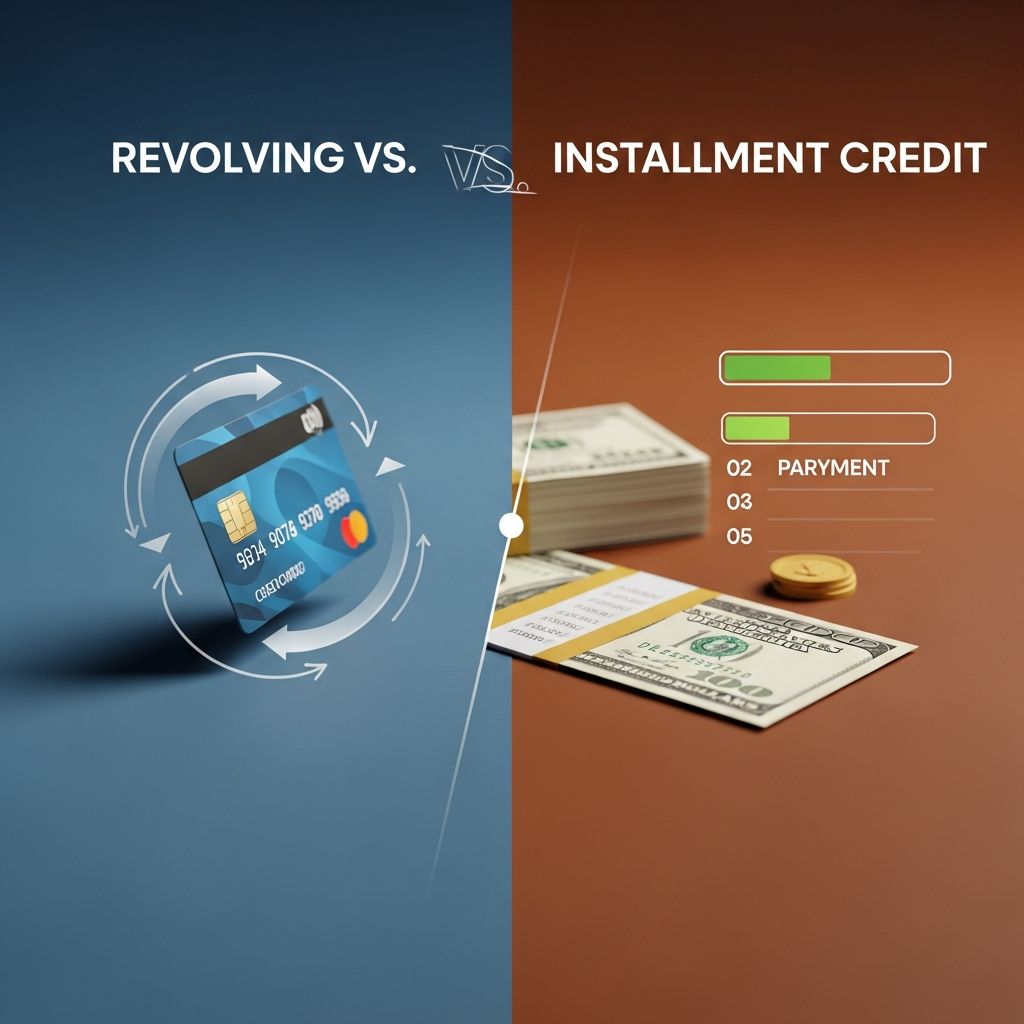
Revolving credit provides ongoing access to funds up to a limit, allowing repeated borrowing and repayment, whereas installment credit delivers a one-time lump sum repaid in fixed installments over a set period. This fundamental distinction affects everything from payment predictability to overall borrowing costs and credit-building potential.
Defining the Core Concepts
Understanding these credit types starts with their basic mechanics.
Revolving credit
operates like a flexible pool of money. Lenders approve you for a maximum amount, called a credit limit. You draw funds as needed, pay interest only on what you use, and replenish the available credit by making payments. Common examples include credit cards and home equity lines of credit (HELOCs).In contrast,
installment credit
functions as a structured loan. You receive the full approved amount upfront and repay it through equal monthly payments that cover principal and interest until the debt is cleared. Once paid off, the account closes, and no further borrowing is possible without a new application. Typical forms are auto loans, mortgages, and personal loans.Key Differences at a Glance
To visualize the contrasts, consider this comparison table highlighting primary features:
| Feature | Installment Credit | Revolving Credit |
|---|---|---|
| Borrowing Access | Lump sum upfront | Draw as needed up to limit |
| Repayment | Fixed monthly payments | Minimum payments; variable based on balance |
| Interest Calculation | On full amount over term | Only on outstanding balance |
| Reusability | One-time; closes after payoff | Replenishes with payments |
| Best Uses | Large, planned purchases | Ongoing or unexpected expenses |
Mechanics of Revolving Credit in Depth
With revolving accounts, flexibility defines the experience. After approval, your credit limit sets the ceiling—say, $10,000 on a credit card. Spend $2,000, and $8,000 remains available. Make a $500 payment, and that amount reopens for use. Interest accrues daily on the carried balance at a typically variable annual percentage rate (APR), often ranging from 10% to 99% depending on the product and your creditworthiness.
Payments require only the minimum, usually 1-3% of the balance plus interest, but paying more reduces costs. Credit utilization—the ratio of balance to limit—impacts your credit score significantly. Keeping it under 30% signals responsible use to scoring models like FICO.
Business lines of credit follow similar rules, aiding cash flow for variable expenses like inventory or payroll.
How Installment Credit Operates
Installment loans emphasize predictability. Borrow $20,000 for a car at 6% APR over 60 months, and your payment calculates to about $387 monthly, blending principal and interest. Early payments chip away at principal slowly due to amortization, where interest dominates initially.
APRs for these loans often fix, commonly 6-11% for qualified borrowers, making total costs calculable upfront. No reborrowing occurs post-payoff, but on-time payments bolster payment history, a major credit score factor comprising 35% of FICO scores.
Advantages and Drawbacks of Each Type
Strengths of Revolving Credit
- Adaptable for emergencies or recurring costs without reapplying.
- Interest avoidance possible by paying balances fully monthly.
- Builds credit through utilization management and history.
- Quick access, especially for cards versus HELOCs’ longer approvals.
Challenges of Revolving Credit
- Variable payments complicate budgeting.
- High APRs if balances linger.
- Temptation for overspending risks debt cycles.
- High utilization harms scores.
Benefits of Installment Credit
- Stable payments simplify financial planning.
- Lower rates for strong credit profiles.
- Ideal for depreciating assets like vehicles.
- Defined end date motivates completion.
Downsides of Installment Credit
- Interest on entire sum, even if needs change.
- Rigorous approval for best terms.
- No flexibility for additional funds mid-term.
- Longer terms inflate total interest.
Credit Score Implications
Both types influence scores via payment history (35%), amounts owed (30%), and credit mix (10%). Revolving credit’s utilization adds nuance—high ratios signal risk. A balanced mix of both demonstrates versatility to lenders.
Diversifying helps: too much revolving may suggest instability; installment-only might limit history breadth. Responsible use across types optimizes scores over time.
Practical Scenarios for Optimal Use
Choose
installment
for substantial, singular needs: home purchases lock in rates for decades; vehicles match depreciation timelines. Debt consolidation via personal loans streamlines multiple high-interest debts into one fixed payment.Opt for
revolving
in fluid situations: credit cards suit travel rewards or short-term gaps; HELOCs fund renovations with home equity security. Businesses leverage lines for seasonal fluctuations.Strategic Tips for Effective Management
To harness these tools wisely:
- Assess purpose—predictable vs. flexible.
- Compare rates; shop multiple lenders.
- Maintain utilization below 30% on revolving accounts.
- Automate payments to avoid lates.
- Pay revolving balances fully when possible.
- Monitor mixes for score diversity.
Track via free annual credit reports from agencies like Equifax and Experian.
Frequently Asked Questions
Which builds credit faster?
Both contribute via on-time payments, but revolving adds utilization management for quicker gains if handled well.
Can I have both types?
Yes, a mix shows lenders your ability to manage varied debts positively.
Does paying off installment early save money?
Often yes, reducing total interest, but check prepayment penalties.
How does interest differ exactly?
Installment: full principal basis. Revolving: used amount only, daily accrual.
Are rates fixed or variable?
Installment usually fixed; revolving mostly variable, tied to indexes like prime rate.
Navigating Fees and Costs
Beyond interest, watch fees. Installment loans may charge origination (1-8% of amount), late penalties, or prepay charges. Revolving accounts add annual fees ($0-550), cash advance surcharges (3-5%), or inactivity costs.
Small business contexts amplify this: lines might incur draw fees, while installment origination hits 1-6%.
Long-Term Financial Strategy
Incorporate these into broader plans. Use installment for milestones like education (student loans at subsidized rates) or property. Revolving supports liquidity without commitment. Over-reliance on either risks profiles—balance prevents overextension.
Recent data underscores discipline’s value: average credit card APR hovers near 20%, dwarfing installment auto loans at 7%. Projections for 2026 suggest rising rates, amplifying strategic choice importance.
References
- Installment vs. Revolving Credit: What’s the Difference? — Experian. 2023. https://www.experian.com/blogs/ask-experian/revolving-vs-installment-credit/
- Installment Loan vs Revolving Credit: Know the Difference — SoFi. 2024. https://www.sofi.com/learn/content/installment-loan-vs-revolving-credit/
- What is the Difference Between Installment Loans and Revolving Credit — Academy Bank. 2023. https://www.academybank.com/article/what-is-the-difference-between-installment-loans-and-revolving-credit
- Revolving Credit vs. Installment Credit — Equifax. 2024. https://www.equifax.com/personal/education/credit/score/articles/-/learn/revolving-credit-vs-installment-credit/
- Comparing Installment Loans vs. Revolving Credit Explained — AFBank. 2023. https://www.afbank.com/article/comparing-installment-loans-vs-revolving-credit-explained
Similar Articles








Read full bio of medha deb