Reverse Stock Split: Definition, Examples & Impact
Understanding reverse stock splits: How companies reduce shares and maintain market value.
Reverse Stock Split: Definition, Examples & Impact on Investors
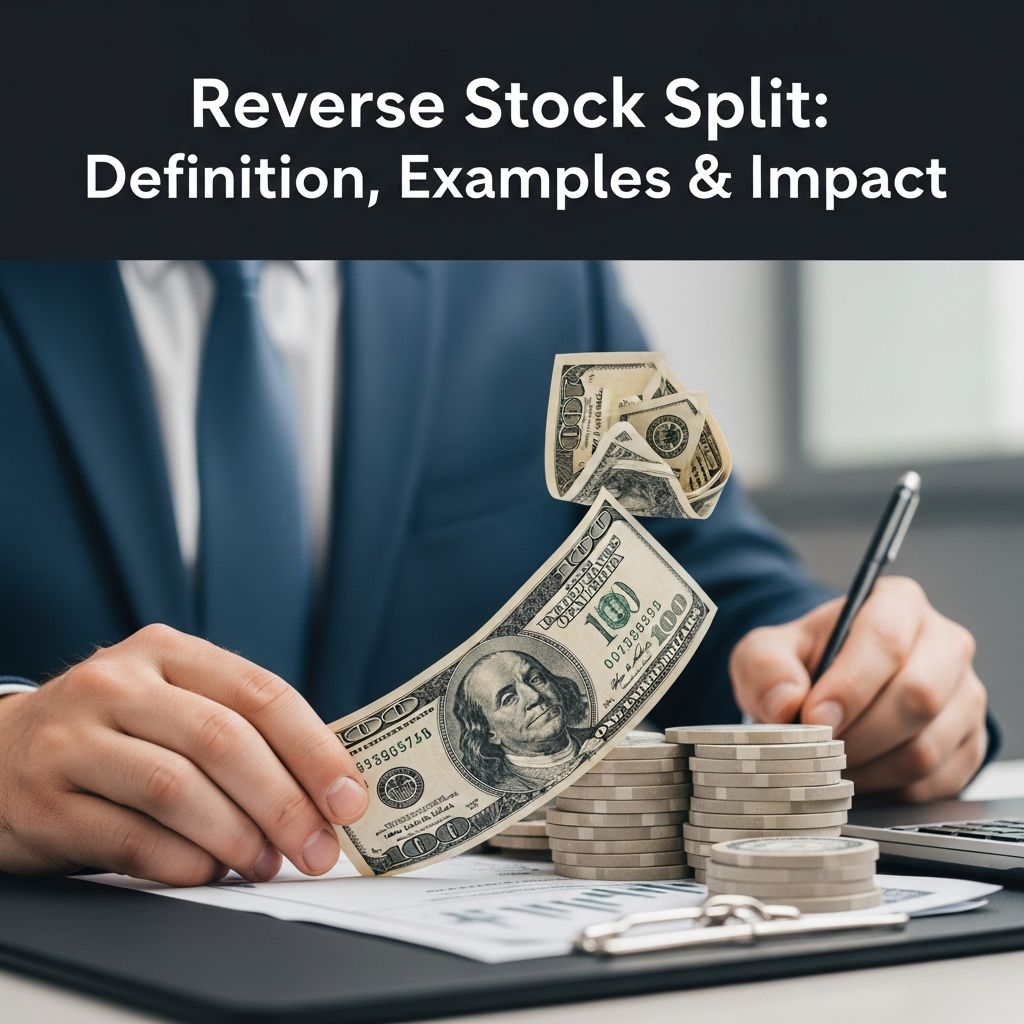
A reverse stock split is a corporate action in which a company reduces the number of its outstanding shares by combining multiple existing shares into a single new share. Unlike a traditional stock split that increases the number of shares, a reverse stock split decreases them while proportionally increasing the share price to maintain the company’s overall market value. This financial maneuver is typically executed based on a predetermined ratio, such as 2:1, 5:1, or 100:1, where investors receive fewer shares worth more per share.
For example, in a 2:1 reverse stock split, an investor holding 100 shares would receive 50 shares after the consolidation. Although the number of shares decreases dramatically, the fundamental value of an investor’s holding remains unchanged because the stock price adjusts proportionally upward.
How Reverse Stock Splits Work
The mechanics of a reverse stock split are straightforward but important to understand. When a company announces a reverse split, it establishes a ratio determining how many old shares combine into one new share. The company then recalculates its outstanding share count by dividing the original number of shares by the split ratio.
Here’s a practical example to illustrate the concept: Suppose Company XYZ has 10 million shares outstanding trading at $0.50 per share, giving it a market capitalization of $5 million. If the company executes a 10:1 reverse split, the new share count becomes 1 million shares. To maintain the $5 million market capitalization, each new share must be worth $5. An investor who owned 1,000 shares at $0.50 (worth $500 total) would now own 100 shares at $5 (still worth $500 total).
The critical principle underlying reverse splits is that market capitalization remains constant. Although the number of shares outstanding decreases significantly, the per-share price increases proportionally, preserving total shareholder value. From an accounting perspective, only a memorandum entry is typically required since no actual change occurs in shareholders’ equity or the company’s fundamental financial position.
Why Companies Execute Reverse Stock Splits
Companies pursue reverse stock splits for several strategic and regulatory reasons. Understanding these motivations helps investors recognize what a reverse split signals about a company’s situation.
Meeting Exchange Minimum Price Requirements
One of the most common reasons for a reverse split is to comply with stock exchange listing requirements. Major exchanges like the New York Stock Exchange (NYSE) impose minimum share price thresholds, typically $1.00 per share. If a company’s stock price closes below this minimum for 30 consecutive trading days, it faces delisting risk, which severely damages liquidity and investor access. A reverse stock split can quickly restore the share price above the minimum threshold, allowing the company to maintain its exchange listing and the credibility that comes with it.
Avoiding Penny Stock Stigma
Stocks trading below $5 per share are classified as penny stocks by the Securities and Exchange Commission (SEC). This classification carries significant stigma in the investment community. Many institutional investors, mutual funds, and financial advisors have internal policies prohibiting investments in penny stocks due to their association with higher risk and volatility. By executing a reverse split to bring the share price above $5, companies can shed the penny stock label and become eligible for investment by institutional portfolios, potentially broadening their investor base and improving stock demand.
Facilitating Corporate Restructuring and Spinoffs
When companies undergo significant corporate actions like spinoffs or reorganizations, reverse splits help maintain appropriate share price ranges. For instance, Hilton Hotels executed a 3:1 reverse split on the same day it spun off two business units (Park Hotels & Resorts and Hilton Grand Vacations) to shareholders. The reverse split ensured that Hilton’s stock price remained in a similar trading range after the spinoff, maintaining the stock’s appeal to existing investors and preventing artificial price distortions from the corporate restructuring.
Reducing Shareholder Count
In more aggressive reverse splits, such as a 100:1 ratio, shareholders holding fewer shares than the split ratio receive cash payments instead of fractional shares. This mechanism can significantly reduce the total number of shareholders, which may allow companies to move into different regulatory categories with less stringent reporting requirements. For example, in the United States, the number of shareholders partially determines whether the SEC regulates a company, affecting compliance costs and administrative burdens.
Improving Company Image and Perception
Beyond regulatory and technical reasons, reverse splits help companies project a more stable and established image. The perception of being a penny stock or having a sub-dollar share price can negatively affect brand perception, customer confidence, and business relationships. A higher share price achieved through a reverse split can enhance the company’s market perception, even though the fundamental business value hasn’t changed.
Reverse Stock Splits and Shareholder Value
A fundamental principle that cannot be overstated is that reverse stock splits do not create or destroy shareholder value. The total market capitalization of the company remains unchanged, and each investor’s proportional ownership stake in the company remains identical. If you owned 1% of the company before the reverse split, you own exactly 1% after the split.
However, reverse splits carry psychological and practical implications. They are often perceived negatively by the market because they typically indicate that a company’s share price has declined significantly. The need to execute a reverse split often signals financial difficulties or lack of investor confidence in the company’s growth prospects. Consequently, announcements of reverse splits frequently trigger market skepticism, even though the split itself has no mathematical impact on shareholder wealth.
Reverse Split Example With Detailed Calculations
Consider this comprehensive example demonstrating how a reverse split affects an investor’s position:
Before the Reverse Split:
- Company ABC has 100,000 shares outstanding
- Stock price: $10 per share
- Market capitalization: $1,000,000
- Investor Cathy holds: 100 shares worth $1,000
After a 100:1 Reverse Split:
- Shares outstanding: 1,000 (100,000 ÷ 100)
- New stock price: $1,000 per share ($1,000,000 ÷ 1,000)
- Market capitalization: $1,000,000 (unchanged)
- Cathy’s holdings: 1 share worth $1,000 (100 shares ÷ 100)
In this example, Cathy’s total investment value remains exactly $1,000 before and after the split. Her ownership percentage of ABC Company remains unchanged. The only difference is that instead of owning 100 shares at $10 each, she now owns 1 share at $1,000.
Market Mechanics and Ticker Symbol Changes
When a reverse stock split takes effect, the stock exchange typically adds a “D” to the end of the company’s ticker symbol during the transition period. This temporary designation alerts investors that a reverse split has occurred. In some cases, particularly when companies undergo significant restructuring, they may also change their corporate name concurrently with the reverse split, necessitating a new ticker symbol entirely.
The transition period typically lasts one or two trading days. After the split is finalized, the “D” designation is removed, and the stock trades under its regular ticker symbol at the new, higher price point.
Reverse Splits and Stock Exchange Listings
| Exchange | Minimum Price Requirement | Consequence of Non-Compliance |
|---|---|---|
| New York Stock Exchange (NYSE) | $1.00 per share | Delisting after 30 consecutive trading days below minimum |
| NASDAQ | $1.00 per share | Delisting after specified period of non-compliance |
| OTC Markets | No formal minimum | Penny stock classification and reduced liquidity |
Over-the-Counter vs. Exchange-Listed Reverse Splits
Reverse splits are far more common among companies trading over-the-counter (OTC) than among established companies on major exchanges like the NYSE or NASDAQ. OTC stocks typically trade at lower prices and face greater challenges attracting institutional investment. However, reverse splits among major exchange-listed companies are rare and often signal serious financial distress or major restructuring.
When a company on a major exchange announces a reverse split, it typically warrants careful investigation by investors. The split may indicate the company is struggling to maintain its stock price and meet listing requirements, which could have implications for the stock’s future performance and volatility.
Reverse Splits as a Risk Signal
Financial advisors and experienced investors view reverse split announcements with caution. While the mathematical mechanics of a reverse split are neutral to shareholder value, the announcement often correlates with increased risk. Reverse splits frequently occur with companies experiencing significant business challenges, particularly smaller companies in development or turnaround situations.
A major red flag is when a reverse split results in a share price many times higher than the pre-split price. For example, if a stock trading at $0.10 undergoes a 100:1 reverse split to reach $10, the massive price adjustment suggests the company’s valuation had deteriorated severely. This scenario indicates substantial prior losses in shareholder value before the split occurred.
Regulatory Considerations and Shareholder Approval
The process for executing a reverse split varies by jurisdiction and company structure. Generally, state corporate law and the company’s articles of incorporation and bylaws govern whether shareholder approval is required. For companies required to file with the SEC, reverse split notifications typically appear in Forms 8-K (current report), 10-Q (quarterly report), or 10-K (annual report), which investors can access through the SEC’s EDGAR database.
Most companies must obtain shareholder approval through a vote before implementing a reverse split, though the specific requirements depend on state incorporation laws and the company’s governance documents.
Real-World Example: ProShares Ultrashort Silver
ProShares Ultrashort Silver (ZSL), an inverse leveraged exchange-traded fund, provides an instructive real-world example of multiple reverse splits. On April 15, 2010, ZSL underwent a 1:10 reverse split, consolidating every 10 shares into one share and multiplying the share price by 10 to $36.45. Later, on February 25, 2011, ZSL completed a 1:4 reverse split, further consolidating the shares. Combined, these two reverse splits meant that one share of ZSL on February 26, 2011 represented 40 original shares from before April 15, 2010.
These repeated reverse splits were necessary because the fund’s value declined more than 90% during this period. Without the reverse splits, the share price would have fallen below a dollar, potentially causing the fund to become unmarketable. The reverse splits maintained a tradeable share price despite the fund’s severe value deterioration.
Frequently Asked Questions
Q: Does a reverse stock split affect the company’s market capitalization?
A: No. A reverse stock split does not change the company’s market capitalization. While the number of outstanding shares decreases, the per-share price increases proportionally, keeping the total market value constant.
Q: Will my investment value change due to a reverse split?
A: No. If you own $1,000 worth of stock before a reverse split, you will own exactly $1,000 worth after the split. Your ownership percentage in the company also remains unchanged.
Q: Why is a reverse split considered a negative signal?
A: Reverse splits typically indicate that a company’s share price has declined significantly, which may signal business difficulties or lack of investor confidence. However, the split itself has no mathematical impact on shareholder value.
Q: Can I lose money in a reverse split?
A: A reverse split itself does not cause losses. However, the underlying business challenges that necessitated the reverse split may have already resulted in shareholder losses before the split was announced.
Q: Do I have to do anything when a reverse split occurs?
A: No. The reverse split occurs automatically on the effective date. Your brokerage account will automatically adjust your share count and price, and your total investment value will remain the same.
Q: What happens if I own fewer shares than the split ratio?
A: In aggressive reverse splits, shareholders holding fewer shares than the split ratio typically receive cash payments equal to the value of their fractional share instead of receiving a partial new share.
Q: How does a reverse split differ from a regular stock split?
A: A stock split divides shares into more pieces (e.g., 1 share becomes 4 shares) and proportionally reduces the price, while a reverse split consolidates shares into fewer pieces (e.g., 4 shares become 1 share) and proportionally increases the price.
References
- Stock Splits — Financial Industry Regulatory Authority (FINRA). Accessed 2025. https://www.finra.org/investors/investing/investment-products/stocks/stock-splits
- Reverse Stock Split — Wikipedia. Accessed 2025. https://en.wikipedia.org/wiki/Reverse_stock_split
- Reverse Stock Split – Definition, Examples, and Reasons — Corporate Finance Institute. Accessed 2025. https://corporatefinanceinstitute.com/resources/career-map/sell-side/capital-markets/reverse-stock-split/
Similar Articles








Read full bio of Sneha Tete