Revenue vs. Profit: Understanding Key Financial Differences
Learn the critical differences between revenue and profit in business accounting.
Revenue vs. Profit: What’s the Difference?
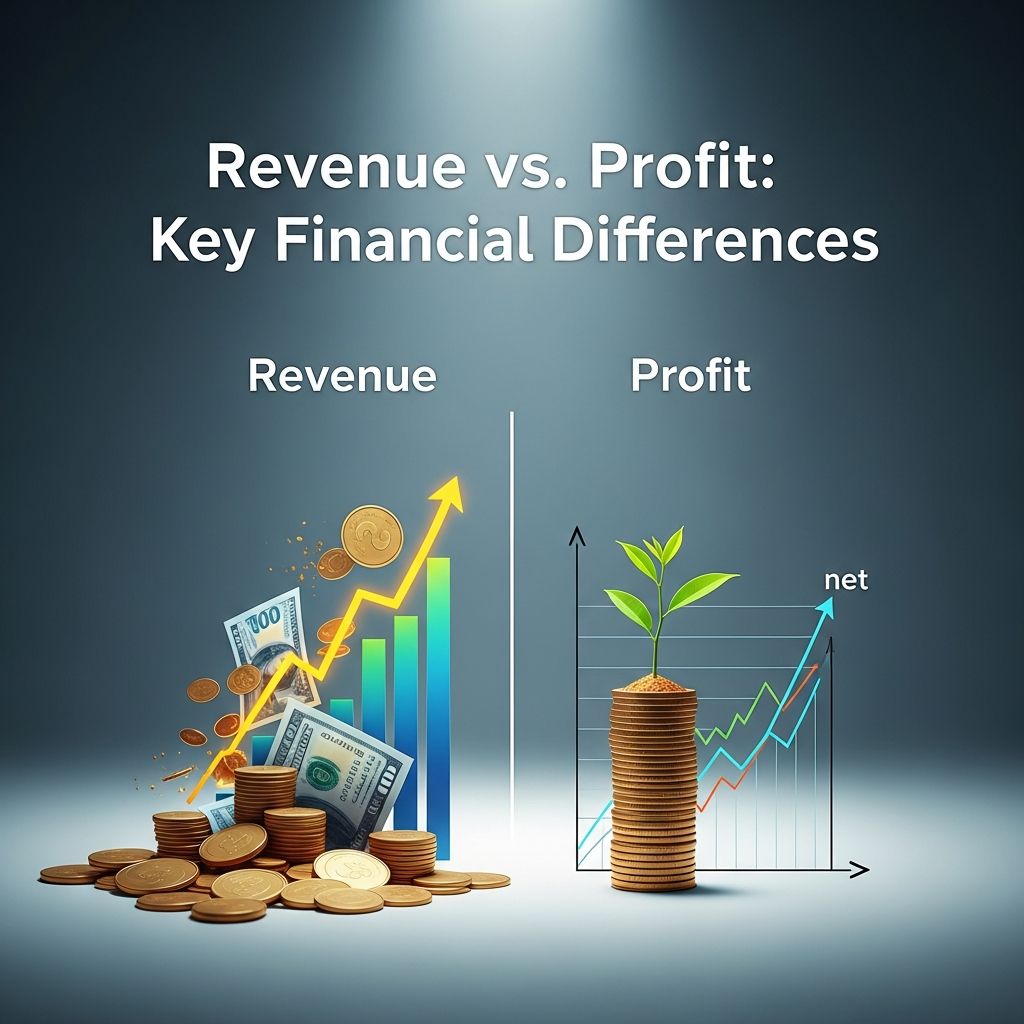
Revenue and profit are two fundamental financial metrics that businesses use to measure their financial performance, yet they represent distinctly different aspects of a company’s financial health. While these terms are often used interchangeably by those unfamiliar with accounting, they have specific meanings that are critical for investors, business owners, and financial analysts to understand. Revenue represents the total income generated by a business from the sale of goods or services, while profit reflects what remains after all expenses, costs, and taxes have been deducted from that revenue. Understanding the distinction between these two metrics is essential for evaluating business performance and making informed financial decisions.
What Is Revenue?
Revenue, often referred to as sales or turnover, is the total amount of income generated by a company from its core business operations before any expenses are deducted. It represents the monetary value of goods sold or services provided during a specific period, typically a fiscal quarter or year. Revenue is the top line on an income statement and serves as the starting point for calculating profitability.
Revenue is calculated by multiplying the number of units sold by the average price per unit. For service-based businesses, revenue is determined by multiplying the number of billable hours by the hourly rate, or by the total value of service contracts completed. This metric provides insight into the company’s ability to generate income from its primary business activities.
Key characteristics of revenue include:
- It is the gross amount earned before any costs or expenses are subtracted
- It appears as the first line item on an income statement
- It reflects the company’s sales volume and pricing strategy
- It does not account for operational efficiency or cost management
- It provides a measure of market demand for the company’s products or services
What Is Profit?
Profit represents the financial gain a company realizes when the revenue generated from business operations exceeds the expenses, costs, and taxes required to sustain the business. Unlike revenue, profit accounts for all the costs associated with running the business, making it a more comprehensive measure of financial success. Profit is often referred to as the “bottom line” because it appears at the bottom of an income statement.
There are several types of profit that businesses calculate depending on which expenses are included in the calculation. These different profit measures provide varying levels of insight into business performance and operational efficiency.
The types of profit include:
- Gross Profit: Revenue minus the cost of goods sold (COGS). It measures profitability from production and sales without accounting for operating expenses.
- Operating Profit: Gross profit minus operating expenses such as salaries, rent, and utilities. It reflects profitability from core business operations.
- Net Profit: The total profit after all expenses, including taxes, interest, and depreciation, have been deducted from revenue.
Key Differences Between Revenue and Profit
While revenue and profit are related, they represent distinct financial metrics with important differences:
| Aspect | Revenue | Profit |
|---|---|---|
| Definition | Total income from sales before expenses | Income remaining after all expenses are deducted |
| Calculation | Units sold × Price per unit | Revenue – All Expenses – Taxes |
| Position on Income Statement | First line item (top line) | Last line item (bottom line) |
| Expenses Considered | None | All operating, administrative, and financial expenses |
| Business Insight | Market demand and sales volume | Operational efficiency and profitability |
| Tax Impact | Not affected by taxes | Affected by corporate income taxes |
How to Calculate Revenue and Profit
Calculating Revenue: Revenue is straightforward to calculate. Simply multiply the number of units sold by the price per unit. For example, if a company sells 1,000 units of a product at $50 per unit, the revenue is $50,000. For service-based businesses, multiply the number of billable hours or projects by the rate charged.
Calculating Profit: Profit calculation is more complex as it requires accounting for various expenses. The basic formula for net profit is:
Net Profit = Revenue – Cost of Goods Sold – Operating Expenses – Taxes – Interest – Other Expenses
For example, if a company has revenue of $500,000, cost of goods sold of $200,000, operating expenses of $150,000, and taxes of $50,000, the net profit would be $100,000. This calculation demonstrates how profit accounts for the actual cost of doing business.
Why Both Metrics Matter
Revenue Importance: Revenue is important because it indicates whether a company is successfully generating sales and gaining market traction. High revenue suggests strong demand for the company’s products or services. However, high revenue alone does not guarantee profitability, as a company can have substantial sales but still operate at a loss if expenses are too high.
Profit Importance: Profit is crucial because it represents the actual financial health of the business. A company can be profitable with lower revenue if it manages costs effectively, while another company with high revenue may be unprofitable due to excessive expenses. Profit determines a company’s ability to reinvest in growth, pay dividends to shareholders, service debt, and sustain operations.
Revenue and Profit in Financial Analysis
Investors and analysts use both revenue and profit to evaluate business performance through various metrics and ratios. Revenue growth rates indicate market expansion and sales momentum, while profit margins reveal operational efficiency and pricing power. Comparing revenue to profit over multiple periods helps identify trends and potential issues within the business.
Analysts often examine the relationship between revenue growth and profit growth. When profit grows faster than revenue, it indicates improving operational efficiency. Conversely, when revenue grows but profit declines or remains flat, it may signal rising costs that the company must address.
Real-World Example
Consider a retail company with annual revenue of $2 million. The cost of goods sold (inventory) is $800,000, and operating expenses (salaries, rent, utilities) total $600,000. After paying $200,000 in taxes, the company’s net profit is $400,000. While the revenue figure of $2 million indicates strong sales, the net profit of $400,000 represents the actual financial gain the company achieved. This example illustrates why both metrics are essential for understanding true business performance.
Frequently Asked Questions (FAQs)
Q: Can a company have high revenue but low profit?
A: Yes, absolutely. A company can generate substantial revenue while maintaining minimal profit if operating expenses are high relative to sales. This often occurs in competitive industries with thin profit margins or when a company is in a growth phase with significant investment in marketing, research, or infrastructure.
Q: What does it mean if a company has negative profit?
A: Negative profit, also called a loss, means the company’s total expenses exceed its revenue. This can happen temporarily as companies invest in growth or face challenging market conditions. However, sustained losses are concerning and may indicate fundamental business problems or unsustainable cost structures.
Q: How do revenue and profit relate to cash flow?
A: While related, revenue and profit are not the same as cash flow. A company can be profitable on paper but face cash flow problems if customers pay slowly or if significant capital expenditures deplete cash reserves. Cash flow reflects the actual movement of money in and out of the business.
Q: Which metric should investors focus on more?
A: Smart investors examine both metrics. Revenue indicates growth potential and market demand, while profit reveals the company’s ability to convert sales into actual earnings. A balanced analysis of both metrics provides a comprehensive view of business performance and financial health.
Q: How do profit margins relate to revenue and profit?
A: Profit margins are ratios that show what percentage of revenue becomes profit. For example, a net profit margin is calculated as (Net Profit / Revenue) × 100. This metric helps compare profitability across companies of different sizes and industries, revealing how efficiently a company converts sales into earnings.
Q: Why do companies focus on revenue growth if profit is what matters?
A: While profit is ultimately what matters for business sustainability, revenue growth often drives company valuation and investor confidence. Growing revenue typically leads to increased profits through economies of scale and operational leverage, making it an important leading indicator of future profitability.
References
- Financial Accounting Standards Board (FASB) — Accounting Standards Codification. 2024. https://www.fasb.org/
- U.S. Securities and Exchange Commission (SEC) — Division of Corporate Finance, Financial Reporting Manual. 2024. https://www.sec.gov/cgi-bin/browse-edgar
- International Financial Reporting Standards (IFRS) — IFRS Standards. 2024. https://www.ifrs.org/
- American Institute of Certified Public Accountants (AICPA) — Accounting and Financial Reporting Guidance. 2024. https://www.aicpa.org/
- Corporate Finance Institute — Business and Financial Education. 2024. https://corporatefinanceinstitute.com/
Similar Articles








Read full bio of medha deb