Revenue vs. Income: Understanding the Key Differences
Learn the critical distinction between revenue and income in financial reporting.
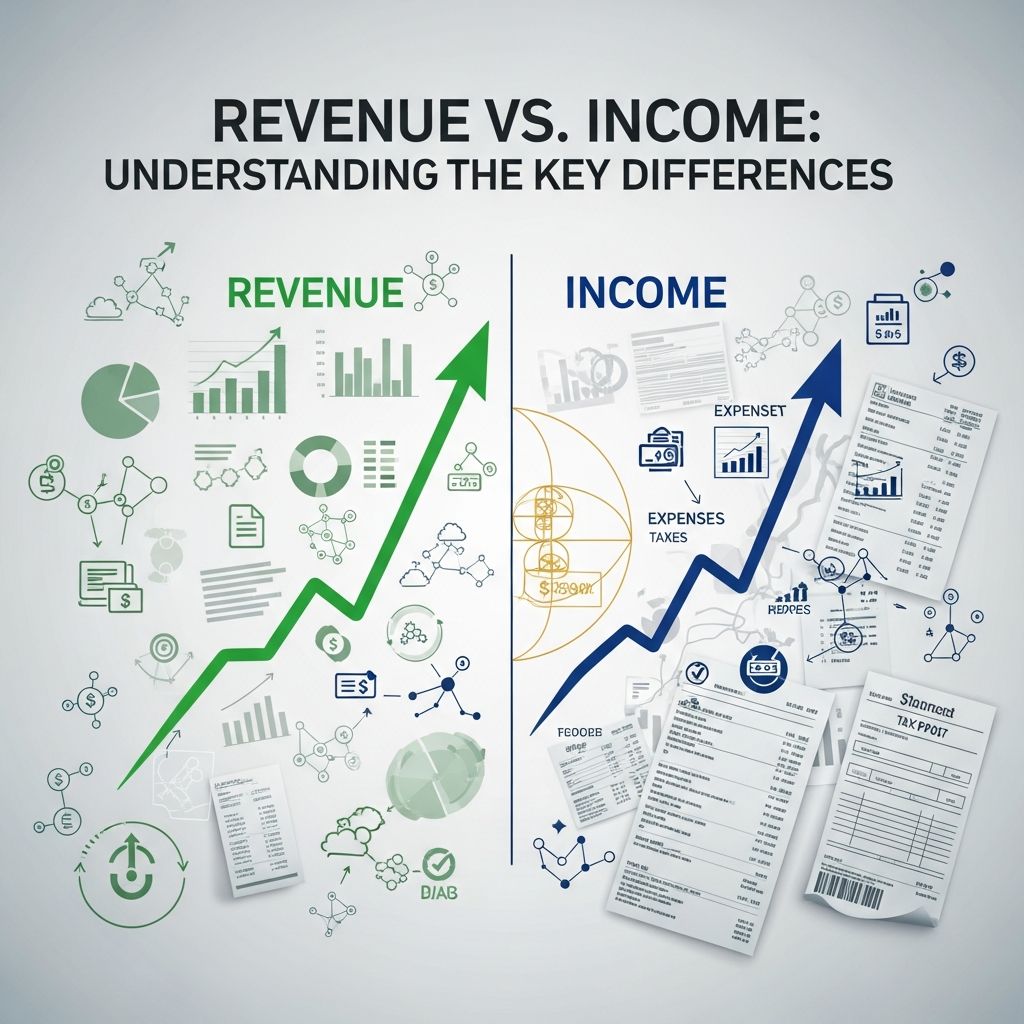
When analyzing a company’s financial health, two terms frequently appear in discussions and financial documents: revenue and income. While these words are sometimes used interchangeably in casual conversation, they represent distinctly different concepts in accounting and finance. Understanding the difference between revenue and income is essential for investors, business owners, and anyone interested in interpreting financial statements accurately.
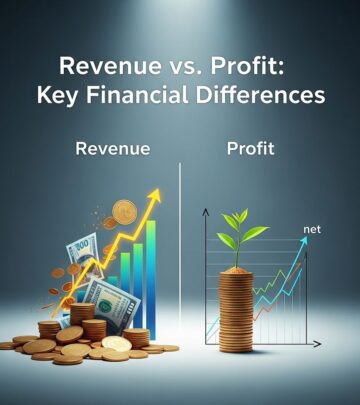
Revenue represents the total amount of money a company generates from selling its goods or services, while income refers to the profit that remains after all expenses have been deducted from that revenue. This fundamental distinction shapes how analysts evaluate company performance and profitability. A company might generate substantial revenue but still operate at a loss if expenses exceed income. Conversely, a company with lower revenue might achieve significant profits through efficient cost management.
What is Revenue?
Revenue, commonly referred to as the “top line” in financial analysis, represents the total income generated by a company’s primary business operations before any expenses are subtracted. It appears at the top of an income statement, which is why financial professionals use the term “top line” when discussing revenue figures.
Revenue includes only money earned from the sale of products or services that constitute the company’s core business activities. For example, if a shoe retailer generates $50 million from selling shoes, that entire amount represents revenue. Additional income streams, such as investment returns or profits from subsidiary companies, are recorded separately and do not count as revenue, since they don’t derive from the primary business operation of selling shoes.
The revenue figure provides investors with a clear picture of the company’s ability to generate sales and market demand for its offerings. A growing revenue trend typically indicates expanding business operations and increasing customer demand, though high revenue alone doesn’t guarantee profitability or financial health.
What is Income?
Income, also known as net income or “the bottom line,” represents the profit that remains after a company accounts for all expenses, debts, taxes, and operating costs. This figure appears at the bottom of the income statement, which is why it’s called the bottom line. Income reflects the true profitability of a business by showing what the company actually keeps after paying for everything necessary to operate.
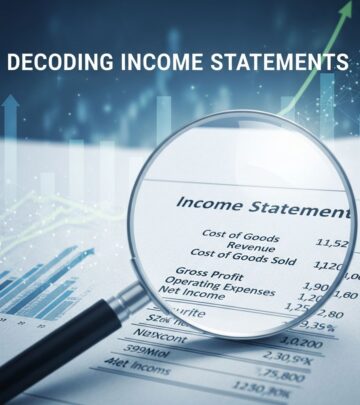
However, income on a financial statement isn’t simply a single number. There are intermediate profit measures that appear between the top line (revenue) and the bottom line (net income). These intermediate measures provide valuable insight into company performance at different stages of expense deduction.
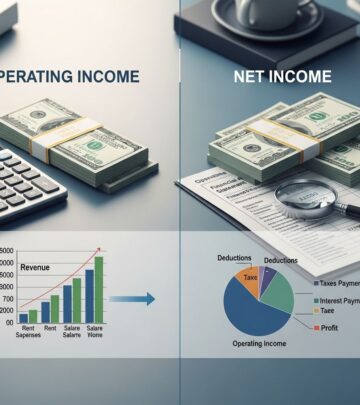
Gross profit represents revenue minus the cost of goods sold (COGS). The cost of goods sold includes all direct costs attributable to producing the goods sold, encompassing raw materials and direct labor expenses. Operating profit, another intermediate measure, represents gross profit minus all other fixed and variable operating expenses, such as rent, utilities, administrative salaries, and marketing costs. Finally, net income is calculated after all expenses, including interest on debt, taxes, and any other miscellaneous costs.
The Relationship Between Revenue and Income
Understanding how revenue transforms into income illustrates the relationship between these two critical financial metrics. The journey from revenue to net income follows a logical progression through various deductions:
Revenue (Top Line) → Minus Cost of Goods Sold → Gross Profit → Minus Operating Expenses → Operating Profit → Minus Interest and Taxes → Net Income (Bottom Line)
Each step in this progression removes different categories of expenses, gradually revealing the company’s true profitability. While revenue shows the company’s sales success, income reveals whether those sales translated into actual profit that shareholders benefit from and that the company can reinvest or distribute.
Key Differences Between Revenue and Income
Several fundamental distinctions separate revenue from income in financial analysis:
Calculation Method: Revenue represents total sales before any deductions. Income requires subtracting all expenses from revenue, making it a more comprehensive profitability measure.
Purpose in Analysis: Revenue indicates market demand and sales performance, while income shows operational efficiency and true profitability. Investors examine revenue for growth trends, but they focus on income to assess whether the company is actually making money.
Appearance on Statements: Revenue appears at the top of income statements, while net income appears at the bottom. This positioning reflects their importance in the sequence of calculations.
Possibility of Loss: A company can generate substantial revenue while reporting a net loss if expenses exceed revenue. This scenario occurs when debts or operating costs are disproportionately high relative to sales.
Real-World Example: J.C. Penney 2017
A practical example demonstrates how revenue and income can diverge significantly. During fiscal year 2017, J.C. Penney reported the following figures:
- Revenue (Total Net Sales): $12.50 billion
- Gross Profit: $4.33 billion (calculated as $12.50B revenue minus $8.17B in cost of goods sold)
- Operating Profit: $116 million (gross profit minus fixed and variable operating expenses)
- Net Income: -$116 million (a loss)
This example powerfully illustrates how a company can generate $12.5 billion in revenue yet report a net loss. J.C. Penney’s high cost of goods sold ($8.17 billion), combined with substantial operating expenses, consumed virtually all gross profit. The company’s revenue demonstrated strong sales activity, but expenses and operating inefficiencies prevented profitability. This scenario is not uncommon in retail, where companies maintain thin profit margins and substantial fixed costs.
Understanding Revenue Recognition
Revenue recognition presents an important accounting concept that affects how and when revenue appears on financial statements. Companies must follow specific accounting principles to determine when to record revenue, even if they haven’t received payment.
Consider a company that sells widgets for $5 each on net-30 payment terms. If the company sells 10 widgets in August but customers don’t pay until 30 days later, the company still recognizes $50 in revenue on its August income statement. This is called accrued revenue. From an accounting perspective, the company records $50 in revenue on the income statement and $50 in accrued revenue as an asset on the balance sheet. When payment is eventually received in September, the cash account increases, the accrued revenue account decreases, but the revenue figure for August remains unchanged.
This revenue recognition principle ensures that financial statements accurately reflect business activity in the period when it occurred, regardless of when cash is exchanged. However, companies must be careful to distinguish accrued revenue from unearned revenue, which represents money customers prepay for goods or services not yet delivered. Unearned revenue is not recognized on the income statement until the company actually delivers the products or services.
Why Both Metrics Matter to Investors
Sophisticated investors examine both revenue and income because they provide complementary information about company performance. Revenue growth without corresponding income growth might indicate rising expenses or operational inefficiency. Conversely, companies with modest revenue but strong income demonstrate excellent cost control and operational efficiency.
Revenue trends help investors assess whether a company is successfully growing its market presence and customer base. Income trends reveal whether management is effectively controlling expenses and converting sales into actual profit. Together, these metrics provide a comprehensive picture of financial health and operational performance.
The Importance of Profit Margins
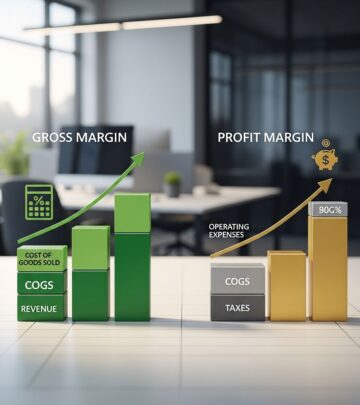
The relationship between revenue and income becomes clearer when examining profit margins. Gross profit margin (gross profit divided by revenue) shows what percentage of sales remains after accounting for the direct costs of production. Operating profit margin (operating profit divided by revenue) reveals the percentage of sales remaining after all operating expenses. Net profit margin (net income divided by revenue) demonstrates the percentage of each sales dollar that becomes actual profit.
These margin percentages allow investors to compare companies of different sizes and across different industries. A company with $1 billion in revenue and $100 million in net income has the same 10% net profit margin as a company with $100 million in revenue and $10 million in net income, even though the first company generates far more absolute dollars in profit.
Common Misconceptions
Many people assume that high revenue automatically means high profitability. However, this assumption frequently proves incorrect, particularly in capital-intensive industries like retail, manufacturing, or transportation. Companies in these sectors often operate with naturally thin profit margins, requiring careful expense management to achieve profitability despite strong revenue figures.
Another misconception involves treating revenue and cash flow as synonymous. However, revenue recognized on an income statement doesn’t always represent cash received. Accrued revenue and timing differences between revenue recognition and cash receipt create important distinctions for cash flow analysis.
Frequently Asked Questions
Q: Can a company have positive revenue but negative income?
A: Yes, absolutely. A company generates positive revenue whenever it sells products or services, but if expenses exceed revenue, the company reports negative income, or a net loss. This scenario is common in growing companies investing heavily in expansion or established companies facing operational challenges.
Q: What’s the difference between income and profit?
A: While the terms are often used interchangeably, income typically refers to net income on financial statements. Profit is a broader term that can refer to gross profit, operating profit, or net income, depending on context. Net income and net profit are the same thing.
Q: Why is revenue called the “top line”?
A: Revenue appears at the top of income statements, literally at the top line. Net income appears at the bottom, making it the “bottom line.” These positional references help investors quickly locate these key metrics on financial documents.
Q: How do companies use revenue and income figures?
A: Companies track revenue to assess sales performance and market demand. They monitor income to evaluate profitability, guide strategic decisions, and determine what profits are available for reinvestment, debt repayment, or shareholder distribution.
Q: Should I invest in a company with high revenue but low income?
A: That depends on the company’s industry, growth stage, and trajectory. Some industries naturally operate with thin margins. Additionally, growing companies might intentionally maintain low income while investing revenue in expansion. Analyze the company’s strategy and industry norms before making investment decisions.
References
- Revenue vs. Profit: What’s the Difference? — Investopedia ReadTheDocs. 2024. https://investopedia.readthedocs.io/en/latest/invest/Ch5/Chapter505.html
- Generally Accepted Accounting Principles (GAAP) — Financial Accounting Standards Board (FASB). 2024. https://www.fasb.org/
- Understanding Financial Statements — U.S. Securities and Exchange Commission (SEC). 2024. https://www.sec.gov/investor/pubs/beginstockinvest.htm
Similar Articles








Read full bio of Sneha Tete