Revenue: Definition, Types, and How It Works
Understanding revenue: The complete guide to business income and financial performance metrics.

Revenue represents the total amount of income generated by the sale of goods or services related to the company’s primary operations. It is one of the most critical metrics on a company’s financial statements and serves as a foundational measure of business performance. Understanding revenue is essential for investors, business owners, and financial analysts who need to evaluate a company’s financial health and growth potential.
Revenue is often referred to as the “top line” of a company’s income statement because it appears at the beginning of the statement. It reflects the total money that flows into a business before any expenses are deducted. This distinction is crucial because revenue differs significantly from profit, which represents the money remaining after all expenses have been paid.
Understanding Revenue Fundamentals
At its core, revenue is the money a company receives from selling its products or services. However, the concept extends beyond simple cash transactions. Revenue recognition follows specific accounting principles that determine when and how revenue should be recorded in financial statements.
The fundamental characteristics of revenue include:
- Primary operations focus: Revenue typically comes from the main business activities, not from secondary sources like interest income or asset sales
- Exchange of value: Revenue results from providing goods or services in exchange for monetary compensation
- Recognition timing: Revenue is recognized when the company has earned it, not necessarily when cash is received
- Measurability: The amount of revenue must be reliably measurable and determinable
Many businesses generate income from various sources. The distinction between operating revenue and non-operating revenue helps analysts understand the sustainability of a company’s earnings. Operating revenue derives from the company’s core business activities, while non-operating revenue comes from ancillary sources such as interest income, royalties, or gains from asset sales.
Revenue vs. Profit: Key Differences
One of the most common misconceptions in business is that revenue and profit are the same thing. While both are important metrics, they represent distinctly different aspects of financial performance.
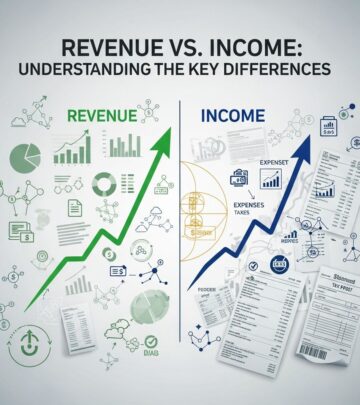
Revenue is the gross income from all sales before any expenses are deducted. It shows the total amount of money flowing into the business.
Profit, conversely, is what remains after subtracting all expenses, costs, and liabilities from revenue. Profit demonstrates whether a business is actually making money after accounting for all operational costs.
Consider this simplified example: A retail company generates $1 million in revenue from product sales. However, if the company’s cost of goods sold, operating expenses, and other costs total $800,000, the profit would only be $200,000. This distinction is vital because a company can have substantial revenue but still be unprofitable if expenses exceed income.
Three primary profit metrics help clarify this relationship:
- Gross Profit: Revenue minus the cost of goods sold (COGS), showing the profit from production before operating expenses
- Operating Profit: Gross profit minus operating expenses, showing profit from core business operations
- Net Profit: Operating profit minus taxes and interest, representing the final bottom-line profit
Types of Revenue
Companies generate revenue through different models and streams, each with unique characteristics and recognition methods. Understanding these distinctions helps stakeholders better assess a company’s financial stability and growth prospects.
Operating Revenue
Operating revenue comes directly from a company’s primary business activities. For a retail company, this includes sales from merchandise. For a technology company, it might include software licenses or subscription fees. Operating revenue is typically the most significant component of total revenue and best reflects a company’s core business performance.
Non-Operating Revenue
Non-operating revenue derives from secondary business activities and investments. Examples include:
- Interest income from bank accounts or bonds
- Dividend income from investments
- Gains from asset sales
- Royalty payments
- Rental income
While non-operating revenue can be meaningful, it typically represents a smaller portion of total revenue and is less predictable than operating revenue.
Service Revenue vs. Product Revenue
Service-based businesses generate revenue from providing expertise, labor, or professional services. Accounting firms, consulting companies, and law firms earn revenue through billable hours or project fees. Product-based businesses generate revenue from manufacturing and selling tangible goods.
The timing of revenue recognition differs between these models. Service revenue is often recognized as services are performed, while product revenue is typically recognized when the customer takes possession of the goods.
Revenue Recognition: When and How Revenue is Recorded
Revenue recognition is governed by accounting standards that determine when a company should record revenue in its financial statements. This is separate from when actual payment is received.
Under the Generally Accepted Accounting Principles (GAAP) in the United States and the International Financial Reporting Standards (IFRS) used globally, revenue is recognized when performance obligations to customers are satisfied. This typically occurs when:
- A customer obtains control of promised goods or services
- The transaction price can be reliably measured
- Collection of payment is reasonably assured
- Performance obligations have been fulfilled
The timing of revenue recognition can significantly impact a company’s reported financial performance in any given period. Companies must carefully track and document when performance obligations are satisfied to ensure accurate financial reporting.
How Revenue is Calculated and Measured
Revenue calculation depends on the business model but follows a basic formula:
Revenue = Quantity of Units Sold × Price per Unit
However, actual revenue calculations often include adjustments for:
- Sales returns and allowances: Products returned by customers or price reductions granted
- Sales discounts: Reductions offered for bulk purchases or early payment
- Revenue deductions: Refunds, warranty costs, or other deductions
The adjusted revenue figure is sometimes called “net revenue” and provides a more accurate picture of actual income received.
Companies using accrual accounting recognize revenue when it is earned, not when payment is received. This can create timing differences where revenue is recorded in one period but payment arrives in another period. These amounts appear as accounts receivable on the balance sheet until collection occurs.
Why Revenue Matters for Business Analysis
Revenue serves multiple critical functions in financial analysis and business evaluation:
Growth Indicator: Year-over-year revenue growth indicates whether a company is expanding its market presence and customer base. Consistent revenue growth typically signals business health and market demand for products or services.
Profitability Assessment: Revenue provides the baseline for calculating profit margins and other profitability ratios. A company’s ability to convert revenue into profit reveals operational efficiency.
Valuation Metric: Investors use revenue multiples to value companies, particularly for startups or companies with inconsistent profitability. Price-to-sales ratios help compare companies within the same industry.
Forecasting Tool: Historical revenue data helps analysts and management forecast future performance and plan resource allocation.
Performance Comparison: Revenue allows investors to compare companies of different sizes and profitability levels on a standardized basis.
Revenue Streams and Diversification
Many successful companies generate revenue from multiple streams, reducing dependence on any single income source. Diversified revenue streams provide stability and reduce business risk.
Examples of multiple revenue streams include:
- A software company earning revenue from both software licenses and consulting services
- An airline generating income from passenger tickets, cargo transportation, and loyalty programs
- A media company receiving revenue from subscriptions, advertising, and content licensing
Analyzing revenue by stream helps stakeholders understand which business segments are most profitable and which may require strategic attention.
Common Revenue Metrics and Ratios
Financial analysts employ several revenue-based metrics to evaluate business performance:
Revenue Growth Rate: Measures the percentage increase in revenue over a specific period, calculated as (Current Period Revenue – Prior Period Revenue) / Prior Period Revenue × 100.
Revenue per Customer: Indicates average spending per customer, helpful for understanding customer value and lifetime profitability.
Recurring Revenue: For subscription-based models, represents predictable, ongoing income from existing customers.
Profit Margin: The percentage of revenue retained as profit after expenses, showing operational efficiency.
Frequently Asked Questions
Q: What is the difference between revenue and income?
A: Revenue is the total income from business operations before expenses. Income typically refers to profit, which is revenue minus all expenses. Revenue is the top line; income is closer to the bottom line of financial performance.
Q: How does revenue appear on financial statements?
A: Revenue appears at the top of the income statement as the first line item. It shows the total sales before any expenses are deducted, establishing the baseline for calculating profitability metrics.
Q: Can a company have high revenue but low profit?
A: Yes, absolutely. A company can generate substantial revenue while remaining unprofitable if operating expenses and costs exceed the revenue generated. This indicates operational inefficiency or unsustainable business practices.
Q: What factors can affect revenue?
A: Revenue can be affected by market demand, pricing strategy, competition, economic conditions, consumer preferences, product quality, and marketing effectiveness. Both internal business decisions and external market forces influence revenue generation.
Q: How is revenue different for service-based vs. product-based businesses?
A: Service-based businesses recognize revenue as services are provided, while product-based businesses typically recognize revenue when the customer receives the goods. The timing and measurement methods differ based on the nature of the business model.
References
- Revenue Recognition Accounting Standards — Financial Accounting Standards Board (FASB). 2023-05-15. https://www.fasb.org/Page/PageContent?PageId=/en-US/Page/Topic/Summary/topic-606
- International Financial Reporting Standard 15: Revenue from Contracts with Customers — International Accounting Standards Board (IASB). 2023. https://www.ifrs.org/issued-standards/list-of-ifrs-standards/ifrs-15-revenue-from-contracts-with-customers/
- Financial Statements: Components and Structure — U.S. Securities and Exchange Commission (SEC). 2024. https://www.sec.gov/cgi-bin/browse-edgar
- Business Accounting Fundamentals — American Institute of Certified Public Accountants (AICPA). 2024. https://www.aicpa.org/
Similar Articles








Read full bio of Sneha Tete