Retirement Savings By Age: 6 Benchmarks To Hit
Discover retirement savings benchmarks by age, compare your progress, and learn strategies to meet goals for a secure future.
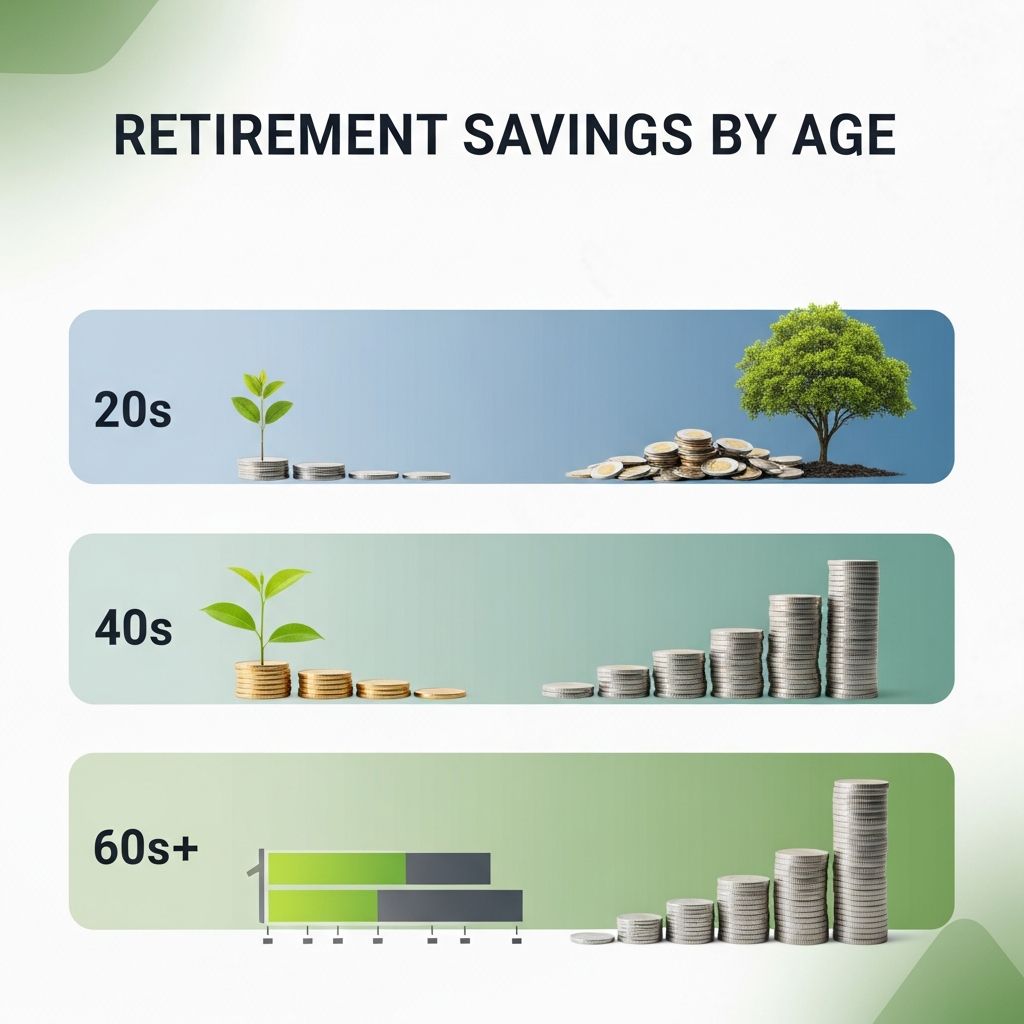
Planning for retirement requires understanding how much you should have saved at different ages. National data reveals stark differences between average savings, medians, and recommended benchmarks, highlighting the need for proactive strategies. This guide breaks down retirement savings by age, drawing from Federal Reserve surveys and financial experts like Fidelity Investments, to help you assess your progress and adjust your plan.
Average vs. Median Retirement Savings: What the Numbers Mean
Average retirement savings are often skewed by high earners, making medians a better gauge of typical savers. For instance, households under 35 have an average of $49,130 but a median of $18,800, showing most young adults have modest balances. This gap widens with age: for 55-64 year-olds, the average is $537,560 versus a median of $185,000. Use medians for realistic comparisons and averages to understand broader trends.
Retirement Savings Benchmarks by Age Group
Financial institutions like Fidelity and T. Rowe Price provide salary-multiple guidelines to stay on track. These targets account for compound growth, assuming 15% annual savings including employer matches. Here’s how current savings stack up against ideals.
| Age Group | Median Savings | Average Savings | Fidelity Benchmark (Multiple of Salary) | T. Rowe Price Benchmark |
|---|---|---|---|---|
| Under 35 | $18,800 | $49,130 | 1x by 30; 2x by 35 | 1x-1.5x by 35 |
| 35-44 | $45,000 | $141,520 | 3x by 40 | 1.5x-2.5x by 40; 2.5x-4x by 45 |
| 45-54 | $115,000 | $313,220 | 6x by 50 | 3.5x-5.5x by 50 |
| 55-64 | $185,000 | $537,560 | 8x by 60 | 4.5x-8x by 55; 6x-11x by 60 |
| 65-74 | $200,000 | $609,230 | 10x by 67 | 7.5x-13.5x by 65 |
| 75+ | $130,000 | $462,410 | N/A (Withdrawal phase) | N/A |
Data synthesized from Federal Reserve via Creative Planning (2025) and Savvy Wealth; benchmarks from Fidelity Q4 2024 and T. Rowe Price. For an $80,000 earner at 60, the Fidelity 8x goal is $640,000—far above the $185,000 median, underscoring widespread shortfalls.
Under 35: Building the Foundation
Young adults average $49,130 in retirement savings, but the median $18,800 reflects student debt and entry-level jobs. Fidelity recommends 1x salary by 30 (e.g., $50,000 for $50,000 income). Start with employer 401(k) matches—free money that doubles contributions. Automate 10-15% of paychecks into low-cost index funds for compound growth over decades.
35-44: Accelerating Growth
Averages rise to $141,520 (median $45,000) as careers advance, but family expenses compete. Target 3x salary by 40. Maximize Roth IRAs for tax-free growth if eligible. High-yield savings for emergencies frees more for retirement. Gen X in this range averages $192,300 in 401(k)s, with 10.2% employee contributions.
45-54: Peak Earning Years
Savings hit $313,220 average (median $115,000), yet college and mortgages strain budgets. Aim for 6x salary by 50. Shift to balanced portfolios (60/40 stocks/bonds) to protect gains. Millennials here average $67,300 in 401(k)s, prioritizing target-date funds (70.1% usage).
55-64: Final Push Before Retirement
Pre-retirees average $537,560 (median $185,000), often below 8x salary targets. Use catch-up contributions: $7,500 extra for 401(k)s over 50 (2026 limit). Baby boomers average $249,300 in 401(k)s and $257,002 in IRAs. Review Social Security projections—full benefits at 67 average $1,900/month.
65-74: Transition to Withdrawals
Peak averages at $609,230 (median $200,000) before required minimum distributions (RMDs) at 73. Follow the 4% rule: withdraw 4% annually ($24,400 on $609,230) adjusted for inflation. Healthcare costs average $315,000 per couple; Medicare supplements gaps.
75+: Preservation Phase
Savings dip to $462,410 average ($130,000 median) due to spending and longevity risks. Focus on income annuities or bonds for steady cash flow. Long-term care insurance earlier prevents depletion.
How Much Should You Save Each Year?
Save 15% of income annually, including matches, starting early. For $75,000 salary:
- Age 25 start: $11,250/year reaches $2.5M by 65 (7% return).
- Age 35 start: $14,063/year for same goal.
- Age 45 start: $24,140/year—catch-up urgency.
Tools like Vanguard’s retirement calculator refine personalized targets. Prioritize tax-advantaged accounts: 2026 401(k) limit $24,000 ($31,500 over 50).
Strategies to Boost Retirement Savings
- Maximize Employer Matches: 5% average match; claim it fully.
- Automate and Increase Contributions: 1% annual raises to savings rate.
- Diversify Investments: Target-date funds simplify (81.5% Gen Z usage).
- Catch-Up if Behind: Over-50 boosts close gaps.
- Side Hustles and Windfalls: Direct bonuses to IRAs.
- Minimize Fees: Index funds under 0.1% expense ratios outperform.
- Delay Social Security: 8% annual benefit increase to 70.
Generational Trends in Retirement Savings
Baby Boomers lead with $249,300 401(k) averages; Gen Z trails at $13,500 but starts strong (7.2% contributions). Younger generations favor Roth options (18%+ usage) and target funds, adapting to gig economies and student debt.
| Generation | Avg 401(k) | Avg IRA | Employee Contribution |
|---|---|---|---|
| Baby Boomers | $249,300 | $257,002 | 11.9% |
| Gen X | $192,300 | $103,952 | 10.2% |
| Millennials | $67,300 | $25,109 | 8.7% |
| Gen Z | $13,500 | $6,672 | 7.2% |
Fidelity Q4 2024 data; 24.5M participants.
Frequently Asked Questions (FAQs)
What’s the average retirement savings by age?
Averages range from $49,130 (under 35) to $609,230 (65-74), but medians are lower: $18,800 to $200,000.
How much should I have saved by age 50?
Fidelity: 6x salary; T. Rowe Price: 3.5x-5.5x. Median is $115,000.
Am I behind on retirement savings?
Compare medians and multiples. Most are below targets; adjust with catch-ups.
What if I started saving late?
Increase to 20-25% savings, use catch-ups, delay retirement.
Should I use a Roth or Traditional 401(k)?
Roth for tax-free withdrawals if young/low tax bracket; traditional if high earner.
References
- Average Retirement Savings by Age Group — 2025 — Creative Planning. 2025. https://creativeplanning.com/insights/retirement/average-retirement-savings-by-age-group-2025/
- Average Retirement Savings by Age — Fidelity Investments. 2024-12-31. https://www.fidelity.com/learning-center/personal-finance/average-retirement-savings
- Average & Median Retirement Savings by Age — Savvy Wealth. 2025. https://www.savvywealth.com/blog-posts/retirement-savings-by-age
- Financial Independence, Retire Early (FIRE) — MoneyRates. 2025. https://www.moneyrates.com/savings/financial-independence-retire-early.htm
- Average Retirement Savings by Age — Empower. 2025-11-25. https://www.empower.com/the-currency/money/average-retirement-savings-by-age
- You’re Age 35, 50, or 60: How Much Should You Have Saved? — T. Rowe Price. 2025. https://www.troweprice.com/personal-investing/resources/insights/youre-age-35-50-or-60-how-much-should-you-have-by-now.html
Similar Articles








Read full bio of medha deb