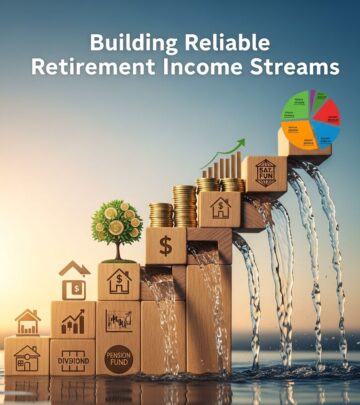
Retirement Nest Egg for $100K Income
Discover how much you need invested to generate $100,000 annual retirement income using proven strategies and safe withdrawal rates.

Generating $100,000 in annual retirement income requires a substantial investment portfolio, typically calculated using safe withdrawal rates that balance longevity risk, market volatility, and inflation. The traditional benchmark suggests needing around $2.5 million, based on a 4% withdrawal rate, but modern approaches like dynamic guardrails and tax strategies can optimize this figure for better outcomes.
Understanding Safe Withdrawal Rates
The foundation of retirement income planning is the
safe withdrawal rate
(SWR), which determines how much you can annually draw from your portfolio without depleting it prematurely. Originating from the Trinity Study, the classic 4% rule posits that withdrawing 4% of your initial portfolio in the first year, adjusted for inflation thereafter, survives 30 years in most historical scenarios.For $100,000 income, this implies a $2.5 million portfolio ($100,000 ÷ 0.04 = $2,500,000). However, recent analyses adjust this downward to 3.3%-3.5% for longer retirements or conservative planning, pushing the required nest egg to $2.86-$3.03 million.
- Historical Basis: Backtested across U.S. market data from 1926-2026, a 4% rate succeeded 95%+ of the time for 30-year horizons with a 50/50 stock-bond mix.
- Modern Adjustments: With lower bond yields and potential equity valuations, experts recommend starting at 3%-3.5% for 40+ year retirements.
- Inflation Impact: Withdrawals increase annually by CPI, preserving purchasing power but amplifying sequence-of-returns risk early in retirement.
Dynamic Strategies Beyond the 4% Rule
Static rules like 4% often lead to underspending in good markets or depletion in bad ones. The
guardrails approach
offers flexibility: set withdrawal bounds around a baseline (e.g., 5% upper, 2.5% lower). If your portfolio exceeds 50% of initial value, boost spending; if below 20%, cut back. This method, tested in simulations, boosts safe income by 20%-30% over rigid plans.Another variant: bucket strategies divide assets into short-term cash (1-2 years expenses), medium-term bonds (3-7 years), and long-term growth equities. This mitigates volatility by spending from stable buckets during downturns.
| Strategy | Target Portfolio for $100K | Pros | Cons |
|---|---|---|---|
| 4% Rule | $2.5M | Simple, historically reliable | Rigid, ignores market conditions |
| Guardrails (5%/2.5%) | $2.2M-$2.5M | Flexible, higher lifetime spending | Requires annual monitoring |
| Bucket (3% SWR) | $3.33M | Volatility protection | Opportunity cost in low-yield bonds |
Tax-Efficient Portfolio Construction
Taxes erode retirement income significantly; a poorly placed portfolio can reduce effective yields by 1%-2%. Place income-heavy assets (bonds, REITs) in tax-deferred accounts like traditional IRAs, growth stocks in Roths for tax-free gains, and index ETFs/munis in taxable accounts.
Roth conversions shine in low-income years: convert traditional IRA funds to Roth, paying taxes now for future tax-free withdrawals. For high-net-worth individuals, mega backdoor Roths via after-tax 401(k) contributions amplify this, potentially shifting millions tax-free.
- Model 20-30 year tax savings: Software shows 15%-25% portfolio uplift.
- Annual rebalancing: Use new cash flows to avoid taxable sales.
Asset Allocation for Sustainable Income
A balanced portfolio underpins reliable income. Retirees should target 40-60% equities for growth/inflation hedge, 30-40% bonds for stability, and 10-20% alternatives (real estate, private credit) for diversification. Avoid over-concentration in U.S. tech; include international stocks and commodities.
In 2026, trends favor private assets in retirement plans for illiquidity premiums and non-correlated returns. A sample allocation:
- Income Bucket: 20% bonds/CDs/TIPS (1-2 years expenses).
- Growth Bucket: 50% global equities/ETFs.
- Hedge Bucket: 20% real assets, 10% alternatives.
Quarterly rebalancing maintains targets, capturing mean reversion while controlling risk.
Advanced Tactics for High Earners
Executives with concentrated stock face unique risks. Diversify via exchange funds (swap single stock for a basket, deferring taxes), collars (options hedge without selling), or systematic sales over 3-7 years. Charitable donations of appreciated shares yield deductions plus gain avoidance.
Integrate annuities selectively: Fixed or inflation-linked products guarantee portions of income (e.g., 30% of $100K), freeing the rest for growth. Long-term care insurance protects against healthcare shocks, preserving principal.
2026 Trends Shaping Retirement Planning
Regulatory shifts like SECURE 2.0 expand Roth access and auto-enrollment. AI-driven personalization tailors portfolios, while private markets enter 401(k)s for yield enhancement. Global uncertainties underscore diversification and cash buffers (1-2 years expenses).
Younger generations prioritize flexibility; millennials/Gen X blend side gigs with investments, targeting earlier retirements via aggressive saving (25%+ income).
Common Pitfalls and Mitigation
Avoid lifestyle creep pre-retirement and underspending post-retirement. Sequence risk—early crashes—demands 2-3 years cash. Over-reliance on Social Security (max $50K/year) leaves gaps; plan for $50K-$70K from portfolio.
- Stress-test: Model 30% market drop Year 1.
- Healthcare: Budget $300K+ lifetime; use HSAs.
- Inflation: Favor TIPS, equities over nominal bonds.
FAQs
How much do I need for $100K retirement income?
Around $2.5M at 4% SWR, but $2.8M+ for conservatism. Adjust for taxes/Social Security.
Is the 4% rule still valid in 2026?
It’s a baseline; dynamic methods like guardrails improve outcomes amid low yields.
What allocation for income-focused portfolio?
50% stocks, 40% bonds, 10% alternatives; rebalance quarterly.
Role of annuities?
Guarantee base income (20-40%); pair with growth assets.
Tax tips for retirees?
Roth ladders, asset location, QCDs from IRAs.
References
- 10 Advanced Strategies for Retirement Planning in 2026 — Commonwealth. 2026. https://www.commonsllc.com/insights/strategies-for-retirement-planning
- Retirement Investing 2026: Strategic Portfolio Tips — Early Retirement Advice. 2026-02-14. https://earlyretirementadvice.com/2026/02/14/retirement-investing-market-outlook-2026/
- Policy, Investment Trends to Watch in 2026 — PSCA. 2026-01. https://www.psca.org/news/psca-news/2026/1/policy-investment-trends-to-watch-in-2026/
- 4 Retirement Income Strategies: Which one Wins in 2026? — YouTube (James Conole, CFP). 2026. https://www.youtube.com/watch?v=n7n2946-eUI
- 7 Smart Money Moves for 2026 Retirement Planning — Fidelity. 2026. https://www.fidelity.com/learning-center/personal-finance/retirement/2026-money-moves
Similar Articles








Read full bio of medha deb