Building Your Retirement: 401(k) vs IRA Strategy
Maximize your retirement savings by understanding when to prioritize a 401(k) versus an IRA.
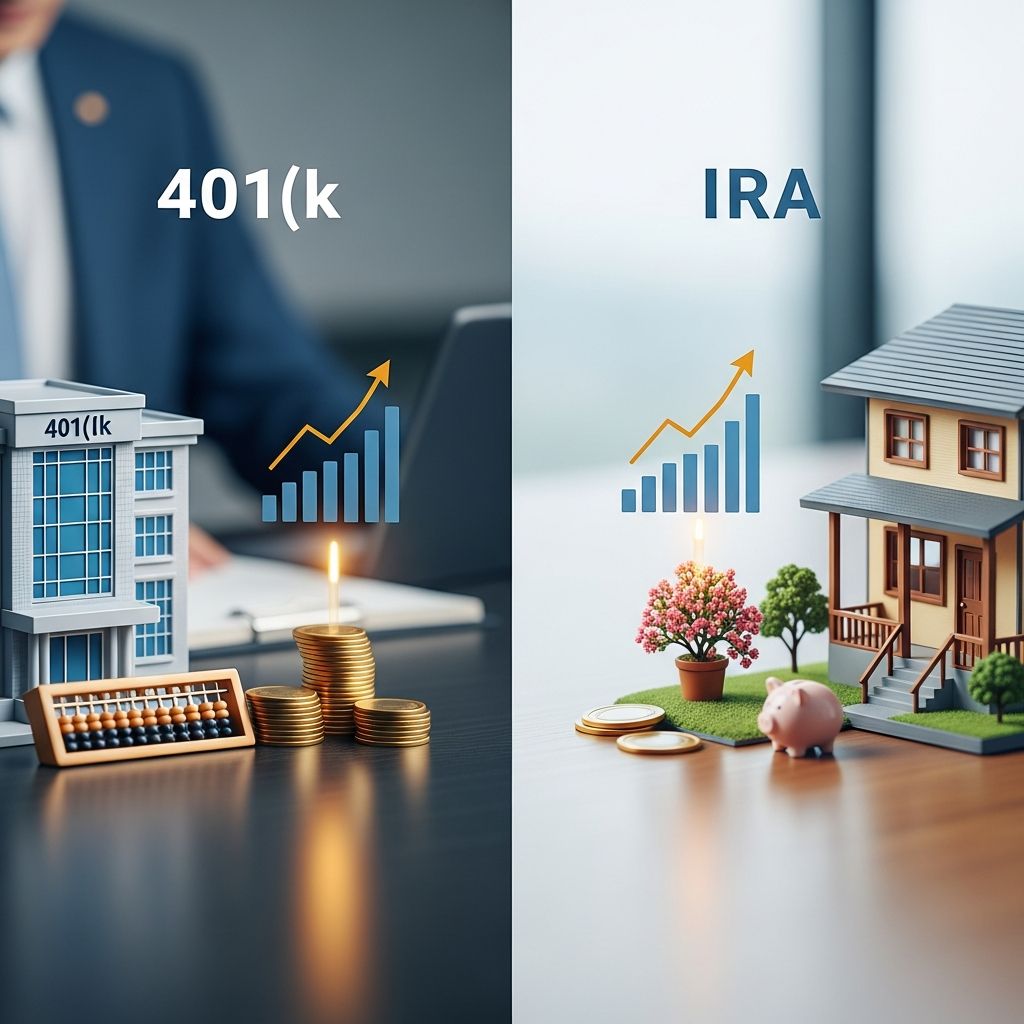
Saving for retirement requires thoughtful decision-making about where to direct your hard-earned money. Two of the most powerful vehicles available to working Americans are employer-sponsored 401(k) plans and Individual Retirement Accounts (IRAs). While both offer significant tax advantages, they serve different purposes and come with distinct features. Understanding which account to prioritize can substantially impact your long-term financial security.
Understanding the Core Mechanics of Retirement Accounts
Retirement accounts function as tax-advantaged savings vehicles designed to encourage Americans to prepare for their later years. Both 401(k)s and IRAs allow your investments to grow without being taxed annually on gains, a feature known as tax-deferred growth. However, the mechanics of how contributions work and how taxes are ultimately handled differ significantly between these two account types.
The fundamental distinction lies in who controls the account and how contributions are managed. A 401(k) is an employer-sponsored plan where your employer establishes and maintains the program for its employees. An IRA, by contrast, is an individual account you open and manage independently, regardless of your employment status. This structural difference creates ripple effects throughout how each account functions, from investment choices to contribution limits to withdrawal rules.
Contribution Limits and Your Savings Capacity
One of the most striking differences between these accounts involves how much money you can contribute annually. For 2026, the contribution limits reflect recent increases designed to help savers keep pace with inflation:
- 401(k) plans: You can contribute up to $24,500 annually if you’re under age 50
- 401(k) catch-up contributions: Those age 50 and older can add an additional $8,000, reaching $32,500 total
- Enhanced catch-up: Workers between ages 60 and 63 benefit from an additional $11,250 in catch-up contributions, potentially reaching $35,750
- Traditional or Roth IRA: The limit is $7,500 for those under 50
- IRA catch-up contributions: People age 50 and older can contribute an additional $1,100, reaching $8,600 total
The disparity in contribution limits reveals why many financial advisors recommend maximizing employer benefits first. A 401(k) allows you to set aside roughly three times more money than an IRA, creating substantially greater accumulation potential over decades of saving.
The Employer Match: Free Money You Shouldn’t Ignore
Perhaps the most compelling reason to prioritize your 401(k) is the employer match—essentially free money that many employers provide as a benefit to participating employees. An employer match typically works as follows: your employer contributes a percentage to your 401(k) account based on how much you contribute. For example, an employer might match 50% of contributions up to 6% of your salary, meaning if you earn $50,000 and contribute $3,000 (6%), your employer adds $1,500.
This matching contribution is an immediate return on your investment that you cannot replicate in an IRA, since IRAs don’t involve employers. Failing to contribute enough to capture your full employer match means leaving money on the table—funds you’ve already earned through your employment that your employer is offering to provide. From a financial optimization perspective, capturing the full match should typically be your first priority before considering contributions to other retirement vehicles.
Tax Treatment: Traditional Versus Roth Strategies
Both 401(k)s and IRAs offer tax advantages, but the structure differs and can have long-term implications for your finances:
Traditional 401(k) and IRA Contributions
Traditional contributions provide immediate tax relief. When you contribute to a traditional 401(k) or IRA, you may deduct those contributions from your taxable income in the year you make them, reducing the income taxes you owe. This appeals to people in higher tax brackets who benefit from reducing their current tax burden. However, when you withdraw money in retirement, those distributions are taxed as ordinary income.
Roth 401(k) and Roth IRA Contributions
Roth accounts operate on the opposite principle. You fund them with after-tax dollars, meaning you don’t get an upfront deduction. However, if you meet the holding requirements—the account must be open for at least five years and you must be at least 59½ years old—all withdrawals, including investment earnings, are completely tax-free. This structure benefits people who expect to be in higher tax brackets in retirement or who simply prefer tax-free income streams.
For Roth IRAs specifically, there’s an additional consideration: income limits determine eligibility. In 2026, single filers with modified adjusted gross income (MAGI) exceeding $168,000 cannot contribute directly to a Roth IRA, while married couples filing jointly phase out at $252,000. Roth 401(k)s have no income limits, making them accessible to higher earners who want Roth tax treatment.
Investment Flexibility and Choice
A significant advantage of IRAs is the breadth of investment options available. When you open an IRA through a brokerage firm, you can invest in virtually any security the firm offers: individual stocks, bonds, exchange-traded funds (ETFs), mutual funds, and numerous other investment vehicles. This flexibility allows you to build a precisely tailored portfolio aligned with your risk tolerance and investment philosophy.
By contrast, 401(k) plans limit you to the investment options selected by your employer and plan administrator. A typical 401(k) might offer 15 to 25 mutual funds and target-date funds, but not the ability to purchase individual stocks or choose from thousands of ETF options. While this limitation might seem restrictive, many employer plans now include self-directed brokerage windows allowing limited access to additional investments.
If you have strong investment convictions or prefer to maintain control over security selection, an IRA provides substantially more latitude. However, if you’re comfortable with your employer’s fund menu or prefer the simplicity of preset options, the 401(k) limitation may be inconsequential.
Strategic Priority Framework
Given these differences, financial professionals often recommend a prioritized approach to retirement savings:
- Contribute enough to capture the full employer match in your 401(k): This is non-negotiable free money that will never be available through an IRA
- Max out your IRA contribution if you value investment flexibility or have income too high for Roth IRA contributions: This step allows you to leverage the broader investment universe
- Return to your 401(k) and contribute additional funds: After securing the match and funding your IRA, maximize remaining 401(k) space to take advantage of the higher contribution limits
- Consider employer stock options or special 401(k) features: Some plans offer additional benefits worth exploring
This framework acknowledges that neither account is universally superior; instead, they serve complementary roles in a comprehensive retirement strategy. Many financial experts recommend using both accounts to diversify tax treatment and investment options.
Withdrawal Rules and Access Considerations
Understanding how you can access your money matters significantly, particularly before retirement age. Traditional 401(k)s and IRAs generally impose a 10% penalty if you withdraw funds before age 59½, plus you’ll owe income taxes on the distribution. However, both accounts include exceptions for specific circumstances like higher education expenses or, for IRAs, up to $10,000 for a first-home purchase.
Roth IRAs offer more flexibility: you can withdraw your original contributions (not earnings) at any time without penalty or tax consequences, providing emergency access to your money if necessary. This feature appeals to younger savers who want the security of accessible funds while still benefiting from long-term tax-free growth.
Required Minimum Distributions
As of 2024, a significant change took effect: Roth 401(k)s no longer require minimum distributions during your lifetime, matching the treatment of Roth IRAs. Traditional 401(k)s and traditional IRAs still require beginning distributions at age 73. This change has implications for estate planning and long-term wealth accumulation strategies.
Income Phase-Out Considerations for 2026
Your income may affect which accounts you can use effectively. For traditional IRA deductions, if you’re covered by a workplace retirement plan, the deduction phases out at income ranges of $81,000–$91,000 for single filers and $129,000–$149,000 for married couples filing jointly in 2026. This means higher earners cannot take a tax deduction for traditional IRA contributions, making either the 401(k) or Roth IRA a more attractive option.
Frequently Asked Questions
Should I prioritize my 401(k) or IRA?
First, contribute to your 401(k) up to the employer match. Then fund your IRA fully if you value investment flexibility. Finally, return to maximizing your 401(k) contributions.
Can I contribute to both a 401(k) and an IRA in the same year?
Yes. You can contribute to both accounts simultaneously. However, your total IRA contributions across all IRAs (traditional and Roth combined) cannot exceed the annual limit.
What if my employer doesn’t offer a 401(k)?
An IRA becomes your primary retirement savings vehicle. Consider a SEP IRA or Solo 401(k) if you’re self-employed, as these offer higher contribution limits than regular IRAs.
Is a Roth or traditional account better for me?
This depends on your current tax bracket versus expected retirement tax bracket. If you expect higher taxes in retirement, Roth makes sense. If you expect lower taxes in retirement, traditional may be preferable.
What happens to my 401(k) if I change jobs?
You can roll your balance into an IRA, consolidate with your new employer’s plan, or leave it with your former employer if your balance exceeds $5,000.
2026 Account Comparison at a Glance
| Feature | 401(k) | IRA |
|---|---|---|
| Annual Contribution Limit (Under 50) | $24,500 | $7,500 |
| Age 50+ Catch-Up | $8,000 (Standard) or $11,250 (Ages 60-63) | $1,100 |
| Employer Match Available | Yes | No |
| Investment Options | Limited to plan menu | Extensive brokerage options |
| Income Limits (Roth/Deduction) | No limits on Roth 401(k) | Yes, applies to Roth and traditional deductions |
| Loan Options | Permitted under most plans | Not permitted |
| RMD During Lifetime | Yes, starting at age 73 | Yes for traditional; No for Roth |
Making Your Decision
The optimal approach to retirement saving recognizes that 401(k)s and IRAs serve different purposes within a comprehensive strategy. The 401(k)’s higher contribution limits and employer match make it essential for capturing available benefits, while the IRA’s investment flexibility and favorable withdrawal rules add valuable options to your retirement toolkit. By understanding the strengths of each account and implementing a prioritized contribution strategy, you position yourself to build substantial retirement wealth while optimizing tax efficiency and investment control.
References
- IRA vs 401k: Key differences and benefits — Vanguard. 2026. https://investor.vanguard.com/investor-resources-education/iras/401k-vs-ira
- Roth IRA vs. Roth 401(k): A Comprehensive Comparison for 2026 — ABA Retirement. 2026. https://abaretirement.com/article/roth-ira-vs-roth-401k-comprehensive-comparison-2026
- IRA vs. 401(k): What’s the difference? — Fidelity Investments. 2026. https://www.fidelity.com/learning-center/smart-money/ira-vs-401k
- Choosing Between a 401(k) and IRA in 2026 — Nicole Cole Financial. 2026. https://www.nicolecolefinancial.com/blog-01/choosing-between-401k-and-ira-2026
- How the New 401(k) and IRA Limits Affect Your Retirement Planning Strategy — HT&B CPA. 2026. https://htbcpa.com/how-the-new-401k-and-ira-limits-affect-your-retirement-planning-strategy/
Similar Articles








Read full bio of Sneha Tete