Resume Words: Include and Avoid for Maximum Impact
Master the language of resumes: essential words to highlight your strengths and phrases to eliminate.
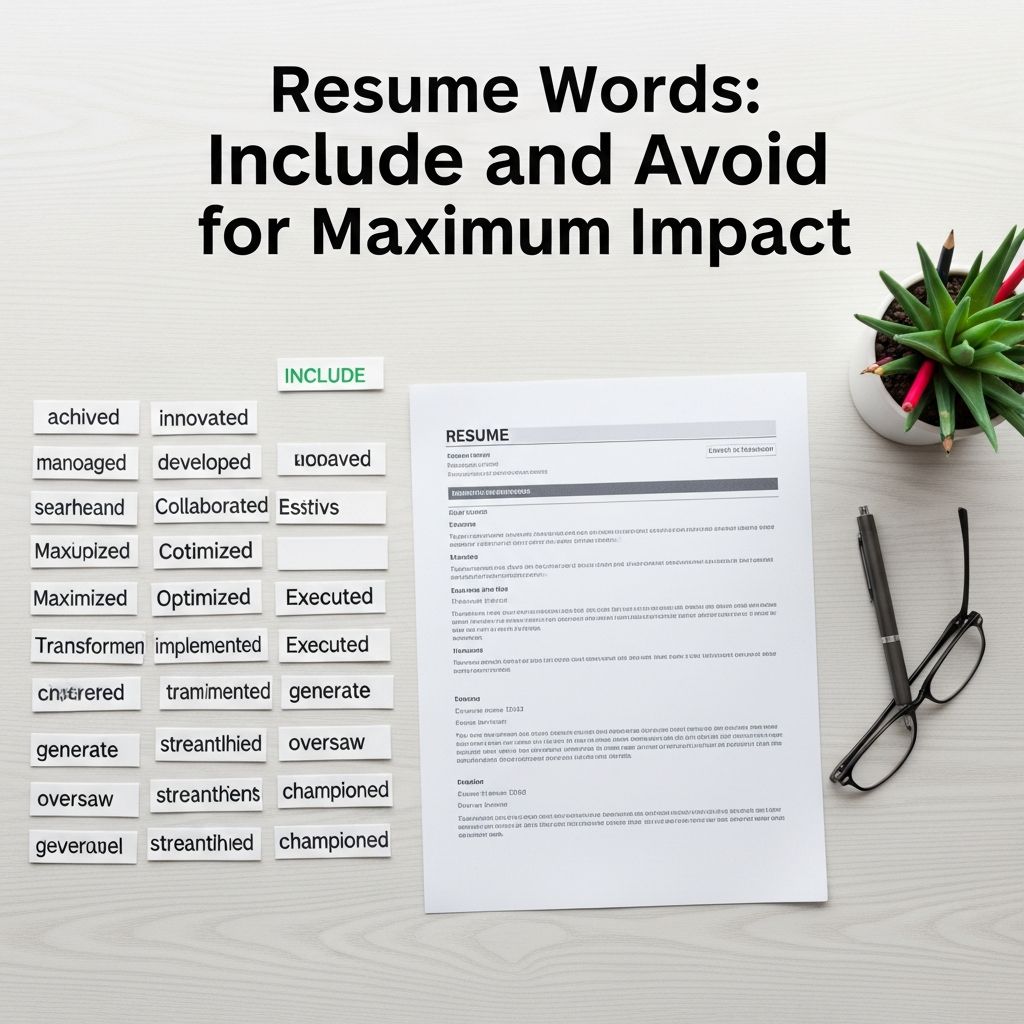
Resume Words: The Complete Guide to Words You Should Include and Avoid
Your resume is one of your most critical career documents. It’s often the first impression you make on potential employers, and every word matters. The language you use on your resume can significantly impact whether a hiring manager invites you for an interview or moves on to the next candidate. Understanding which words to include and which to avoid can dramatically improve your resume’s effectiveness and increase your chances of landing your dream job.
The difference between a mediocre resume and an outstanding one often comes down to word choice. By strategically selecting powerful action verbs, incorporating relevant keywords, and eliminating weak or passive language, you can transform your resume into a compelling marketing document that showcases your qualifications and accomplishments.
The Power of Action Verbs in Your Resume
Action verbs are the foundation of a strong resume. They convey energy, initiative, and accomplishment, making your professional experience more compelling and memorable. Rather than describing what your job entailed, action verbs demonstrate what you actively achieved.
Strong action verbs create a sense of momentum and capability. They help hiring managers visualize your contributions and understand your impact in previous roles. When you use powerful action verbs, you’re not just listing responsibilities—you’re highlighting your value as an employee.
Best Action Verbs for Leadership and Management
If you’ve held leadership positions or managed teams, these verbs showcase your executive abilities:
- Directed—Shows you guided projects or teams toward specific outcomes
- Oversaw—Indicates comprehensive supervision and responsibility
- Managed—Demonstrates your ability to handle people, budgets, or projects
- Coordinated—Emphasizes your organizational and team collaboration skills
- Delegated—Shows your ability to distribute tasks effectively
- Supervised—Highlights your responsibility for team performance
- Led—Conveys active leadership and vision
- Established—Demonstrates your ability to create new systems or teams
Action Verbs for Achievement and Results
These verbs emphasize what you accomplished and the tangible results you delivered:
- Increased—Perfect for showing growth in sales, revenue, or efficiency
- Improved—Highlights enhancements to processes or outcomes
- Generated—Shows revenue creation or idea production
- Achieved—Emphasizes goal completion and success
- Exceeded—Demonstrates performance beyond expectations
- Accelerated—Shows speed and momentum in achieving results
- Optimized—Indicates efficiency improvements
- Transformed—Conveys significant positive change
Action Verbs for Problem-Solving and Innovation
These verbs demonstrate your analytical and creative capabilities:
- Resolved—Shows you fixed issues or conflicts
- Implemented—Indicates you put plans into action
- Developed—Demonstrates your ability to create and improve
- Designed—Shows creative and strategic thinking
- Engineered—Highlights technical problem-solving
- Streamlined—Emphasizes process improvement
- Innovated—Shows creative thinking and new approaches
- Customized—Demonstrates ability to tailor solutions
Keywords and Industry-Specific Language
Beyond action verbs, incorporating relevant keywords from your industry is essential. Many companies use Applicant Tracking Systems (ATS) to scan resumes for specific keywords related to the job posting. If your resume doesn’t contain these keywords, it may never reach a human recruiter.
When reviewing a job description, identify the specific skills, technologies, certifications, and qualifications mentioned. Incorporate these terms naturally throughout your resume. However, avoid keyword stuffing—your resume should still read naturally and make sense to human reviewers.
Technical Skills and Certifications
If the job posting mentions specific software, programming languages, or certifications, be sure to include these exact terms in your skills section. For example, if the position requires expertise in specific tools like Salesforce, Microsoft Excel, or project management software, list these explicitly.
Industry Jargon and Terminology
Using industry-appropriate terminology demonstrates that you’re knowledgeable about your field. Whether it’s marketing metrics like conversion rates and customer acquisition cost, healthcare terms like electronic health records (EHR), or finance terminology like financial modeling and risk assessment, speaking the language of your industry signals professionalism and expertise.
Weak Words and Phrases to Eliminate
Just as important as knowing which words to include is understanding which words and phrases to avoid. Weak language undermines your credibility and diminishes the impact of your accomplishments.
Passive Language to Remove
Passive phrases like “My duties included” or “Responsible for” weaken your resume by making you seem like a bystander rather than an active participant. Instead of saying “Responsible for managing social media accounts,” say “Managed social media accounts, increasing followers by 50%.”
Replace phrases like:
- “My duties included” → Use specific action verbs instead
- “Responsible for” → “Managed,” “Oversaw,” or “Handled”
- “Worked on” → “Led,” “Developed,” or “Created”
- “Helped with” → “Facilitated,” “Supported,” or “Contributed to”
Overused and Generic Words
Certain words appear so frequently on resumes that they’ve lost their impact. Hiring managers see these words countless times and they fail to make your resume stand out:
- Hardworking—This is assumed; show it through accomplishments instead
- Team player—Demonstrate collaboration through specific examples
- Detail-oriented—Prove this through your results and accomplishments
- Fast-paced environment—Avoid clichés; be specific about challenges you handled
- Go-getter—This is too informal and vague for professional documents
- Synergy—This buzzword is overused and often meaningless
- Proven track record—Show, don’t tell; let your accomplishments speak
Vague and Non-Specific Language
Avoid words that don’t provide concrete information about your contributions:
- “Various”—Specify which ones
- “Several”—Give exact numbers when possible
- “Stuff”—This is far too casual for a professional document
- “Things”—Be specific about what you’re referencing
- “Other”—Specify what the other items are
Negative or Limiting Words
Never use words that suggest you struggled, failed, or weren’t confident in your abilities:
- “Attempted”—Use “accomplished” or “achieved” instead
- “Failed”—Focus on what you learned or how you overcame challenges
- “Struggled”—Emphasize how you overcame obstacles
- “Only”—Avoid diminishing your accomplishments
- “Somewhat”—Be confident and specific about your abilities
- “Mediocre”—Never describe your work this way
Quantifying Your Accomplishments
While avoiding weak language, strive to include numbers and metrics wherever possible. Quantified accomplishments are far more compelling than general statements. Instead of “Improved customer satisfaction,” write “Improved customer satisfaction scores from 78% to 94%, a 16-point increase.”
Include metrics such as:
- Percentage increases in revenue, efficiency, or engagement
- Dollar amounts saved or generated
- Number of people managed or projects completed
- Time saved through process improvements
- Specific numbers for social media growth, website traffic, or lead generation
- Award placements or recognition levels
Adapting Your Language to Job Descriptions
One of the most effective strategies is to customize your resume for each application by mirroring the language used in the job description. If the posting emphasizes “collaboration,” include examples of how you’ve worked effectively with teams. If it mentions specific software or methodologies, incorporate these terms into your skills section.
This approach serves two purposes: it helps your resume pass through ATS systems, and it demonstrates to hiring managers that you understand what they’re looking for in a candidate. However, always remain truthful—never exaggerate your skills or experience.
Professional Tone and Language Choices
Your resume should maintain a professional tone throughout. Avoid slang, contractions, and overly casual language. While you want your resume to be engaging, it should never feel like a personal email or social media post.
Use consistent verb tenses—past tense for previous positions and present tense if you’re currently employed in a role. Ensure your language is concise and direct; eliminate unnecessary words and phrases that don’t add value.
Common Resume Word Mistakes to Avoid
Beyond weak language, certain mistakes with word usage can hurt your resume’s effectiveness:
Spelling and Grammar Errors
Nothing undermines your credibility faster than spelling or grammatical errors. These mistakes suggest carelessness and poor attention to detail—qualities that concern any employer. Use spell-check tools, but don’t rely on them exclusively; proofread your resume multiple times and have others review it as well.
Inconsistent Terminology
If you refer to a position as “Manager” in one place and “Management Professional” in another, it creates confusion. Be consistent with your terminology throughout your resume. Use the same formatting, style, and language for similar entries.
Unnecessary Jargon
While industry-specific language is valuable, avoid using jargon just to sound impressive. If a term isn’t commonly used in your industry or isn’t necessary to understand your accomplishment, leave it out. Your resume should be clear and understandable to someone who isn’t an expert in your field.
Creating a Word Bank for Your Resume
Create a personal word bank of powerful action verbs and industry keywords specific to your field. Review job postings in your target positions and note which words and phrases appear frequently. This research will help you identify the language that resonates with employers in your industry.
Organize your word bank by category—verbs for leadership, accomplishment, innovation, and communication. When you’re updating your resume or tailoring it for a specific position, refer to this resource to ensure you’re using the most impactful language.
Frequently Asked Questions
Q: Can I use the same resume for every job application?
A: While you can start with the same base resume, it’s highly recommended to customize it for each position. Tailor your resume to match the language and keywords in the job description. This increases your chances of passing through ATS systems and demonstrates to hiring managers that you’ve given thoughtful consideration to the role.
Q: How many action verbs should I include in my resume?
A: Each bullet point under your experience section should begin with a different action verb when possible. Aim for three to five bullet points per position, each starting with a strong action verb. This variety keeps your resume engaging and demonstrates diverse skills and accomplishments.
Q: Should I include numbers in every achievement?
A: While not every achievement will have a quantifiable metric, you should include numbers whenever possible. Quantified accomplishments are more memorable and compelling. If you can’t include a specific number, describe the scope or significance of your achievement in other concrete terms.
Q: Is it acceptable to use “I” or “me” in my resume?
A: No, avoid using first-person pronouns like “I,” “me,” or “my” on your resume. Since it’s clearly your document, these pronouns are unnecessary and waste valuable space. Starting bullet points with action verbs automatically eliminates the need for first-person language.
Q: How can I describe achievements if I worked as part of a team?
A: You can describe team accomplishments while highlighting your specific role. Use phrases like “Collaborated with cross-functional team to” or “Supported efforts to” when appropriate. However, ensure that any accomplishment you list is one where you played a meaningful role.
Q: What’s the difference between “managed” and “oversaw”?
A: “Managed” typically implies more hands-on involvement and daily interaction, while “oversaw” suggests a higher-level responsibility and broader oversight. Choose the verb that most accurately describes your level of involvement in the role.
Q: Are buzzwords and jargon helpful on a resume?
A: Industry-specific terminology and keywords are helpful and often necessary to pass ATS systems. However, avoid overused buzzwords like “synergy” or “paradigm shift” that don’t add meaningful information. Use professional language that’s commonly used in your industry without resorting to empty corporate jargon.
References
- Resume Writing 101: Tips for Creating a Resume — Indeed Career Advice. Accessed November 30, 2025. https://www.indeed.com/career-advice/resumes-cover-letters/resume-writing-101
- Résumé Writing Guide — Cornell School of Hotel Administration. 2019. https://sha.cornell.edu/wp-content/uploads/sites/4/2019/04/ResumeGuide2012-13.pdf
- Career Preparation: Resume and Interview Preparation — Laredo College Academic Departments. Accessed November 30, 2025. https://www.laredo.edu/Academic-Departments/community-education/Transitions/career_connect/Career_Preparation.html
Similar Articles








Read full bio of medha deb