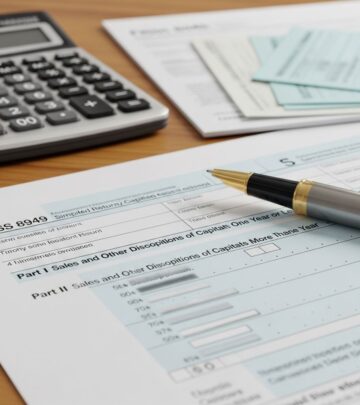
Reporting Capital Gains and Losses on Form 8949
Complete guide to filing IRS Form 8949 for capital gains and losses on investments.

Understanding Form 8949: Sales and Dispositions of Capital Assets
Form 8949, officially titled “Sales and Other Dispositions of Capital Assets,” is a critical tax document that allows individuals, partnerships, and corporations to report the sale of investment assets to the Internal Revenue Service (IRS). Whether you’ve sold stocks, cryptocurrency, real estate, mutual funds, or other capital assets, Form 8949 provides the detailed transaction information the IRS needs to verify your capital gains and losses.
The primary purpose of Form 8949 is to reconcile amounts reported to both you and the IRS on Form 1099-B or Form 1099-S (broker statements and similar documents) with the amounts you report on your tax return. This reconciliation ensures accuracy and helps prevent discrepancies between what your broker reports and what you claim as your gains or losses.
When Do You Need to File Form 8949?
Not every investor needs to file Form 8949. Understanding when this form is required can help you determine your filing obligations and avoid unnecessary paperwork.
You Must File Form 8949 If:
Your cost basis isn’t reported to the IRS: If your broker did not report the cost basis on your Form 1099-B, you’ll need to complete Form 8949 to provide this information to the IRS.
You need to make adjustments: If you’re making adjustments to your gains or losses (such as accounting for wash sales, inherited assets, or other basis adjustments), Form 8949 allows you to document these changes.
You have transactions not reported on 1099-B: Some capital asset sales aren’t reported on Form 1099-B, including certain partnership interests, personal property sales, and assets acquired before 2011. These transactions must be reported on Form 8949.
You have specific types of gains or losses: Form 8949 is required for reporting distributed capital gains, undistributed capital gains, losses from wash sales, short sales, gains or losses from options trading, and losses from capital assets held for personal use.
You Don’t Need Form 8949 If:
If all your capital gains and losses are properly reported on Form 1099-B with correct basis information, and you don’t need to make any adjustments, you may be able to skip Form 8949 and report directly on Schedule D. However, many taxpayers find they need Form 8949 anyway to maintain proper documentation and ensure accuracy.
Information Required on Form 8949
To complete Form 8949 accurately, you’ll need specific details about each transaction. Gather this information from your broker statements, investment account records, and any purchase confirmations before you begin filling out the form.
For each capital asset sale or exchange, you’ll need to provide:
- Description of property: The specific asset sold (e.g., “100 shares of XYZ Corporation stock” or “0.5 Bitcoin”)
- Acquisition date: The date you purchased or acquired the asset
- Disposition date: The date you sold or disposed of the asset
- Sales proceeds: The total amount you received from the sale (not including fees or commissions)
- Cost basis: Your original purchase price plus any acquisition fees or commissions
- Adjustments: Any modifications to basis, such as those required for wash sales or other special circumstances
Categorizing Your Transactions
Form 8949 is divided into two main parts, and transactions must be categorized based on two key factors: holding period and whether the cost basis was reported to the IRS.
Part I: Short-Term Capital Gains and Losses
Part I of Form 8949 is used for short-term transactions—those involving assets held for one year or less. Short-term capital gains are taxed at ordinary income rates, which are typically higher than long-term capital gains rates.
Within Part I, you’ll encounter three checkboxes:
- Box A: Short-term transactions reported on Form 1099-B where cost basis was reported to the IRS
- Box B: Short-term transactions reported on Form 1099-B where cost basis was NOT reported to the IRS
- Box C: Short-term transactions not reported on Form 1099-B
Part II: Long-Term Capital Gains and Losses
Part II is used for long-term transactions—those involving assets held for more than one year. Long-term capital gains typically receive preferential tax rates.
Part II also contains three checkboxes:
- Box D: Long-term transactions reported on Form 1099-B where cost basis was reported to the IRS
- Box E: Long-term transactions reported on Form 1099-B where cost basis was NOT reported to the IRS
- Box F: Long-term transactions not reported on Form 1099-B
Step-by-Step Instructions for Completing Form 8949
Step 1: Gather Your Documentation
Before you begin, collect all necessary documents including Form 1099-B from your broker, investment account statements, purchase confirmations, and sale confirmations. Having everything organized will make the process much smoother and reduce errors.
Step 2: Separate Your Transactions
Divide your investment transactions into two groups: short-term (held one year or less) and long-term (held more than one year). Within each group, further categorize based on whether cost basis was reported to the IRS and whether you received a Form 1099-B.
Step 3: Check the Appropriate Box
At the top of each section, check the box (A, B, C, D, E, or F) that corresponds to your transaction category. Use only one box per Form 8949 section; if you have multiple categories, you’ll need to complete multiple Forms 8949.
Step 4: Enter Transaction Details
For each transaction, enter the following information in the appropriate columns:
- Column (a): Description of property
- Column (b): Date acquired
- Column (c): Date sold or disposed
- Column (d): Proceeds (sales price)
- Column (e): Cost or other basis
- Column (f): Adjustment codes (if applicable)
- Column (g): Adjustment amounts
- Column (h): Gain or loss (Column d minus Column e, plus or minus Column g)
Step 5: Apply Adjustment Codes if Needed
If you need to adjust your gain or loss amounts, enter the appropriate code in Column (f) and the adjustment amount in Column (g). Common adjustment codes include those for wash sales, inherited property adjustments, and other special circumstances. The IRS instructions provide a complete list of valid adjustment codes.
Step 6: Calculate Totals
After entering all transactions for a particular box category, total the columns and enter these amounts at the bottom of Form 8949. These totals will be transferred to Schedule D.
Step 7: Transfer to Schedule D
The totals from Form 8949 are carried over to Schedule D (Form 1040), which provides a summary of all your capital gains and losses for the tax year. Schedule D is then attached to your Form 1040 tax return.
Understanding the Connection Between Form 8949 and Schedule D
Form 8949 and Schedule D work together as part of the capital gains and losses reporting system. Think of Form 8949 as the detailed receipts and Schedule D as the summary sheet—the IRS wants both to verify your numbers.
Form 8949’s role: Provides detailed information about each individual transaction, including descriptions, dates, and basis adjustments.
Schedule D’s role: Summarizes your total capital gains and capital losses from Form 8949, calculates your net capital gain or loss, and integrates this information into your overall tax picture.
The totals from Form 8949 flow directly into Schedule D, which then connects to your Form 1040, adjusting your Adjusted Gross Income (AGI) and ultimately determining your tax liability.
Special Situations and Exceptions
Wash Sales
A wash sale occurs when you sell an investment at a loss and then repurchase the same or a substantially identical investment within 30 days before or after the sale. The IRS disallows the loss in the year of the sale, and you must adjust your basis on the replacement purchase. Use the appropriate adjustment code to reflect this change on Form 8949.
Inherited Assets
When you inherit investment assets, you receive a “step-up” in basis to the fair market value on the date of death. Report inherited asset sales on Form 8949 using the stepped-up basis as your cost basis.
Capital Gains Distributions
Mutual funds and other investment funds often distribute capital gains to shareholders. Report distributed capital gains and undistributed capital gains on Form 8949 in the appropriate part (I or II) based on the holding period.
Partnership and S Corporation Gains/Losses
If you receive Schedule K-1 forms from partnerships or S corporations showing capital gains or losses, report your share of these gains or losses on Form 8949 using the appropriate box checked and entering “From Schedule K-1 (Form 1065)” or similar in the description column.
Capital Loss Limitations and Carryovers
Capital losses can be valuable for reducing your tax liability. When your capital losses exceed your capital gains, you can use up to $3,000 of net capital losses against ordinary income in the current tax year. Any excess capital losses can be carried forward to future tax years indefinitely, allowing you to use them when you have capital gains or additional room in your $3,000 annual ordinary income deduction.
This carryover feature makes it important to track capital losses carefully across multiple tax years, and Form 8949 documentation helps establish this record.
Common Mistakes to Avoid
Incorrect holding period calculations: Verify whether assets are held more or less than one year. Many investors miscalculate by including the purchase date as day one, when actually the holding period begins the day after purchase.
Missing cost basis information: Gather all basis information before starting. Estimating or leaving blanks can trigger IRS inquiries.
Failing to adjust for wash sales: The IRS tracks wash sales carefully. Use the appropriate adjustment codes if applicable.
Arithmetic errors: Double-check all calculations, especially gain or loss computations and column totals.
Using the wrong box category: Ensure you’re checking the correct box (A-F) for your transaction type.
Filing Form 8949 Electronically
Most taxpayers file Form 8949 electronically through tax preparation software or through their accountant. Major tax software platforms like TurboTax, TaxAct, and others include forms for Form 8949 and automatically carry totals to Schedule D. If using tax software, you’ll typically navigate to the investment income section and select an option to enter capital gains and losses.
For those preparing returns manually, Form 8949 is available on the IRS website as a PDF that can be printed and filled out by hand, though electronic filing remains the recommended approach.
Frequently Asked Questions
Q: What’s the difference between short-term and long-term capital gains?
A: Short-term capital gains come from assets held one year or less and are taxed at your ordinary income tax rate. Long-term capital gains come from assets held more than one year and typically receive preferential tax rates (0%, 15%, or 20% depending on your income level).
Q: Do I need Form 8949 if my broker reported everything correctly on Form 1099-B?
A: Not necessarily. If all your gains and losses are correctly reported on 1099-B with accurate cost basis and you don’t need adjustments, you may report directly on Schedule D. However, many taxpayers use Form 8949 anyway for documentation purposes.
Q: Can I use capital losses to offset other income?
A: Yes, up to $3,000 per year in net capital losses can offset ordinary income. Excess losses carry forward to future years to use against future gains or additional ordinary income.
Q: What if I need to make multiple sections of Form 8949?
A: You can complete multiple Form 8949s—one for each transaction category (short-term basis reported, short-term basis not reported, short-term no 1099-B, etc.). Each form should check only one box.
Q: How long should I keep Form 8949 documentation?
A: Keep all documentation supporting Form 8949 (broker statements, purchase confirmations, sale confirmations) for at least three years, and longer if you plan to carry forward capital losses to future years.
Q: Does Form 8949 apply to cryptocurrency sales?
A: Yes. Cryptocurrency sales are treated as capital assets, and gains or losses must be reported on Form 8949 and Schedule D, just like stock sales.
References
- How to Use IRS Form 8949 for Capital Gains and Losses — TaxAct Blog. 2024. https://blog.taxact.com/irs-form-8949-capital-gains-losses/
- Instructions for Form 8949 (2024) — Internal Revenue Service. 2024. https://www.irs.gov/instructions/i8949
- FORM 8949: Instructions & Information on Capital Gains/Losses — Community Tax. 2024. https://www.communitytax.com/tax-form/form-8949/
- About Form 8949, Sales and other Dispositions of Capital Assets — Internal Revenue Service. 2024. https://www.irs.gov/forms-pubs/about-form-8949
- Stocks, Crypto, and More: How Form 8949 Tracks Your Capital Gains — Bright Tax. 2024. https://brighttax.com/blog/irs-tax-form-8949-american-expats/
- Form 8949 (PDF) — Internal Revenue Service. 2024. https://www.irs.gov/pub/irs-pdf/f8949.pdf
Similar Articles








Read full bio of Sneha Tete