Relative Strength Index (RSI): Definition and Guide
Master RSI trading signals: Learn overbought/oversold levels, calculations, and practical applications.
What Is the Relative Strength Index (RSI)?
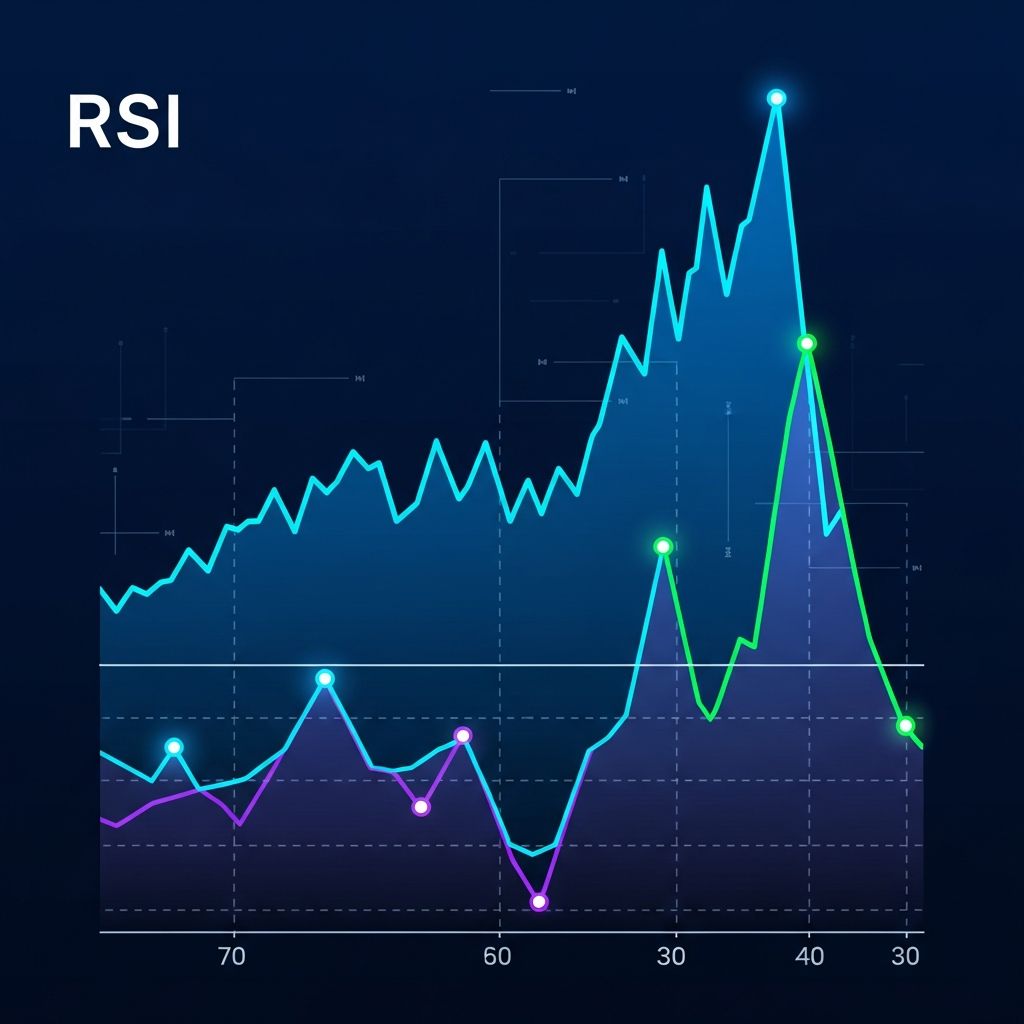
The Relative Strength Index (RSI) is one of the most popular and widely used momentum oscillators in technical analysis. Developed by J. Welles Wilder, a renowned mechanical engineer turned technical analyst, the RSI measures both the speed and rate of change of price movements within a market. This powerful indicator helps traders identify potential trading opportunities by quantifying the magnitude of recent price changes to evaluate overbought or oversold conditions in the price of a security.
The RSI oscillator typically operates over a 14-period measurement window, though traders can adjust this timeframe based on their specific trading strategy and security characteristics. Values fluctuate between zero and 100, creating a bounded oscillator that provides clear, interpretable signals for market participants.
Understanding RSI Fundamentals
At its core, the RSI is a momentum indicator that does not measure the direction of price movement, but rather the speed and magnitude of price changes. This distinction is crucial for traders who want to understand what the RSI actually represents in market dynamics.
Traditional RSI interpretation establishes that readings above 70 indicate overbought conditions, while readings below 30 suggest oversold conditions. These threshold levels represent extremes in price momentum and often precede short-term trend reversals that present valuable trading opportunities.
Key RSI Characteristics
- Operates on a scale from 0 to 100
- Standard calculation period: 14 days (adjustable)
- Overbought threshold: Above 70
- Oversold threshold: Below 30
- Bounded oscillator providing clear signal levels
- Frequently used by swing traders monitoring short to intermediate-term price movements
How RSI Works in Practice
The RSI functions by comparing average gains to average losses over a specified period, generating a momentum reading that reflects whether buyers or sellers currently control price action. When upward price movements dominate, the RSI climbs toward 100. When downward movements prevail, the RSI descends toward zero.
Traders leveraging the RSI look for signals of waning or strengthening momentum to time their entries and exits. An RSI reading below 30 suggests a security may be oversold and potentially due for a bounce, while a reading above 70 indicates possible overbought conditions where profit-taking could occur.
RSI Calculation Explained
While the complete RSI calculation involves highly technical and complex explanations, the fundamental concept can be expressed through a relatively simple formula. For traders and analysts seeking to fully understand the calculation methodology, J. Welles Wilder’s own explanation in his 1978 book New Concepts in Technical Trading Systems remains the definitive resource.
The basic RSI calculation involves:
- Computing average gains over the specified period
- Computing average losses over the same period
- Calculating the Relative Strength (RS) ratio
- Converting the RS to a normalized index between 0 and 100
Most modern charting software automatically calculates the RSI, allowing traders to focus on interpretation rather than manual computation.
Interpreting Overbought and Oversold Conditions
Traditionally, the RSI signals overbought conditions when above 70 and oversold conditions when below 30. However, these threshold levels are not absolute rules carved in stone. Experienced traders frequently adjust these levels to better fit the price movement characteristics of specific securities they monitor.
For example, if a particular security consistently reaches above 70 or falls below 30 without accurately forecasting a price trend change, a trader might adjust the upper threshold to 80 and the lower threshold to 20 to generate more reliable trading signals specific to that security’s behavior.
Adjusting RSI Thresholds
Customizing RSI thresholds requires understanding a security’s individual characteristics and volatility patterns. A security prone to strong momentum swings might benefit from wider thresholds, while a more stable security might work better with narrower ranges. This customization process represents a key advantage of using the RSI—traders can fine-tune the indicator to match their specific trading universe.
RSI Behavior During Trending Markets
One critical insight that separates novice traders from experienced practitioners involves understanding how RSI behaves differently during bull and bear markets. This contextual understanding prevents false signals and improves trading accuracy significantly.
Bullish Market RSI Ranges
During strong bull markets, RSI values typically operate in the 40 to 90 range rather than oscillating between 0 and 100. In these uptrend conditions, the 40-50 range often acts as support, meaning RSI readings in this zone frequently precede further upward price movements. This elevated baseline reflects the underlying strength of the uptrend and the dominance of buying pressure.
Bearish Market RSI Ranges
Conversely, during bear markets, RSI readings typically remain confined within the 10 to 60 range. The 50-60 zone often signals resistance in downtrend conditions. This compressed range reflects the underlying weakness and selling pressure dominating the market structure.
Understanding these market-dependent RSI ranges prevents traders from misinterpreting indicator readings. An RSI of 75 might represent extreme overbought conditions during a normal market but could signal healthy uptrend momentum during a powerful bull market.
RSI Divergence: A Powerful Trading Signal
Beyond standard overbought and oversold levels, traders watch closely for divergence between price movement and RSI values. Divergence occurs when price makes a new high or new low that is not confirmed by a corresponding new high or low in the RSI reading. This disconnect often indicates an impending price reversal.
Bullish Divergence
Bullish divergence forms when price reaches a new low while the RSI fails to reach a corresponding new low or actually begins rising. This pattern suggests that selling pressure is weakening despite continued price declines, indicating that an uptrend may be developing. Bullish divergence frequently precedes reversals from downtrend to uptrend market phases.
Bearish Divergence
Bearish divergence develops when price reaches a new high without the RSI confirming this move with a corresponding new high. This pattern suggests that buying pressure is insufficient to sustain higher prices, often preceding reversals from uptrend to downtrend conditions.
RSI divergence signals represent some of the most reliable indicators of upcoming trend changes, making them invaluable for traders positioning ahead of market reversals.
Practical Application for Traders
The Relative Strength Index serves multiple functions within a comprehensive trading strategy. Traders use RSI to identify potentially good buy entry points when a security appears oversold and sell points when conditions appear overbought. The indicator also provides early warning signals for possible trend changes through divergence patterns.
Swing Trading Applications
Swing traders particularly favor the RSI for its effectiveness in identifying short to intermediate-term trading opportunities. By monitoring RSI readings in conjunction with price action, swing traders can time their entries and exits with greater precision, improving their risk-reward ratios and overall profitability.
Important Trader Considerations
Traders must remember that during periods of very strong trends, a security’s price may continue rising for extended periods even after RSI signals overbought conditions. Similarly, prices may fall substantially after RSI indicates oversold conditions during powerful downtrends. The RSI is most effective when used in conjunction with other technical indicators and price action analysis rather than as a standalone trading signal.
RSI vs. Other Momentum Indicators
| Indicator | Range | Primary Use | Best For |
|---|---|---|---|
| RSI | 0-100 | Overbought/Oversold | Momentum confirmation |
| Stochastic | 0-100 | Price positioning | Trend reversals |
| MACD | Unbounded | Trend direction | Trend following |
| Rate of Change | Unbounded | Momentum strength | Acceleration detection |
Frequently Asked Questions About RSI
What does RSI stand for?
RSI stands for Relative Strength Index. It is a momentum oscillator that measures the speed and magnitude of price changes to evaluate whether a security is overbought or oversold.
What is the standard RSI period?
The standard RSI period is 14, typically representing 14 days for daily charts, 14 weeks for weekly charts, or 14 months for monthly charts. Traders can adjust this period based on their trading timeframe and strategy.
When should I buy or sell based on RSI?
Traditionally, RSI readings below 30 suggest oversold conditions (potential buy signals) while readings above 70 indicate overbought conditions (potential sell signals). However, these signals work best when confirmed by other technical indicators and price action analysis.
Can RSI be adjusted?
Yes, both the period and the overbought/oversold thresholds can be adjusted. If a security frequently triggers false signals with standard 70/30 levels, traders might adjust to 80/20 or other custom thresholds that better match the security’s behavior.
What is RSI divergence?
RSI divergence occurs when price makes a new high or low that is not confirmed by a corresponding new high or low in the RSI reading. This often signals an impending trend reversal and represents one of the most reliable RSI trading signals.
Is RSI reliable for all markets?
RSI works across different asset classes including stocks, commodities, cryptocurrencies, and forex. However, RSI behavior varies based on market conditions, requiring traders to adjust their interpretation based on current trend strength and market volatility.
How do I avoid false RSI signals?
Combine RSI with other technical indicators, use divergence signals rather than extreme levels alone, understand the current market trend context, and adjust RSI thresholds to match individual security characteristics.
Conclusion
The Relative Strength Index remains one of the most powerful tools in a technical analyst’s arsenal, helping traders determine potentially good entry and exit points while signaling possible trend changes. By understanding RSI fundamentals, recognizing how the indicator behaves in different market conditions, and incorporating divergence signals into their trading strategy, traders can significantly improve their decision-making process. While the RSI should never be used in isolation, its integration into a comprehensive technical analysis framework can enhance trading performance and risk management across all market environments and timeframes.
References
- Relative Strength Index (RSI) – Definition, Guide, How It Works — Corporate Finance Institute. https://corporatefinanceinstitute.com/resources/career-map/sell-side/capital-markets/relative-strength-index-rsi/
- Relative Strength Index (RSI) — Investopedia. April 27, 2019. https://www.youtube.com/watch?v=7FvtcVc6S2M
- Chart Advisor: Mastering the Relative Strength Index (RSI) – How to Read It Correctly — Interactive Brokers. May 9, 2025. https://www.interactivebrokers.com/campus/traders-insight/securities/macro/chart-advisor-mastering-the-relative-strength-index-rsi-how-to-read-it-correctly/
- New Concepts in Technical Trading Systems — J. Welles Wilder Jr. 1978. Wilder’s foundational text remains the authoritative source for RSI calculation methodology.
Similar Articles








Read full bio of Sneha Tete