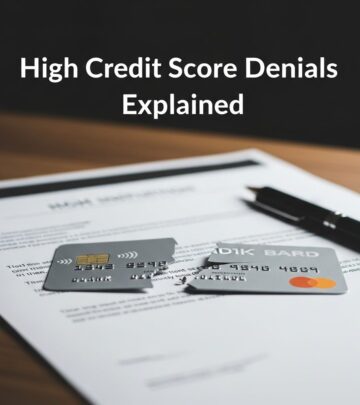
Rejected Credit Card Despite Strong Credit
Discover why excellent credit scores don't guarantee approval and learn proven strategies to boost your chances next time.

Receiving a credit card denial letter can be frustrating, especially when your credit score looks solid. Lenders evaluate far more than just FICO or VantageScore numbers during the approval process. Factors like recent financial changes, income stability, and application patterns play crucial roles. This guide breaks down the hidden reasons behind rejections and provides clear paths to recovery and future success.
Understanding the Full Credit Evaluation Process
Credit card issuers use sophisticated algorithms that go beyond basic scores. They pull reports from Equifax, Experian, and TransUnion, analyzing payment history, utilization, inquiries, and public records. Even a 750+ score might not suffice if other red flags appear. Federal regulations require issuers to send an adverse action notice detailing primary reasons within 30 days, helping you pinpoint issues.
Key elements in their decision-making include:
- Payment reliability: Consistent on-time payments build trust, but any lapses signal risk.
- Debt burden: High balances relative to limits or income raise concerns.
- Account diversity: A mix of revolving and installment debt shows balanced management.
- Recent activity: New accounts or inquiries can suggest instability.
Top Reasons for Denial with Excellent Credit Scores
Surprisingly, high scores don’t immunize against rejection. Here’s why even strong profiles get turned down.
1. Income Falls Short of Expectations
Issuers verify income to ensure repayment capacity. They calculate debt-to-income (DTI) ratios, ideally under 36%. If your reported earnings seem insufficient for the card’s typical limits—often $5,000+ annually per applicant—approval stalls. Self-employed individuals or those with variable pay face extra scrutiny, as lenders prefer stable W-2 documentation.
Students, gig workers, or recent graduates often underestimate includable income like alimony, investments, or spousal support. Listing only base salary misses the full picture.
2. Elevated Debt Levels Despite Low Utilization
Your credit utilization (balances divided by limits) under 30% boosts scores, but total debt across loans matters too. A high DTI from mortgages, auto loans, or student debt signals overextension. For instance, $50,000 in revolving debt with $100,000 income yields a 50% DTI, prompting caution.
| DTI Range | Risk Level | Lender Response |
|---|---|---|
| < 30% | Low | High approval odds |
| 30-40% | Moderate | Possible with strong history |
| > 40% | High | Likely denial |
3. Surge in Recent Credit Inquiries
Multiple hard inquiries within 12 months—say, 5+ from cards, loans, or mortgages—suggest desperation or poor planning. Each pull dings scores temporarily (5-10 points) and flags risk. Premium cards like travel rewards have stricter thresholds, viewing inquiry sprees as instability.
4. Thin or Stagnant Credit Profile
A short history (under 2 years) or few accounts limits data for algorithms. “Good credit” with minimal activity lacks proof of sustained responsibility. Newcomers to credit or those closing old accounts unintentionally thin their files.
5. Negative Marks Overlooked in Scores
Scores emphasize positives, but issuers scrutinize delinquencies, collections, or judgments. A single 60-day late payment lingers 7 years, outweighing recent perfection. Bankruptcies (Chapter 7/13) stay 10 years, though discharged ones hurt less after 2 years.
6. Frozen Credit Files Blocking Access
Security freezes prevent fraud but halt issuer reviews. Temporary lifts are needed pre-application; forgetting this dooms requests.
7. Mismatched Card Type for Profile
Applying for elite cards (e.g., requiring 800+ scores) with a 700 FICO invites rejection. Business cards demand separate EIN checks, separate from personal scores.
Immediate Steps After Receiving a Denial
Don’t reapply impulsively—wait 30 days minimum to avoid inquiry pileups.
- Review the adverse action notice: It lists top 1-2 reasons with score summaries.
- Pull free weekly reports: AnnualCreditReport.com offers Equifax/Experian/TransUnion views.
- Dispute errors: Inaccurate data (e.g., wrong balances) resolves 20% of issues.
- Check VantageScore/FICO: Free tools from issuers reveal exact models used.
Proven Recovery Strategies for Future Approvals
Build a Robust Financial Profile
Lower DTI by paying debts aggressively. Target high-interest cards first, then consolidate via balance transfers. Aim for utilization under 10% pre-application.
Select Starter or Secured Cards
Secured cards (e.g., deposits $200-$500 become limits) report positively, graduating to unsecured after 6-12 months. Credit-builder loans or authorized user status on trusted accounts thicken files safely.
Master Pre-Approval Checks
Pre-qualify tools use soft pulls, preserving scores. Sites flag matches without commitment, filtering mismatches.
Time Applications Strategically
Space requests 3-6 months apart. Apply mid-week, avoiding month-ends when volumes peak.
Advanced Tactics for Premium Card Access
Once basics stabilize:
- Upgrade existing cards: Request limit increases (soft inquiries often).
- Product change: Switch issuer cards internally without new apps.
- Reconsideration lines: Call denials; provide updated income proof sways 10-20%.
Track progress quarterly. Scores rise 50-100 points in 6 months with discipline.
Frequently Asked Questions
Can I apply again right after denial?
No—wait 30 days. Multiple tries amplify inquiries, worsening odds.
How long do inquiries impact scores?
2 years on reports, but scoring models weigh recent ones heaviest (12 months).
Does becoming an authorized user help?
Yes, if the primary user has excellent history; it boosts age and payment data instantly.
What income sources count?
All verifiable: wages, freelance, rentals, investments, pensions, alimony.
Is denial permanent?
Never—address issues, and approvals follow. Persistence pays.
Long-Term Habits for Unshakable Credit Strength
Maintain 35%+ payment history focus by automating bills. Diversify with one new account yearly max. Monitor via apps for real-time alerts. In 2026’s competitive landscape, proactive profiles secure top rewards: 5% cashback, lounge access, travel perks.
Rejections sting but illuminate paths forward. Implement these steps, and transform “denied” into “approved.”
References
- Why Credit Card Applications Get Denied — Capital One. 2025-10-15. https://www.capitalone.com/learn-grow/money-management/reasons-your-credit-card-application-was-denied/
- Why Was My Credit Card Application Declined? — NerdWallet. 2026-01-20. https://www.nerdwallet.com/credit-cards/learn/why-was-my-credit-card-application-declined
- Why Was My Credit Card Application Denied? — Experian. 2025-11-05. https://www.experian.com/blogs/ask-experian/why-was-my-credit-card-application-denied/
- 10 Potential Reasons Why Your Credit Card Application May Have Been Denied — Citi. 2025-09-12. https://www.citi.com/credit-cards/understanding-credit-cards/why-was-my-credit-card-application-denied
- What can I do if my credit application was denied because of my credit report? — Consumer Financial Protection Bureau (CFPB). 2024-03-01. https://www.consumerfinance.gov/ask-cfpb/my-credit-application-was-denied-because-of-my-credit-report-what-can-i-do-en-1253/
Similar Articles








Read full bio of medha deb