Refinancing Mortgages: Amortization Impact
Discover how loan amortization influences refinancing choices and strategies to optimize your mortgage payments for long-term savings.
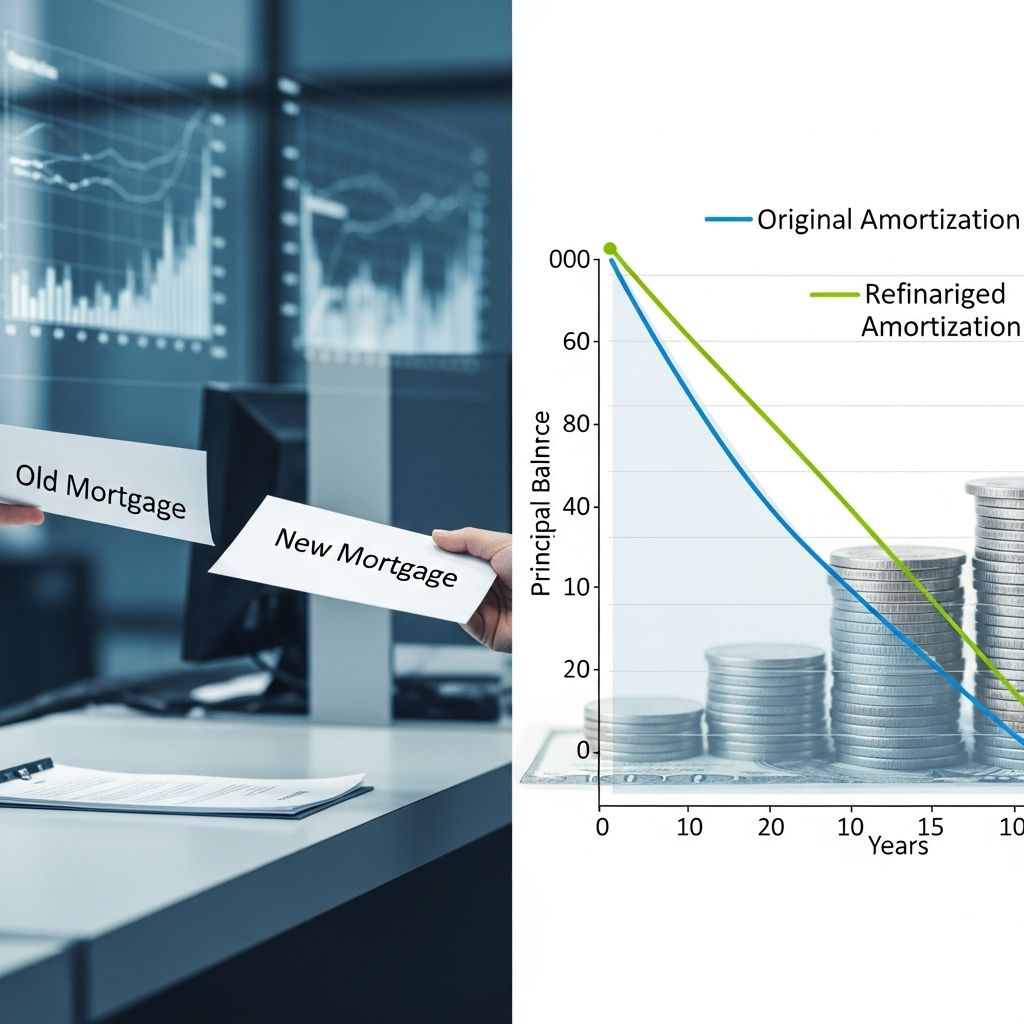
Mortgage refinancing replaces an existing home loan with a new one, often to secure better terms like lower interest rates or adjusted payment schedules. A critical factor in this decision is
loan amortization
, which outlines how each payment allocates between principal reduction and interest over the loan’s life. Understanding this process helps homeowners assess whether refinancing accelerates equity growth or extends interest payments.Understanding Loan Amortization Basics
Amortization refers to the gradual repayment of a loan through scheduled payments that cover both principal and interest. Early in the loan term, most of the payment goes toward interest, with a smaller portion reducing the principal balance. As time progresses, this ratio shifts, directing more funds to principal payoff.
For a typical 30-year fixed-rate mortgage, this front-loaded interest structure means borrowers build equity slowly at first. Consider a $250,000 loan at 4% interest: the monthly principal-and-interest payment is approximately $1,193.54. In the first month, interest alone consumes about $833, leaving just $360 for principal.
- Key Components: Principal (amount borrowed), interest (cost of borrowing), and sometimes escrow for taxes and insurance.
- Amortization Schedule: A table detailing each payment’s breakdown, remaining balance, and cumulative interest paid.
- Impact of Term Length: Longer terms lower monthly payments but increase total interest; shorter terms do the opposite.
Why Amortization Matters in Refinancing
Refinancing resets the amortization schedule, creating a new loan with fresh terms. This “restart” can be advantageous with lower rates but risky if it prolongs high-interest periods. For instance, switching to a longer term reduces monthly outlays but may inflate lifetime costs.
Homeowners midway through their original loan—where principal payments are rising—might hesitate to refinance into another 30-year term, as it recycles early-stage interest dominance. Instead, opting for a 15- or 20-year loan accelerates payoff and equity accumulation.
| Loan Stage | Payment Allocation | Equity Build |
|---|---|---|
| Early (Years 1-10) | 70-90% Interest | Slow |
| Mid (Years 11-20) | 50-70% Interest | Moderate |
| Late (Years 21-30) | 20-50% Interest | Fast |
This table illustrates typical shifts in a 30-year mortgage, highlighting why timing affects refinance value.
Types of Mortgage Refinancing Options
Different refinance strategies interact uniquely with amortization:
- Rate-and-Term Refinance: Adjusts interest rate and/or term without cash exchange. Lowers payments via reduced rates but resets amortization clock.
- Cash-Out Refinance: Borrows more than owed, providing cash for other uses. Increases principal, extending amortization and interest.
- Cash-In Refinance: Pays down principal upfront, shrinking the balance and potentially qualifying for better rates.
- No-Closing-Cost Refinance: Rolls fees into the loan, slightly raising principal and monthly payments.
Each type alters the amortization trajectory, demanding careful comparison of new schedules.
Step-by-Step Guide to the Refinancing Process
Navigating refinancing involves structured steps, each influencing the final amortization outcome.
- Assess Goals: Determine if aiming for lower payments, shorter term, or cash access. Review current amortization to gauge progress.
- Check Eligibility: Lenders evaluate credit score, debt-to-income ratio (DTI), and home equity. Strong profiles secure better rates.
- Apply and Shop Rates: Submit documents like income proof and asset statements. Receive a Good Faith Estimate and Truth-in-Lending disclosure.
- Appraisal and Underwriting: Property valuation confirms equity; underwriters approve based on risk.
- Lock Rate: Secure interest rate against market shifts, often with a deposit credited to closing.
- Review Closing Disclosure: Finalizes costs three days pre-closing.
- Close and Fund: Sign documents, pay fees, and await rescission period (three business days). Old loan pays off; new one activates.
This process typically spans 30-45 days, culminating in a new amortization schedule.
Calculating Your New Amortization Schedule
To predict refinance impacts, compute the new schedule using principal, rate, and term. Formula for monthly payment (P):
[ P = (r · PV) / (1 – (1 + r)^-n) ]
Where r is monthly rate, PV is present value (balance), n is payments remaining.
Example Comparison:
| Scenario | Balance | Rate | Term | Monthly P&I | Total Interest |
|---|---|---|---|---|---|
| Original (10 yrs paid) | $200,000 | 4% | 20 yrs | $1,215 | $92,000 |
| Refi 30-yr | $200,000 | 3% | 30 yrs | $843 | $103,500 |
| Refi 15-yr | $200,000 | 3% | 15 yrs | $1,380 | $48,400 |
Refinancing to 30 years saves $372 monthly but adds $11,500 in interest. A 15-year term costs $165 more monthly but saves $43,600 overall.
Pros and Cons of Refinancing with Amortization in Mind
Advantages
- Lower rates reduce interest portion, freeing cash flow.
- Shorter terms build equity faster, reducing total interest.
- Remove PMI if equity hits 20%.
Disadvantages
- Reset clock prolongs interest-heavy payments.
- Closing costs (2-5% of loan) may offset savings.
- Extended terms increase lifetime costs.
Strategies to Maximize Refinance Benefits
To counter amortization resets:
- Refinance only if break-even (costs/recurring savings) is under 2-3 years.
- Choose terms matching remaining original timeline.
- Make extra principal payments post-refi to mimic accelerated schedule.
- Compare multiple lenders for optimal rates.
Government resources emphasize evaluating full costs before proceeding.
Frequently Asked Questions (FAQs)
What happens to my amortization schedule when I refinance?
It resets with the new loan’s terms, restarting principal-interest allocation.
Is it better to refinance to a shorter or longer term?
Shorter terms save interest but raise payments; longer ease cash flow but cost more overall. Align with financial goals.
How do closing costs affect amortization?
Financed costs increase principal, extending the schedule slightly.
Can I refinance if I’ve paid off much of my principal?
Yes, strong equity improves rates, but weigh reset against progress.
What’s the break-even point for refinancing?
Divide closing costs by monthly savings; aim for recovery within 24-36 months.
Final Considerations for Smart Refinancing
Amortization profoundly shapes refinance outcomes. Tools like online calculators aid projections, but consult professionals for personalized advice. With rates fluctuating, timing is key—act when savings outweigh reset costs. This approach ensures refinancing enhances financial stability and homeownership goals.
References
- Refinancing and Your Amortization Schedule – What You Need to Know — Ent Credit Union. 2023. https://www.ent.com/education-center/life-events-major-purchases/refinancing-and-your-amortization-schedule-what-you-need-to-know/
- 5 Steps of the Mortgage Refinancing Process — Citizens Bank. 2024. https://www.citizensbank.com/learning/refinance-process.aspx
- How Does Refinancing Work — loanDepot. 2024. https://www.loandepot.com/refinance/how-does-refinancing-work
- How Does Refinancing a Mortgage Work? — PNC Insights. 2025-03-15. https://www.pnc.com/insights/personal-finance/borrow/how-does-refinancing-mortgage-work.html
- Refinancing a mortgage: How it works — Rocket Mortgage. 2025. https://www.rocketmortgage.com/learn/how-does-refinancing-work
- Refinancing A Mortgage: What It Means, How It Works — Bankrate. 2025-02-20. https://www.bankrate.com/mortgages/how-does-refinancing-a-mortgage-work/
- How Loan Amortization Can Affect Your Decision to Refinance — Experian. 2024-06-10. https://www.experian.com/blogs/ask-experian/how-loan-amortization-can-affect-decision-to-refinance/
- A Consumer’s Guide to Mortgage Refinancings — Federal Reserve. 2004-10-01 (authoritative guide, remains relevant for core processes). https://www.federalreserve.gov/pubs/refinancings/
Similar Articles








Read full bio of medha deb