Refinancing: Does It Restart Loan Term?
Explore how refinancing impacts your loan timeline, costs, and savings—make informed choices for your financial future.

Refinancing a loan typically involves taking out a new loan to pay off an existing one, which frequently results in a fresh repayment period that starts from the beginning. This process can lower interest rates or adjust monthly payments but extends the overall time to become debt-free unless you specifically shorten the term.
Understanding the Core Mechanics of Loan Refinancing
At its essence, refinancing substitutes your current debt obligation with a new agreement tailored to current market conditions or your evolving financial needs. Lenders assess your creditworthiness, income stability, and asset position much like they did for the original loan approval. For home loans, this means submitting pay stubs, tax documents, bank statements, and details on the existing mortgage.
The new loan’s structure dictates much of the outcome. Borrowers often select terms ranging from 15 to 30 years for mortgages, effectively resetting the clock even if years remain on the prior loan. Auto refinances similarly offer terms up to 84 months, potentially prolonging payoff compared to the original schedule.
Types of Refinancing Options Available
Refinancing comes in several forms, each altering the loan term differently:
- Rate-and-Term Refinance: Focuses on securing a lower rate or different duration without pulling equity. This directly resets the term if you choose a new length.
- Cash-Out Refinance: Increases the loan principal to access home equity as cash, usually with a full new term applied.
- Cash-In Refinance: Involves paying down principal upfront to qualify for better rates, still starting a new term.
- No-Closing-Cost Refinance: Rolls fees into the loan balance, maintaining a reset term but raising the principal slightly.
These variations allow flexibility, but all generally initiate a new repayment timeline unless customized otherwise.
Step-by-Step Journey Through the Refinancing Process
Navigating refinancing mirrors securing initial financing but skips property search hassles. Here’s a breakdown:
- Evaluate Readiness: Review credit scores—aim for 620+ for conventional options—and calculate equity via recent home valuation.
- Shop Lenders: Compare rates from banks, credit unions, and online platforms, considering fees and service quality.
- Submit Application: Provide W-2s, pay stubs, tax returns, and asset proofs. Expect a Good Faith Estimate outlining costs.
- Undergo Review: Processors collect docs, underwriters scrutinize credit and debts, appraisers value the property, and title firms clear liens.
- Lock Rates: Secure an interest rate amid market fluctuations, often valid until closing.
- Receive Disclosures: Get a Closing Disclosure days before finalizing, detailing all fees.
- Close and Fund: Sign documents, pay costs (or roll them in), and await the three-day rescission period before the old loan pays off.
This sequence typically spans 30-45 days, culminating in new mortgage statements.
Financial Implications: Payments, Interest, and Total Costs
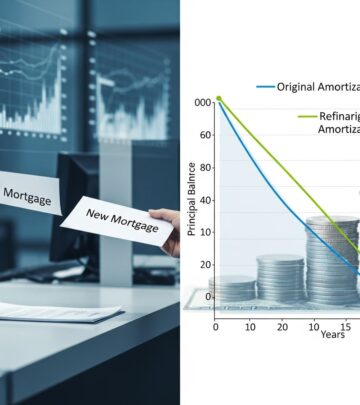
Resetting the term profoundly affects affordability. A lower rate on a 30-year mortgage slashes monthly outflows—say, from $1,500 to $1,200 on a $250,000 balance—but you pay interest over more years, potentially exceeding original totals.
| Scenario | Original Loan (20 years left) | Refinance to 30 Years | Refinance to 15 Years |
|---|---|---|---|
| Monthly Payment | $1,500 | $1,200 | $1,800 |
| Total Interest Paid | $120,000 | $182,000 | $80,000 |
| Payoff Time | 20 years | 30 years | 15 years |
Note: Figures are illustrative based on 6% original rate dropping to 4%; actuals vary.
Closing costs, 2-5% of loan amount ($4,000-$10,000 on $200,000), demand breakeven analysis: divide by monthly savings to gauge recovery months.
Effects on Credit Profile and Borrowing Power
Multiple inquiries ding scores temporarily (5-10 points), but timely payments on the new loan boost profiles long-term. High debt-to-income ratios improve with lower payments, enhancing future borrowing capacity.
When Refinancing Makes Strategic Sense
Ideal timing aligns with rate drops (0.5-1% savings), stable residency plans, and strong equity. Use calculators to project savings exceeding costs within your stay duration. Avoid if planning a move soon or facing prepayment penalties.
Common Pitfalls and How to Sidestep Them
- Overlooking Fees: Factor lender charges, appraisals ($300-500), and title work.
- Extending Unnecessarily: Longer terms ease cash flow but inflate interest; balance with goals.
- Ignoring Equity: Cash-out erodes buffers against market dips.
- Rushing Applications: Poor credit or incomplete docs delay approvals.
Refinancing Beyond Mortgages: Auto and Personal Loans
Auto refinancing follows similar steps but emphasizes vehicle value via inspections. Terms reset here too, often to 36-72 months, cutting rates from 7%+ to 4-5% for qualified drivers. Personal loans refinance debt consolidation, restarting 3-7 year clocks.
Future-Proofing Your Refinance Decision
Monitor Federal Reserve actions and economic shifts for rate trends. Consult advisors for personalized math, ensuring alignment with retirement or major life events. Tools like amortization schedules reveal true costs.
Frequently Asked Questions
Does refinancing always extend my loan term?
No, you can select shorter terms to accelerate payoff, though payments rise.
How soon after refinancing can I do it again?
Typically 6 months for conventional loans, but seasoning rules vary by lender and type.
Will refinancing hurt my credit score?
Short-term dips from inquiries, but long-term gains from better terms.
What’s the breakeven point for refinancing?
Closing costs divided by monthly savings; aim for recovery within 2-3 years.
Can I refinance if I have low equity?
Limited options exist, like FHA streamline, but most require 20% equity.
Refinancing empowers financial recalibration when approached methodically. Weigh term resets against holistic benefits for optimal results.
References
- 5 Steps of the Mortgage Refinancing Process — Citizens Bank. 2023. https://www.citizensbank.com/learning/refinance-process.aspx
- How Does Refinancing a Mortgage Work? — PNC Insights. 2024. https://www.pnc.com/insights/personal-finance/borrow/how-does-refinancing-mortgage-work.html
- Refinancing a mortgage: How it works — Rocket Mortgage. 2024. https://www.rocketmortgage.com/learn/how-does-refinancing-work
- What Is a Mortgage Refinance, and How Does it Work? — Freedom Mortgage. 2023. https://www.freedommortgage.com/learn/refinancing/what-is-refinance
- Refinancing A Mortgage: What It Means, How It Works — Bankrate. 2024. https://www.bankrate.com/mortgages/how-does-refinancing-a-mortgage-work/
- How Mortgage Refinancing Works — Space Coast Credit Union. 2023. https://www.sccu.com/articles/home-mortgage/how-mortgage-refinancing-works
- How Does Refinancing a Mortgage Work? — Experian. 2024. https://www.experian.com/blogs/ask-experian/how-does-refinancing-a-mortgage-work/
Similar Articles








Read full bio of medha deb