Refinance or Consolidate Student Loans?
Discover whether refinancing or consolidating your student loans best fits your financial goals, with expert comparisons on rates, benefits, and eligibility.
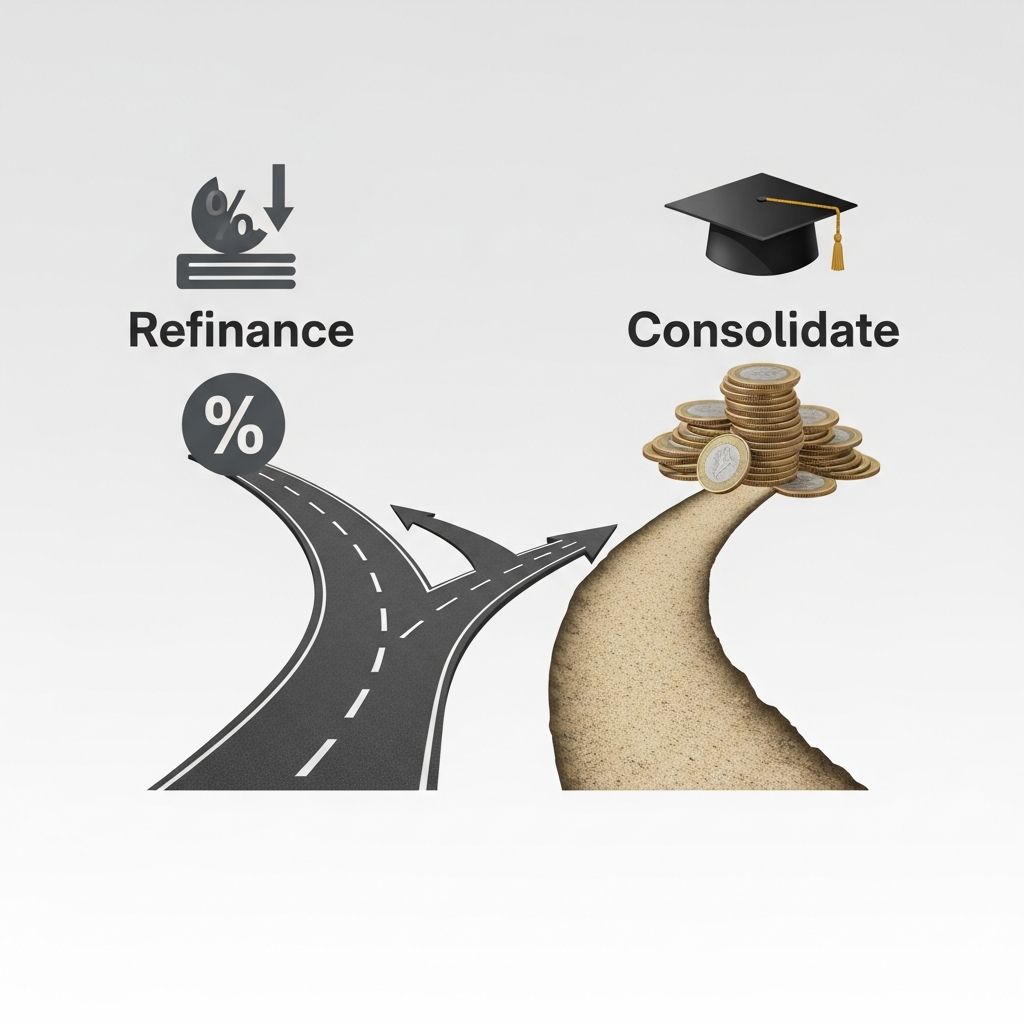
Managing multiple student loans can feel overwhelming, with varying interest rates, payment schedules, and servicers adding to the complexity. Two popular strategies to streamline this burden are refinancing and consolidation. Refinancing replaces your existing loans with a new private loan, often at a lower interest rate based on your creditworthiness. Consolidation, particularly for federal loans, merges them into a single federal loan with a weighted average rate. Choosing between them hinges on your financial stability, loan types, and long-term objectives.
Defining the Core Concepts
Understanding the fundamentals is crucial before deciding. Student loan consolidation typically applies to federal loans, combining them into one Direct Consolidation Loan through the U.S. Department of Education. This process doesn’t alter the total principal or drastically change rates; instead, it calculates a new fixed rate as the weighted average of the originals, rounded up to the nearest 1/8th of a percent.
Refinancing, on the other hand, involves private lenders who pay off your current loans and issue a new one. This can include both federal and private loans, with rates determined by your credit score, income, and debt-to-income ratio rather than loan averages. The goal here is often cost savings through lower rates or adjusted terms.
Key Differences at a Glance
To visualize the distinctions, consider this comparison table:
| Feature | Consolidation | Refinancing |
|---|---|---|
| Eligible Loans | Federal only (Direct, FFEL) | Federal and/or private |
| Interest Rate | Weighted average, rounded up | Market-based, credit-driven |
| Federal Benefits Retained | Yes (IDR, forgiveness) | No |
| Credit Check Required | No | Yes |
| Potential for Lower Rate | No | Yes, if good credit |
This table highlights how consolidation prioritizes simplicity and benefit preservation, while refinancing targets savings.
Advantages of Loan Consolidation
Consolidation shines for borrowers valuing federal protections. By merging loans, you deal with one servicer and one payment, reducing administrative hassle. For example, if you hold several federal loans totaling $40,000 with mixed rates, consolidation creates a single loan at an averaged rate, easing tracking.
- Preserve Protections: Keep access to income-driven repayment (IDR) plans, which cap payments at a percentage of discretionary income, and forgiveness programs like Public Service Loan Forgiveness (PSLF).
- Flexible Terms: Opt for extended repayment up to 30 years to lower monthly outlays, though this increases total interest paid.
- Fixed Rate Lock: Converts variable rates to fixed, shielding against hikes.
- No Credit Impact: Ideal if your credit isn’t strong, as approval doesn’t hinge on it.
Professionals in public service or those anticipating income dips often benefit most, maintaining pathways to relief.
Drawbacks to Watch with Consolidation
Despite upsides, consolidation isn’t flawless. The rate, being an average, won’t decrease—some loans may even see slight increases due to rounding. Extending terms for affordability often leads to higher lifetime costs. Private loans can’t qualify for federal consolidation, limiting its scope. Additionally, switching servicers might disrupt payment history if not managed carefully.
Benefits That Make Refinancing Attractive
Refinancing appeals to those with solid credit seeking savings. Lenders offer competitive rates, potentially dropping payments significantly. A borrower with good credit might secure a rate below their current average, accelerating payoff or freeing cash for other goals.
- Rate Reduction: Custom rates based on qualifications, often lower than federal averages.
- Universal Application: Handles mixed loan portfolios seamlessly.
- Term Customization: Shorten for quicker repayment or extend for breathing room.
- Co-Signer Release: Many programs allow removing cosigners after good payment history.
- Fixed Predictability: Swap variables for stability amid rate uncertainty.
High earners or those without federal benefit needs frequently save thousands this way.
Potential Pitfalls of Refinancing
The primary downside is forfeiting federal perks. Refinanced loans become private, losing IDR, deferment, and forgiveness eligibility. If economic hardship strikes, options narrow. It requires strong credit; poor scores may yield high rates or denial. Shop multiple lenders to avoid this.
Ideal Scenarios for Each Approach
When Consolidation Fits Best
Opt for consolidation if:
- You have only federal loans and want to retain benefits like PSLF or IDR.
- Simplifying payments is priority over rate cuts.
- Your credit doesn’t support refinancing.
- You’re pursuing forgiveness-qualifying employment.
When Refinancing Makes Sense
Choose refinancing when:
- You have excellent credit for better rates.
- No plans for federal programs.
- Managing private or mixed loans.
- Seeking aggressive payoff via shorter terms.
Real-World Examples: Crunching the Numbers
Suppose you owe $50,000 across federal loans at 6.5% average rate, standard 10-year term, monthly payment ~$580. Consolidation keeps this rate (rounded), one payment. Extend to 25 years: drops to ~$340/month, but total interest balloons from ~$20,000 to $52,000.
Refinance at 4.5% (strong credit), same term: payment falls to ~$520/month, saving ~$7,200 interest. Shorten to 5 years at 4%: ~$930/month, paid off faster. Use calculators from lenders to model your scenario.
Navigating the Application Process
For consolidation, apply via StudentAid.gov. Gather loan details; process takes 30-60 days. Select IDR post-consolidation.
Refinancing: Compare lenders (credit unions, banks). Submit financials; approval in days. Funds pay old loans directly. Prequalify without hard inquiries.
Frequently Asked Questions
Can I do both consolidation and refinancing?
Yes, sequentially. Consolidate federal loans first, then refinance the result if rates drop and benefits aren’t needed.
Does consolidation hurt my credit?
No, as it doesn’t require a credit check and payments continue seamlessly.
Is refinancing worth losing federal benefits?
Only if savings outweigh potential forgiveness and you have stable finances.
How often can I consolidate?
Once per loan group, but refinance anytime with new lenders.
What if rates are high now?
Wait for drops or consolidate for fixed protection.
Strategic Tips for Success
Assess goals: simplification or savings? Run projections. Improve credit pre-refinance. Avoid if pursuing forgiveness. Monitor rates; refinance multiples if beneficial. Consult non-profits like NFCC for guidance.
Ultimately, align with your horizon—federal perks for uncertainty, private savings for stability.
References
- Student loan refinancing vs. consolidation – Citizens Bank — Citizens Bank. 2023. https://www.citizensbank.com/learning/student-loan-consolidation-vs-refinancing.aspx
- The Basics of Consolidation vs. Refinancing Student Loans — Navy Federal Credit Union. 2023. https://www.navyfederal.org/makingcents/college-planning/student-loans-refinancing-vs-consolidation.html
- Student Loan Consolidation vs. Refinancing – MEFA — MEFA. 2023. https://www.mefa.org/article/education-loan-consolidation-vs-refinancing/
- Should I consolidate or refinance my student loans? — Consumer Financial Protection Bureau. 2024-03-15. https://www.consumerfinance.gov/ask-cfpb/should-i-consolidate-refinance-student-loans-en-561/
- Student Loan Consolidation vs Refinancing – Sallie Mae — Sallie Mae. 2023. https://www.salliemae.com/blog/student-loan-consolidation-vs-refinancing/
- Student Loans: Consolidation vs. Refinancing – ELFI — ELFI. 2023. https://www.elfi.com/difference-between-student-loan-consolidation-and-refinancing/
- Student Loan Consolidation vs. Refinancing: What’s the Difference? — Nelnet Bank. 2023. https://www.nelnetbank.com/learning-center/consolidation-vs-refinancing/
Similar Articles








Read full bio of Sneha Tete