Recourse vs Non-Recourse Loans: Key Differences
Understand the critical differences between recourse and non-recourse loans and how they affect borrowers.
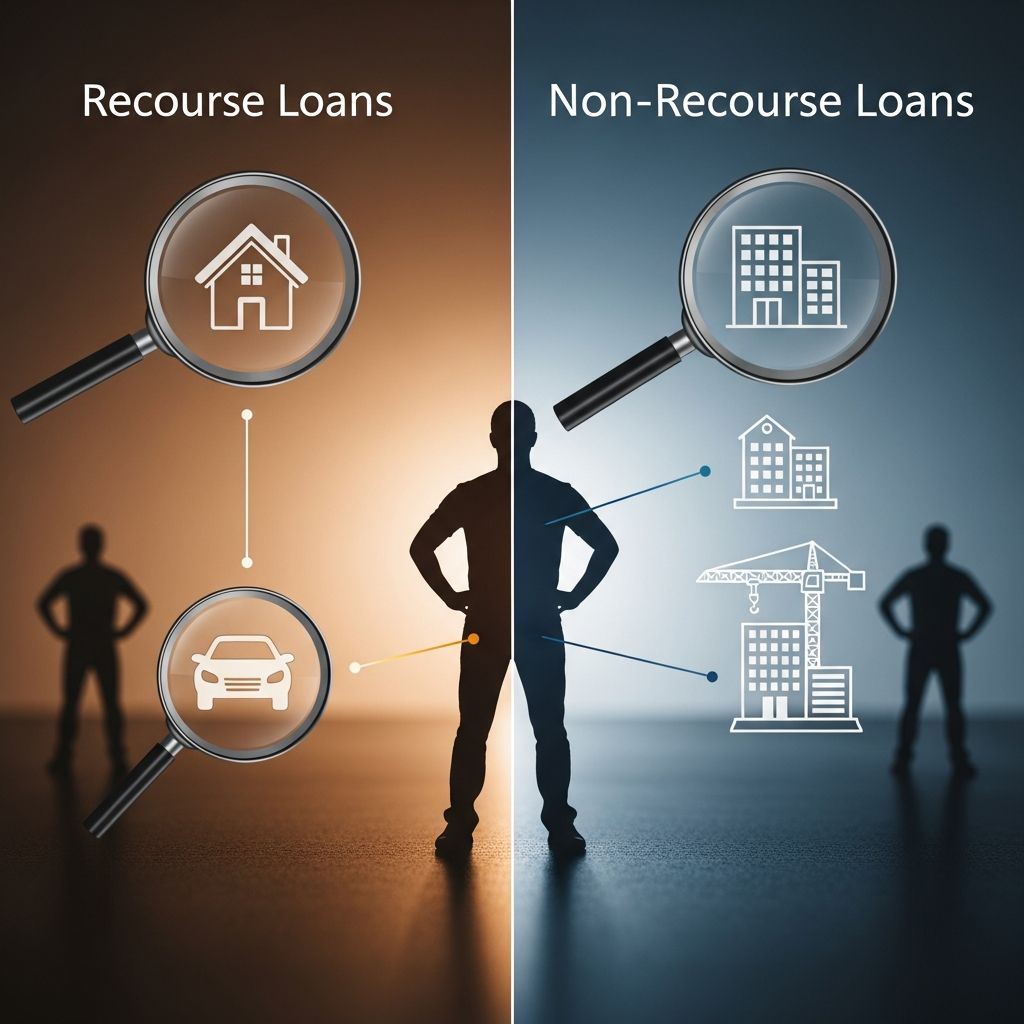
Recourse vs Non-Recourse Loans: Understanding the Fundamental Differences
When borrowing money for significant purchases like real estate or business ventures, it’s crucial to understand the types of loans available and how they affect your personal financial liability. Two primary loan structures exist in the lending world: recourse loans and non-recourse loans. While both are secured by collateral, they differ significantly in terms of borrower liability, risk allocation, and loan conditions. Understanding these distinctions can help you make more informed financial decisions and protect your assets.
The choice between a recourse and non-recourse loan can have substantial implications for your financial future. A recourse loan allows a lender to pursue your personal assets if the collateral doesn’t cover the full loan balance, while a non-recourse loan limits the lender’s recovery to only the pledged collateral. This fundamental difference impacts everything from interest rates to loan approval requirements.
What Is a Recourse Loan?
A recourse loan is a secured loan in which the lender has the right to pursue not only the collateral pledged against the loan but also other personal assets of the borrower if the collateral sale fails to cover the outstanding debt. In essence, the borrower maintains full personal liability for the entire loan amount.
When you default on a recourse loan, the lender can seize the collateral first. However, if selling that collateral doesn’t generate enough proceeds to cover what you owe, the lender can then go after your other assets. This might include your home, car, bank accounts, investment accounts, or even your wages through garnishment. The lender has multiple avenues to recover the remaining debt, which is why it’s called a “recourse” loan—the lender has recourse to other assets beyond the original collateral.
Recourse loans are the most common type of financing offered by banks and traditional lending institutions. Most mortgages, auto loans, personal loans, bridge loans, and construction loans operate as recourse loans. Because lenders have additional protection through the borrower’s personal assets, they’re willing to offer more favorable terms.
What Is a Non-Recourse Loan?
A non-recourse loan is a secured loan where the lender can only seize the specific collateral pledged against the loan in case of default. The borrower’s personal liability is limited entirely to the collateral. If the collateral sale doesn’t cover the full outstanding debt, the lender must absorb the loss and cannot pursue the borrower’s other assets or income.
Non-recourse loans are less common than recourse loans and are typically offered for specific asset classes and situations. These loans are frequently used in commercial real estate financing, particularly through government-sponsored enterprises like Fannie Mae and Freddie Mac, as well as in commercial mortgage-backed securities (CMBS) financing. Non-recourse loans are also increasingly popular in self-directed IRA investments.
With a non-recourse loan, the borrower has significant protection. If you default and the property is foreclosed upon and sold for less than what you owe, you have no obligation to pay the difference. However, this protection comes with important caveats. Most non-recourse loans include “bad act carve-outs,” which mean the non-recourse protection can be waived if the borrower commits fraud, intentionally misrepresents the property, or violates specific loan covenants.
Key Differences Between Recourse and Non-Recourse Loans
Understanding the distinctions between these loan types is essential for any borrower. Here are the major differences:
Borrower Liability
Recourse Loans: The borrower is personally liable for the entire loan amount. If you default and the collateral is sold for less than the outstanding balance, you remain responsible for the deficiency.
Non-Recourse Loans: The borrower’s liability is limited to the collateral only. Once the collateral is seized and sold, the lender’s claim is satisfied, even if the sale proceeds don’t cover the full debt.
Risk Allocation
Recourse Loans: These loans shift the majority of risk to the borrower. Because the lender can pursue personal assets, the borrower faces potentially unlimited financial exposure.
Non-Recourse Loans: These loans shift the majority of risk to the lender. The lender’s recovery is capped at the collateral value, making these loans riskier for lenders but safer for borrowers.
Interest Rates and Terms
Recourse Loans: Because lenders have lower risk through access to multiple repayment sources, recourse loans typically offer lower interest rates. A Federal Reserve study from December 2021 found that recourse loans have interest rates approximately 52 basis points lower than non-recourse loans. Recourse loans also typically feature more flexible terms and higher loan-to-value (LTV) ratios.
Non-Recourse Loans: To compensate for higher lender risk, non-recourse loans carry higher interest rates and more conservative terms. These loans typically feature lower LTV ratios, usually around 2.8% lower than recourse loans, meaning borrowers must put down larger down payments.
Borrower Qualification Requirements
Recourse Loans: Lenders can approve recourse loans for borrowers with varying experience levels and credit profiles. Lenders may consider the borrower’s personal income and creditworthiness as additional security.
Non-Recourse Loans: Non-recourse lenders are typically much more selective. They generally require experienced, financially strong borrowers with significant assets. The property itself must also be strong, located in desirable markets, and meet specific performance metrics.
Applicable Asset Types
Recourse Loans: Recourse loans can be used for virtually any asset type—residential property, commercial real estate, vehicles, equipment, or personal purposes.
Non-Recourse Loans: Non-recourse loans are typically restricted to strong assets in strong locations. These loans are commonly used for stabilized commercial multifamily properties, office buildings, and industrial properties in primary markets.
Practical Example: How Risk Differs
Consider Sarah, who borrows $2 million to purchase an apartment building. She makes a $500,000 down payment, leaving a $1.5 million loan balance.
If this were a recourse loan: The property value declines to $1.2 million. Sarah defaults, and the lender forecloses and sells the property for $1.2 million. This leaves a $300,000 deficiency. Because it’s a recourse loan, the lender can pursue Sarah’s personal assets—potentially her wages, her home, her other investment properties, or her bank accounts—to recover that $300,000.
If this were a non-recourse loan: The same scenario occurs—the property sells for $1.2 million with a $300,000 deficiency. However, because it’s a non-recourse loan, the lender cannot pursue Sarah’s personal assets. The lender must absorb the $300,000 loss (assuming Sarah hasn’t violated any bad act carve-outs). Sarah walks away from the deal with no additional liability.
Conversion from Recourse to Non-Recourse
In commercial real estate financing, some lenders offer hybrid structures that begin as recourse loans but convert to non-recourse loans once specific conditions are met. This approach benefits both parties: the lender retains protection during the riskier development or stabilization phase, while the borrower gains non-recourse status once the property performs well.
A typical conversion scenario might work like this: An investor takes a recourse loan to acquire and renovate a multifamily property. The lender stipulates that the financing automatically becomes non-recourse once the property achieves a 90% occupancy rate for three consecutive months following capital improvements. Additionally, the property must maintain a debt service coverage ratio (DSCR) of 1.20x or 1.25x during that period. Once these milestones are achieved, the borrower’s personal liability is eliminated.
Advantages and Disadvantages
Recourse Loan Advantages and Disadvantages
Advantages for Borrowers:
– Lower interest rates- More flexible loan terms- Higher loan-to-value ratios- Easier approval process- Wider availability
Disadvantages for Borrowers:
– Full personal liability- Risk of asset seizure beyond collateral- Potential wage garnishment- Higher financial exposure
Non-Recourse Loan Advantages and Disadvantages
Advantages for Borrowers:
– Limited personal liability- Protection of personal assets- Ability to walk away if collateral value declines- Better capital preservation in self-directed IRAs- Simpler syndication and partnership structures- Ability to increase leverage without personal income restrictions
Disadvantages for Borrowers:
– Higher interest rates- More conservative terms- Lower loan-to-value ratios- Stricter qualification requirements- Limited availability- Typically restricted to strong assets
Comparison Table: Recourse vs. Non-Recourse Loans
| Feature | Recourse Loan | Non-Recourse Loan |
|---|---|---|
| Risk Profile | Riskier for borrowers | Riskier for lenders |
| Borrower Liability | Full personal liability | Limited to collateral |
| Lender Recourse | Can pursue personal assets | Limited to collateral only |
| Interest Rate | Lower (approximately 52 basis points) | Higher |
| Loan-to-Value Ratio | Higher (approximately 2.8% more) | Lower |
| Borrower Profile | Any creditworthy borrower | Experienced, financially strong |
| Asset Types | Any asset type | Restricted to strong assets |
| Common Examples | Mortgages, auto loans, personal loans | CMBS, Fannie Mae/Freddie Mac loans |
Frequently Asked Questions
Q: Can a lender pursue my personal assets with a recourse loan?
A: Yes. If you default on a recourse loan and the collateral sale doesn’t cover the full debt, the lender can pursue your personal assets, including bank accounts, investments, other property, and even garnish your wages.
Q: Are non-recourse loans always better for borrowers?
A: Non-recourse loans offer better protection but come with significant trade-offs. They typically have higher interest rates, lower LTV ratios, and stricter qualification requirements. The better choice depends on your specific situation and priorities.
Q: What are “bad act carve-outs” in non-recourse loans?
A: Bad act carve-outs are exceptions to non-recourse protection. They allow lenders to pursue personal assets if the borrower commits fraud, intentionally misrepresents the property, violates specific loan covenants, or engages in other prohibited conduct.
Q: Which loan type is more common?
A: Recourse loans are far more common. Most mortgages, auto loans, personal loans, and bank financing are structured as recourse loans. Non-recourse loans are primarily used in commercial real estate and specific investment scenarios.
Q: Can a recourse loan become non-recourse?
A: Yes. Some commercial lenders offer conversion features that allow a loan to transition from recourse to non-recourse once the property reaches certain performance milestones, such as achieving stabilized occupancy rates and debt service coverage ratios.
Q: Why do non-recourse loans have higher interest rates?
A: Non-recourse loans carry higher interest rates because lenders assume greater risk. Without access to the borrower’s personal assets, the lender’s recovery is limited to the collateral value, which may not be sufficient in a default scenario.
Making the Right Choice
Choosing between a recourse and non-recourse loan depends on several factors specific to your situation. Consider your financial position, the strength of the asset you’re purchasing, your risk tolerance, and your long-term investment goals.
If you’re purchasing a primary residence or have limited liquid assets, the lower rates of recourse loans may be more advantageous despite the higher personal liability. If you’re an experienced investor purchasing a strong commercial property and want to minimize personal risk, the additional costs of a non-recourse loan might be worthwhile.
Always consult with a financial advisor or attorney before committing to either loan type. Understanding the implications of each choice ensures you make the decision that best aligns with your financial objectives and risk tolerance.
References
- Three Major Differences Between Recourse and Non-Recourse Loans — Mandelbaum Barrett PC. 2023-11-01. https://mblawfirm.com/blog/three-major-differences-between-recourse-and-non-recourse-loans/
- Recourse vs. Non-Recourse Commercial Loans — Multifamily Loans. 2025. https://www.multifamily.loans/apartment-finance-blog/recourse-vs-nonrecourse-loans/
- Recourse vs Non-Recourse Loans Explained and Compared — SoFi. 2025. https://www.sofi.com/learn/content/what-is-a-non-recourse-loan/
- Recourse vs. Non-Recourse Loan—What Do They Mean to Real Estate Investors — Kiavi. 2025. https://www.kiavi.com/blog/recourse-vs.-non-recourse-loan
- Non-Recourse vs. Recourse Loans — Corporate Finance Institute. 2025. https://corporatefinanceinstitute.com/resources/commercial-lending/non-recourse-vs-recourse-loans/
- Board of Governors of the Federal Reserve System – Commercial Real Estate Finance Survey — Federal Reserve. 2021-12. https://www.federalreserve.gov/datadownload/Choose.aspx?rel=CRSBS
Similar Articles








Read full bio of Sneha Tete