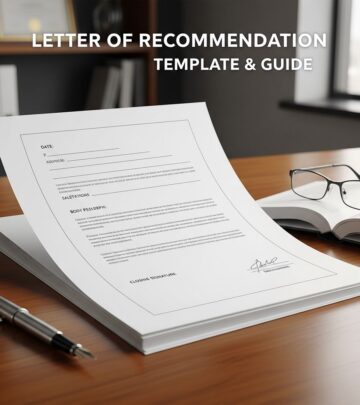
Recommendation Letter Template & Writing Guide
Master the art of writing compelling recommendation letters with proven templates and expert tips.

How to Write a Recommendation Letter: Complete Guide with Templates
A well-crafted recommendation letter can significantly impact someone’s career prospects, academic advancement, or business opportunities. Whether you’re writing for a colleague seeking a promotion, a former employee applying for a new position, or a student pursuing higher education, knowing how to write an effective recommendation letter is essential. This comprehensive guide will walk you through the process, provide proven templates, and share best practices to ensure your letter makes a meaningful impact.
Understanding the Purpose and Importance of Recommendation Letters
Recommendation letters serve as third-party endorsements that validate a person’s qualifications, character, and professional capabilities. Unlike a resume or cover letter written by the applicant themselves, a recommendation letter carries credibility because it comes from someone with direct knowledge of the person’s abilities and work ethic. These letters are commonly requested for job applications, graduate school admissions, professional certifications, business partnerships, and personal references.
The power of a recommendation letter lies in its ability to provide specific examples and concrete evidence of someone’s strengths. Hiring managers and admissions committees rely on these letters to gain insights beyond what’s presented in standard application materials. A thoughtfully written recommendation can distinguish a candidate from others and tip the scales in their favor.
Step 1: Gather Essential Background Information
Before you begin writing, you need to understand the context and purpose of the recommendation letter. This foundational step ensures your letter addresses the right qualities and positions the candidate appropriately for their intended goal.
When someone asks you to write a recommendation letter, take time to ask clarifying questions. Request the following information from them:
- The specific position, program, or opportunity they’re pursuing
- Contact details for the letter’s recipient (hiring manager, admissions officer, etc.)
- A current resume or CV
- A detailed job description or program requirements
- Specific examples, accomplishments, or skills they’d like you to highlight
- The deadline for submission
- Their preferred submission method (email, mail, online portal)
Having this information in hand allows you to craft a focused letter that emphasizes the most relevant qualities and accomplishments. It also demonstrates that you take the request seriously and are willing to invest time in creating a personalized, impactful document.
Step 2: Establish Your Professional Connection
A strong recommendation letter begins by clearly establishing your relationship with the person you’re recommending. The recipient needs to understand your credibility and why your opinion matters. Explain how you know the candidate, the nature of your professional relationship, and the duration of your working relationship.
For example, you might write: “I had the pleasure of working with Marcus as his direct supervisor at TechCore Solutions for three years” or “Sarah was a standout student in my Advanced Marketing seminar during the 2023 academic year.” This context helps the reader understand the basis for your recommendation and the depth of your knowledge about the candidate.
Be specific about your role relative to the candidate. Were you their supervisor, peer, subordinate, professor, or mentor? Different relationships provide different perspectives, and being clear about this helps readers interpret your recommendations appropriately.
Step 3: Highlight Key Strengths and Accomplishments
The body of your recommendation letter should focus on specific strengths, skills, and accomplishments that directly relate to the position or opportunity the candidate is pursuing. Rather than using generic descriptions, provide concrete examples that demonstrate their capabilities.
Instead of writing “Sarah is a great communicator,” try “Sarah led our team’s client presentation on three major accounts, resulting in a 25% increase in contract renewals. Her ability to translate complex technical concepts into clear business benefits consistently impressed both our internal team and external clients.”
Focus on qualities that matter most for their target role:
- Leadership and decision-making abilities
- Problem-solving and innovation
- Team collaboration and interpersonal skills
- Technical expertise and industry knowledge
- Work ethic and reliability
- Adaptability and learning agility
- Project management and organizational skills
Each strength should be supported by a specific example or story that illustrates the quality in action. This makes your letter more compelling and credible.
Step 4: Master the Letter Format and Structure
A professional recommendation letter follows a standard business format that includes specific essential elements:
- Your contact information: Include your name, title, organization, phone number, and email address
- Date of writing: Add the current date
- Recipient information: Include the name, title, organization, and address of the person receiving the letter
- Formal salutation: Begin with “Dear [First and Last Name]” or “Dear Hiring Manager” if the recipient’s name is unknown
- Opening paragraph: State your purpose and establish your relationship with the candidate
- Body paragraphs: Provide specific examples and details supporting your recommendation
- Closing paragraph: Summarize your endorsement and offer to provide additional information
- Professional signature: Include your handwritten signature, typed name, title, and organization
Keep your letter concise yet comprehensive, typically one page in length. Use professional letterhead if available and maintain a formal tone throughout.
Recommendation Letter Template
Use this template as a starting point for your recommendation letter:
[Your Name]
[Your Title]
[Organization]
[Email Address]
[Phone Number]
[Date]
Dear [Recipient’s Name],
I am pleased to recommend [Candidate’s Name] for the [Position/Program] at [Organization]. I have had the opportunity to work closely with [Candidate] at [Your Organization] for [number] years, during which time [he/she/they] served as [their role]. During our time together, [Candidate] has proven to be an invaluable member of our team and has consistently demonstrated exceptional abilities in [key skill].
[Candidate] possesses outstanding [relevant skill or quality]. Specifically, [provide concrete example of achievement]. This experience showcases [his/her/their] ability to [relevant outcome].
Beyond technical capabilities, [Candidate] is an excellent [soft skill] who brings [specific quality] to every project. [He/She/They] is [describe personality trait] and has a remarkable ability to [describe capability]. These qualities, combined with [his/her/their] dedication and work ethic, make [him/her/them] an exceptional candidate for your organization.
I am confident that [Candidate] will make significant contributions to your team and would be a tremendous asset to [Organization]. Without hesitation, I recommend [him/her/them] for this opportunity. Please feel free to contact me at [phone number] or [email address] if you would like to discuss [Candidate]’s qualifications further.
Best regards,
[Your Signature]
[Your Typed Name]
[Your Title]
[Organization Name]
Recommendation Letter Example
Here’s a real-world example demonstrating how to apply the template effectively:
Jennifer Martinez
Senior Director, Marketing
Global Solutions Inc.
jmartinez@globalsolutions.com
(555) 123-4567
November 15, 2025
Dear Ms. Chen,
I am delighted to recommend David Thompson for the Marketing Manager position at your organization. David and I have worked together at Global Solutions Inc. for the past four years, where he has served as a Senior Marketing Specialist under my direct supervision.
During his tenure, David has proven to be an exceptional marketing professional with outstanding strategic thinking and creative problem-solving abilities. Most notably, he spearheaded our digital transformation initiative, which increased our online engagement by 45% and generated an additional $2.3 million in revenue. His ability to analyze market trends, develop targeted campaigns, and measure ROI with precision demonstrates his comprehensive understanding of modern marketing practices.
Beyond his technical expertise, David is an outstanding communicator and natural leader. He has mentored three junior staff members who have all been promoted within our organization. His collaborative approach, combined with his meticulous attention to detail and genuine passion for driving results, make him an exceptional candidate.
I am confident David will excel in this role and contribute significantly to your marketing team. I wholeheartedly recommend him for this position. Please contact me if you need any additional information about David’s qualifications.
Best regards,
Jennifer Martinez
Senior Director, Marketing
Global Solutions Inc.
Key Tips for Writing Compelling Recommendation Letters
Follow these best practices to maximize the impact of your recommendation letter:
- Be honest and authentic: Only write recommendations for candidates you genuinely believe in. A lukewarm or false recommendation damages your credibility.
- Use specific examples: Replace vague statements with concrete stories that illustrate the candidate’s abilities.
- Tailor to the position: Emphasize qualities most relevant to the specific role or program the candidate is pursuing.
- Maintain professional tone: Avoid overly casual language or excessive praise that might seem exaggerated.
- Address potential concerns: If the candidate has any gaps or weaknesses, focus on their strengths rather than dwelling on negatives.
- Proofread carefully: Spelling and grammatical errors undermine your credibility and the candidate’s application.
- Keep it concise: One page is typically sufficient; avoid unnecessary wordiness.
- Provide clear contact information: Make it easy for the recipient to reach you with questions.
Different Types of Recommendation Letters
Recommendation letters vary depending on their purpose. Understanding the specific context helps you tailor your letter appropriately:
| Letter Type | Purpose | Key Focus | Typical Recipients |
|---|---|---|---|
| Employment Recommendation | Support job application | Work skills, achievements, work ethic | Hiring managers, HR departments |
| Academic Recommendation | Support graduate/undergraduate admission | Academic performance, research skills, potential | Admissions officers |
| Character Reference | Verify personal integrity and trustworthiness | Personal qualities, reliability, honesty | Legal professionals, background checkers |
| Professional Development | Support certification or promotion | Professional expertise, advancement readiness | Professional organizations, internal committees |
| Business/Partnership Reference | Support business dealings or partnerships | Business acumen, reliability, track record | Business partners, vendors |
Frequently Asked Questions About Recommendation Letters
Q: Can I write a recommendation letter for someone I haven’t worked with directly?
A: It’s best to write recommendations only for people you know well enough to speak credibly about their abilities. If you haven’t had direct working experience, your recommendation will lack the specificity and authority that makes letters compelling.
Q: How long should a recommendation letter be?
A: One page is the standard length. This provides sufficient space to establish your relationship, provide examples, and offer a strong endorsement without overwhelming the reader.
Q: Should I address specific weaknesses in the letter?
A: Focus primarily on strengths, but you can briefly acknowledge how someone has grown or overcome challenges. Avoid dwelling on negatives or presenting information that might harm their candidacy.
Q: What should I do if I’m asked to write a recommendation but don’t feel comfortable?
A: Politely decline and, if possible, recommend someone else who might be better positioned to write the letter. It’s better to be honest than to write an unenthusiastic recommendation.
Q: Can I submit a recommendation letter electronically?
A: Yes, many organizations now accept digital submissions. Follow the specific submission instructions provided by the recipient, whether that’s email, online portal, or mail.
Q: How many recommendation letters does someone typically need?
A: This varies by situation. Most job applications request one to three letters, while graduate programs typically require two to four letters. Always check the specific requirements.
Q: Should I let the candidate see the letter before submitting it?
A: Many recommenders keep the letter confidential to preserve its credibility. However, some organizations allow candidates to waive this right. Follow the guidelines specified in the recommendation request.
Common Mistakes to Avoid
Be aware of these pitfalls that can weaken your recommendation letter:
- Being too generic: Avoid clichéd phrases that could apply to anyone. Specificity is what makes letters powerful.
- Exceeding one page: Lengthy letters may not be fully read and can dilute your key messages.
- Using overly casual language: Maintain a professional tone appropriate to the context.
- Making unsupported claims: Every statement should be backed by experience or examples.
- Failing to proofread: Errors suggest carelessness and undermine your credibility.
- Submitting late: Missing deadlines reflects poorly on both you and the candidate.
Final Thoughts
Writing a strong recommendation letter requires thoughtfulness, specificity, and genuine enthusiasm for the candidate. By following this guide, using the provided templates, and incorporating best practices, you can create letters that meaningfully contribute to someone’s professional advancement or academic success. Remember that your recommendation carries weight and responsibility—invest the time to make it count.
References
- How to Write a Letter of Recommendation (Template Included!) — The Muse. Accessed November 2025. https://www.themuse.com/advice/heres-a-template-to-write-a-perfect-and-personalized-letter-of-recommendation
- How To Write a Financial Reference Letter (With Example) — Indeed Career Advice. Accessed November 2025. https://www.indeed.com/career-advice/resumes-cover-letters/financial-reference-letter
- Bank Reference Letter Templates — Nuvo. Accessed November 2025. https://nuvo.com/blog/bank-reference-letter
Similar Articles








Read full bio of Sneha Tete