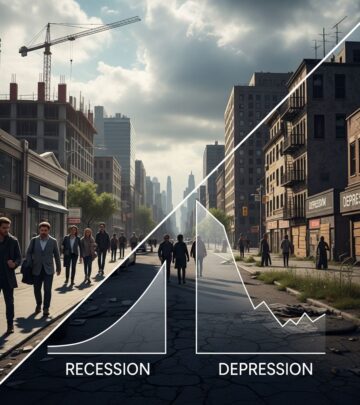
Recessionary Gap: Definition, Causes, and Economic Impact
Understanding recessionary gaps and their role in economic downturns and policy responses.
What Is a Recessionary Gap?
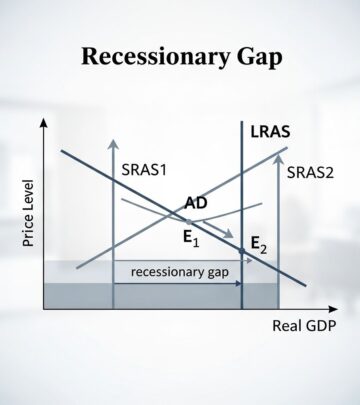
A recessionary gap represents a fundamental macroeconomic imbalance in which an economy’s actual real gross domestic product (GDP) falls below its potential GDP. This divergence indicates that the economy is operating below full capacity, with resources—including labor, capital, and technology—underutilized. When a recessionary gap exists, the economy is not producing at the level it theoretically could achieve with its current productive resources and technology. This situation typically emerges during economic downturns or recessions and signals the presence of idle productive capacity and wasted economic potential.
The concept of a recessionary gap is crucial for understanding macroeconomic health. It serves as a diagnostic tool for policymakers and economists to assess whether an economy is functioning optimally or whether intervention is necessary to restore full employment and maximize output. Unlike temporary fluctuations in economic activity, a recessionary gap represents a persistent state where the economy has not yet returned to equilibrium at its potential output level.
Understanding Potential GDP
To grasp the significance of a recessionary gap, one must first understand the concept of potential GDP. Potential GDP represents the maximum level of output an economy can sustainably produce given its current stock of labor, capital, technology, and institutional framework. It is not a fixed number but rather a dynamic measure that can increase over time as the economy accumulates more resources, develops better technology, or improves efficiency.
Potential GDP is often associated with full employment, a state in which unemployment is at its natural rate. The natural rate of unemployment includes structural and frictional unemployment but excludes cyclical unemployment caused by insufficient aggregate demand. When an economy achieves an equilibrium where actual GDP equals potential GDP, unemployment stands at its natural rate, and resources are efficiently allocated across the economy.
Key Characteristics of a Recessionary Gap
Several distinctive features characterize economies experiencing a recessionary gap:
- Output Shortfall: Actual real GDP remains below potential GDP, creating a measurable gap between what the economy produces and what it could produce.
- High Unemployment: When output falls below potential, firms reduce hiring and may lay off workers. Unemployment rates exceed the natural rate of unemployment, indicating cyclical joblessness.
- Underutilized Resources: Capital equipment sits idle, workers remain jobless, and technological capabilities are not fully exploited.
- Downward Pressure on Prices: Weak aggregate demand relative to supply capacity tends to suppress inflation and may even lead to deflation in severe cases.
- Economic Stagnation: Growth slows, business confidence declines, and consumer spending weakens as households face income uncertainty.
Causes of Recessionary Gaps
Recessionary gaps emerge from various economic shocks and imbalances that reduce aggregate demand below the level needed to sustain full employment. Understanding these causes helps explain why gaps form and persist:
Demand-Side Shocks
Anything that reduces aggregate expenditure can trigger a recessionary gap. A sharp decline in consumer confidence leads households to increase savings and reduce consumption. Similarly, a collapse in business investment—whether due to pessimistic profit expectations or tightened credit conditions—reduces overall spending. Government spending cuts and tax increases also diminish aggregate demand. Additionally, a contraction in international trade, whether from foreign recessions or protectionist policies, reduces export demand for domestic goods and services.
Financial Crises
Banking system disruptions and credit market freezes prevent businesses and consumers from accessing financing needed to maintain spending and investment levels. When credit dries up, economic activity contracts sharply, creating substantial recessionary gaps.
Supply Shocks
While primarily affecting inflation, severe supply-side disruptions—such as oil price spikes or pandemic-related production halts—can trigger recessions. The initial shock forces companies to cut output and employment, opening a recessionary gap even if demand remains stable.
The Keynesian Cross and Recessionary Gaps
In Keynesian macroeconomic theory, the relationship between recessionary gaps and equilibrium is illustrated through the Keynesian cross diagram. This framework plots aggregate expenditure on the vertical axis and real GDP on the horizontal axis, with a 45-degree line representing points where aggregate expenditure equals real GDP (the definition of equilibrium).
When the aggregate expenditure line intersects the 45-degree line at a point below potential GDP, a recessionary gap exists. At this equilibrium, aggregate demand is insufficient to pull the economy toward full employment. The critical insight of Keynesian theory is that markets do not automatically self-correct to eliminate recessionary gaps. Prices and wages may be sticky, meaning they adjust slowly downward, so the economy can remain stuck in underemployment equilibrium indefinitely without policy intervention.
Economic Consequences of Recessionary Gaps
The presence of a recessionary gap generates several harmful economic consequences:
Unemployment and Human Costs
Elevated unemployment imposes severe costs on workers and households. Job loss leads to lost income, reduced consumer spending, and increased poverty. Long-term unemployment can erode workers’ skills and damage their career prospects. Additionally, the psychological toll of joblessness extends beyond financial hardship, affecting mental health and social cohesion.
Lost Output and Foregone Income
The gap between actual and potential GDP represents economic output that society never produces. This lost production translates into lower incomes, fewer goods and services available for consumption, and reduced living standards across the economy.
Reduced Tax Revenue and Increased Public Spending
With lower employment and business profitability, tax revenues decline at the federal, state, and local levels. Simultaneously, demand for government assistance programs—unemployment benefits, welfare, food assistance—rises. This combination widens government budget deficits and constrains fiscal capacity for other priorities.
Deflation Risk
Persistent recessionary gaps can lead to falling price levels. While moderate deflation might seem beneficial to consumers, it actually discourages spending and investment. Businesses delay purchases expecting lower future prices, and consumers reduce consumption anticipating further declines. Deflation also increases the real burden of existing debt, harming borrowers.
Policy Responses to Recessionary Gaps
Economists and policymakers employ two primary policy approaches to address recessionary gaps: fiscal policy and monetary policy.
Fiscal Policy Interventions
The Keynesian response to a recessionary gap involves fiscal stimulus to shift the aggregate expenditure function upward. Governments can increase spending on public works, infrastructure, education, or defense. Alternatively, they can cut taxes to boost household disposable income and consumption. These measures expand aggregate demand, shifting the equilibrium point rightward and upward along the 45-degree line. If properly calibrated, fiscal stimulus can close the recessionary gap and restore full employment.
The magnitude of fiscal stimulus needed depends on the size of the gap and the multiplier effect. When government increases spending by one dollar, the ultimate increase in GDP exceeds one dollar due to the multiplier process: recipients of government payments spend part of their income, creating income for others who spend again, and so forth. The multiplier amplifies the initial stimulus, though its exact size depends on the marginal propensity to consume and other factors.
Monetary Policy Interventions
Central banks can combat recessionary gaps by expanding the money supply and lowering interest rates. Lower borrowing costs encourage businesses to invest and consumers to take loans for purchases. By making credit more accessible and affordable, monetary easing stimulates aggregate demand. In severe recessions where conventional interest rate cuts reach zero, central banks may employ unconventional tools such as quantitative easing—large-scale purchases of long-term securities to inject liquidity into the financial system.
Supply-Side Policies
While demand-side policies receive more emphasis in addressing recessionary gaps, some economists advocate for supply-side measures. Reducing regulatory burdens, improving education and training, and encouraging technological innovation can increase the economy’s potential output over time. However, these measures typically work more slowly than demand-side policies and are better suited for addressing long-term growth rather than cyclical recessions.
Recessionary Gap vs. Inflationary Gap
The opposite situation—an inflationary gap—occurs when actual GDP exceeds potential GDP, pushing unemployment below the natural rate. In this scenario, aggregate demand outpaces the economy’s productive capacity. Unable to produce enough goods and services to satisfy demand at current prices, prices rise, generating inflation. While recessionary gaps involve unused resources and unemployment, inflationary gaps involve overheated demand and tight labor markets. Policymakers address inflationary gaps through contractionary fiscal or monetary policy—reducing government spending, raising taxes, or tightening credit—to bring demand back into alignment with potential output.
Measuring Recessionary Gaps
Economists measure recessionary gaps as the absolute difference between potential GDP and actual GDP, or as a percentage of potential GDP. The larger the gap, the more severe the economic slack and the greater the costs of underemployment. Gap measurements inform policy decisions about the appropriate scale of stimulus needed. However, measuring potential GDP presents challenges because it cannot be directly observed. Economists estimate potential GDP using various methods, including trend analysis, production function approaches, and statistical filters. Different estimation methods can yield different gap measurements, introducing uncertainty into policy guidance.
Historical Examples
The 2008-2009 financial crisis created one of the largest recessionary gaps in modern history. As credit markets froze and confidence collapsed, aggregate demand plummeted. The resulting recession produced unemployment exceeding 10% and created output gaps that took years to close, even with aggressive policy responses. More recently, the COVID-19 pandemic created sudden, severe recessionary gaps as lockdowns shut down economic activity. However, rapid and substantial fiscal and monetary stimulus helped narrow these gaps more quickly than in previous downturns.
Frequently Asked Questions
Q: How long do recessionary gaps typically persist?
A: The duration varies widely depending on the severity of the shock, policy responses, and structural factors. Some gaps close within one to two years; others persist for five years or longer. The 2008 financial crisis created gaps that took nearly a decade to fully close.
Q: Can a recessionary gap exist without a recession?
A: Yes. An economy can grow but still operate below potential—a situation sometimes called a “slow recovery” or “disappointingly slow growth.” Output expands but not fast enough to reach full employment.
Q: How does a recessionary gap affect inflation?
A: Recessionary gaps typically reduce inflation or create deflation. Weak demand pressure on prices downward. This contrasts with inflationary gaps, which generate upward price pressure.
Q: What role do automatic stabilizers play in recessionary gaps?
A: Automatic stabilizers—unemployment benefits, progressive taxation, and welfare programs—automatically expand during recessions without requiring new legislation. They cushion income losses and support demand, partially offsetting the recessionary gap.
Q: Can recessionary gaps be eliminated entirely?
A: Theoretically, yes, through appropriate fiscal or monetary policy. Practically, perfectly eliminating gaps proves difficult because policymakers face uncertainty about gap size, policy effectiveness, and economic structure. Over-correction risks creating inflationary gaps.
References
- Recessionary Gap — Fiveable, Intermediate Macroeconomic Theory. Accessed 2025-11-29. https://fiveable.me/key-terms/intermediate-macroeconomic-theory/recessionary-gap
- Equilibrium and the Multiplier Effect: Recessionary and Inflationary Gaps in the Income-Expenditure Model — Lumen Learning, Macroeconomics. Accessed 2025-11-29. https://courses.lumenlearning.com/wm-macroeconomics/chapter/equilibrium-and-the-multiplier-effect/
Similar Articles








Read full bio of Sneha Tete