Recession vs. Depression: Key Differences
Understand the stark contrasts between recessions and depressions, from GDP drops to unemployment spikes, with historical insights.
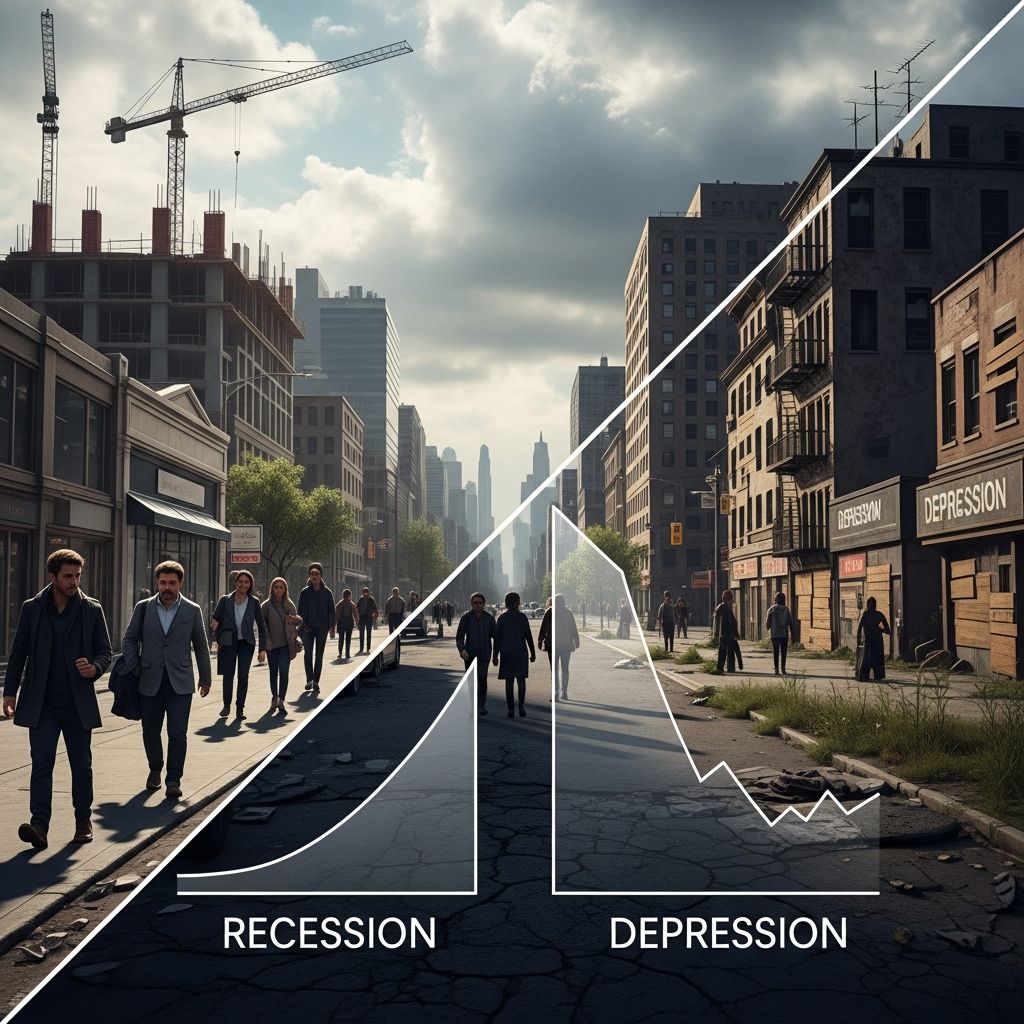
A recession marks a notable but typically temporary dip in economic activity, while a depression represents a far more intense and prolonged crisis that disrupts economies on a massive scale. These terms describe phases in the business cycle where growth stalls, but their scale and consequences set them worlds apart.
Defining Economic Downturns
Economists rely on established criteria to classify these events. A recession involves a significant decline in activity across the economy, lasting more than a few months, and visible in metrics like real GDP, income, employment, industrial output, and sales. The National Bureau of Economic Research (NBER) officially dates U.S. recessions based on such indicators, often pinpointing two consecutive quarters of negative GDP growth, though this is a rule of thumb rather than a strict definition.
In contrast, depressions lack a formal universal definition but are viewed as extreme recessions with deeper cuts to output and employment. They feature sharply reduced production, massive unemployment, halted construction, and slashed international trade. Some analysts peg depressions to GDP contractions exceeding 10%, alongside prolonged stagnation.
Core Metrics: GDP, Jobs, and Production
Gross Domestic Product (GDP) serves as the primary gauge. Recessions usually see GDP fall by less than 10%, with modern examples like 2007-2009 showing a 5% drop over 18 months. Depressions, however, involve contractions of 10% or more, often with real output plummeting nearly 30% as in 1929-1933.
Unemployment tells a stark story. Recessions push rates up modestly—peaking at 10% in the Great Recession—but depressions send them soaring to 25% or higher, with wages collapsing 42.5% for remaining workers. Industrial production also craters in depressions due to vanished demand, unlike the milder slowdowns in recessions.
| Indicator | Recession | Depression |
|---|---|---|
| GDP Decline | <10%, e.g., 3.4-5% | >10%, up to 30% |
| Unemployment Peak | Up to 10% | 25%+ |
| Duration | Months (avg. brief) | Years (e.g., 43 months) |
| Industrial Output | Reduced | Sharply curtailed |
This table highlights the quantitative gaps, drawn from historical data.
Historical Case Studies
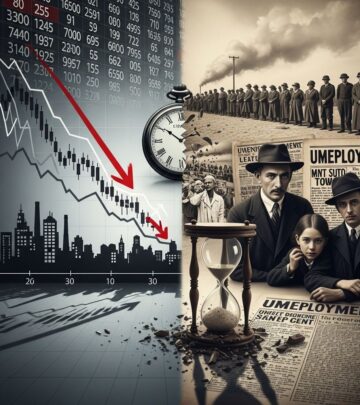
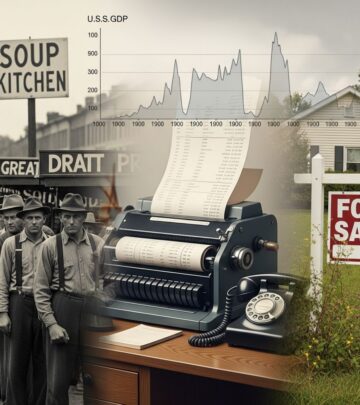
The Great Depression (1929-1933) exemplifies a true depression: GDP fell nearly 30%, unemployment hit 25%, prices deflated 10% annually, banks failed en masse, and stocks crashed. A brief recovery in 1933-1937 gave way to another downturn, underscoring the prolonged nature.
Post-WWII recessions pale in comparison. The 1973-1975 event saw 3.4% GDP loss and 9% unemployment. The 2007-2009 Great Recession lasted 18 months with 5% GDP drop and 10% joblessness, plus stable mild inflation unlike depression-era deflation. No depression has struck the U.S. since the 1930s.
- 1929-1933: 43-month contraction, global reach, deflation.
- 2007-2009: 18 months, housing crash, bank bailouts, recovery followed.
- 1973-1975: Oil shocks, 3.4% GDP drop, contained impact.
Everyday Impacts on People and Businesses
Recessions squeeze household budgets through job losses, hiring freezes, and income drops, curbing spending and production in a feedback loop. Prices may rise initially, hitting purchasing power. Businesses cut output amid lower demand.
Depressions amplify this: widespread layoffs, wage slashes, asset value collapses (stocks, real estate), and banking crises lead to bankruptcies—even giants like General Motors in milder 2008. Consumer prices can plummet in deflation, stifling spending further.
Geographically, recessions might stay national, but depressions often go global, as in the 1930s.
Triggers and Warning Signs
Recessions follow expansions, sparked by tight policy, asset bubbles bursting, or shocks like oil hikes. Indicators include falling industrial production, rising unemployment, and lower incomes.
Depressions build from similar roots but escalate via policy missteps, like poor banking responses in the 1930s. Watch for GDP drops over 10%, unemployment above 20%, and deflation.
Government and Central Bank Responses
Modern recessions prompt stimulus: rate cuts, fiscal packages, quantitative easing—as in 2008. The Fed now acts swiftly to avert depressions.
Depressions demand massive intervention; the New Deal and WWII spending ended the 1930s crisis. Today’s tools make depressions rarer.
Protecting Your Finances
Build emergency funds covering 6-12 months of expenses. Diversify investments beyond stocks. Reduce high-interest debt. During downturns, avoid panic selling; history shows recoveries.
Monitor jobs data, GDP reports from sources like the Bureau of Economic Analysis. Credit health matters—recessions can hike borrowing costs.
Modern Context and Outlook
Recessions remain cyclical, with expansions as the norm. Depressions are outliers; the last century saw one. Yet vigilance is key amid global ties and rapid shocks.
Frequently Asked Questions
Are we in a recession now?
Check NBER announcements for official calls based on multi-indicator trends.
Can a recession turn into a depression?
Rarely with modern policy, but poor responses could worsen it.
How long do recessions last?
Average under a year post-WWII; vary by event.
What’s worse: inflation or deflation in downturns?
Recessions see mild inflation; depressions bring harmful deflation.
Do depressions affect global economies?
Yes, often spreading via trade and finance.
References
- Recession vs. Depression: What is the Difference? — Merriam-Webster. Accessed 2026. https://www.merriam-webster.com/grammar/economic-recession-vs-depression-difference
- What Is the Difference Between a Recession and a Depression? — Experian. Accessed 2026. https://www.experian.com/blogs/ask-experian/what-is-the-difference-between-a-recession-and-a-depression/
- What is the difference between a recession and a depression? — Federal Reserve Bank of San Francisco. 2007-02. https://www.frbsf.org/research-and-insights/publications/doctor-econ/2007/02/recession-depression-difference/
- What Is a Recession vs. Depression? — Britannica Money. Accessed 2026. https://www.britannica.com/money/recession-vs-depression
- Recession vs Depression: What’s the Difference? — Acorns. Accessed 2026. https://www.acorns.com/learn/investing/recession-vs-depression/
- Recession Vs Depression | Economic Cycle Explained — YouTube (Federal Reserve Bank of St. Louis context). Accessed 2026. https://www.youtube.com/watch?v=QTSjn_xEb-g
- Great Recession vs. Great Depression: How They Compare — Federal Reserve Bank of St. Louis. Accessed 2026. https://www.stlouisfed.org/the-great-depression/curriculum/economic-episodes-in-american-history-part-4
Similar Articles








Read full bio of Sneha Tete