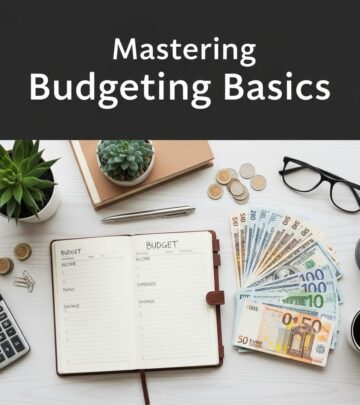
A Realistic Monthly Budgeting Routine That Works
Create a simple, flexible monthly budgeting routine that supports your goals, fits your real life, and helps you stay consistent long term.

Given everything life throws at you—unexpected bills, changing income, and busy schedules—you need a monthly budgeting routine that is simple, flexible, and sustainable. Instead of relying on complicated systems that you abandon after a few weeks, this approach helps you stay consistent with your money goals while still enjoying your life.
This guide walks you through the exact steps of a realistic monthly budgeting routine: from reviewing last month, to planning income, funding your goals first, and closing out your budget with a clear reflection.
Why Create a Monthly Budgeting Routine?
A monthly routine turns budgeting from a stressful, one-off task into a manageable habit. Research shows that having a written budget and regularly tracking finances is associated with higher savings rates and better financial stability. A routine gives you structure, but also room to adjust when life changes.
- Clarity: You always know what is coming in, what is going out, and where your money is going.
- Control: You make intentional decisions instead of reacting to emergencies.
- Consistency: Repeating the same steps each month builds momentum and long-term progress.
- Flexibility: Your budget adapts to variable income, changing priorities, and seasonal expenses.
Step 1: Review Last Month’s Numbers
Before planning a new month, start by looking back. The goal is reflection, not shame. You are gathering data so you can make better decisions going forward.
Set aside 20–30 minutes and pull up your bank statements, credit card activity, budgeting app, or spreadsheet.
What to review
- Total income: How much did you receive from your job, business, side hustles, or other sources?
- Total spending: How much did you spend overall? Where did the biggest chunks go?
- Savings and debt payments: How much did you save or invest? How much extra did you pay toward debt?
- Budget vs. reality: Where did you overspend or underspend compared to your plan?
Helpful reflection questions
- Which spending categories felt too tight? Which ones had extra room?
- Did any unplanned expenses completely derail the budget?
- Did I make progress on my main financial goals?
- What is one thing I want to repeat, and one thing I want to change next month?
Many financial educators recommend this type of regular review as part of building strong money habits, because it helps you learn from experience rather than simply reacting to problems.
Step 2: Map Out Your Income
Next, estimate how much money you will have to work with this month. Your income might be fixed or variable, but you can still plan realistically.
List all expected income sources
- Primary job or salary
- Business owner draws or distributions
- Side hustles or freelance work
- Benefits or stipends (e.g., child benefit, government support where applicable)
- Other expected inflows (bonuses, tax refunds, grants, etc.)
If your income fluctuates, a common recommendation is to budget using your lowest reasonably expected income, so anything extra becomes a bonus instead of something you rely on to cover essentials.
| Income Source | Conservative Estimate | Notes |
|---|---|---|
| Full-time job | $3,200 | After tax and deductions |
| Freelance work | $300 | Based on lowest 3-month average |
| Side gig | $150 | One weekend per month |
| Total planned income | $3,650 |
If additional income comes in, you can later assign it intentionally to savings, debt payoff, or fun money instead of letting it disappear into unplanned spending.
Step 3: Allocate to Your Financial Goals First
This is the cornerstone of a powerful budgeting routine: you fund your financial goals first, before assigning money to regular spending. Many experts refer to this as “paying yourself first”—prioritizing saving, investing, and debt repayment before discretionary expenses.
Common financial goals to plan for
- Building or topping up an emergency fund
- Contributing to retirement accounts or other long-term investments
- Paying down high-interest debt
- Saving for short-term goals like travel, education, or a home deposit
- Growing sinking funds for predictable but irregular costs (car repairs, annual fees, etc.)
Decide your monthly goal allocations
From your planned income, decide how much will go toward goals right away. Even small, consistent contributions add up over time. For example:
- $200 to an emergency fund until you reach 3–6 months of essential expenses (a common guideline from financial institutions).
- 10–15% of income to retirement accounts, including employer contributions, if possible.
- $100 extra toward high-interest debt.
- $50–$100 into specific sinking funds.
You can automate many of these transfers so that they happen shortly after payday, which research shows increases the likelihood of achieving savings goals.
Step 4: Set Realistic Spending Categories
Once your goals are funded, turn to your spending plan. A realistic budget reflects your actual life, not an idealized version of it. That means accounting for your values, habits, and current obligations.
Organize your budget into three main buckets
- Fixed expenses: Bills that are roughly the same each month and must be paid.
Examples: rent or mortgage, utilities, minimum debt payments, insurance, subscriptions, phone and internet. - Variable essentials: Necessary spending that can fluctuate.
Examples: groceries, fuel or transport, household supplies, childcare, medical costs. - Flexible spending: Non-essential or lifestyle spending.
Examples: dining out, entertainment, shopping, personal care, hobbies.
| Category Type | Examples | Can You Adjust Easily? |
|---|---|---|
| Fixed expenses | Rent, insurance, minimum loan payments | Harder in the short term, but review annually or when contracts renew |
| Variable essentials | Groceries, transport, utilities usage | Moderate; you can reduce with planning and habit changes |
| Flexible spending | Eating out, shopping, subscriptions | Easiest to adjust month to month |
Tips for realistic spending amounts
- Use last month’s numbers as a starting point, then adjust based on what felt too tight or too loose.
- Avoid setting categories unrealistically low “just to save more.” If they are not sustainable, you are more likely to give up on the budget.
- Leave a small buffer category for “miscellaneous” to catch minor surprises.
- If the numbers do not work, revisit your goals or lifestyle spending and make trade-offs consciously.
Step 5: Plan for Irregular or Seasonal Expenses
Even well-planned budgets can be derailed by expenses that do not occur every month but are still predictable over the year—things like annual insurance premiums, holidays, or back-to-school costs. Many financial educators recommend creating sinking funds to handle these with less stress.
Identify upcoming irregular costs
Look at your calendar and ask:
- Are there birthdays, anniversaries, or holidays coming up?
- Do I have planned travel or events (weddings, reunions, conferences)?
- Are any annual or semiannual bills due soon (insurance, memberships, subscriptions)?
- Do I expect seasonal costs, such as school expenses, sports fees, or home maintenance?
Build sinking funds
For each expense, divide the total cost by the number of months until it is due. That is the amount to set aside each month.
- $600 car insurance due in 6 months → set aside $100 per month.
- $1,200 holiday budget over 12 months → set aside $100 per month.
- $300 school-related expenses in 3 months → set aside $100 per month.
Keep these funds in a separate savings account or clearly labeled categories within your budgeting system. That way, when the bill arrives, the money is already waiting.
Step 6: Track Weekly, Not Daily
Tracking every transaction every day can be exhausting and may cause “budget burnout.” Instead, commit to a weekly check-in. A weekly rhythm gives you enough data to adjust early while keeping the process manageable.
What a weekly check-in looks like
- Update your transactions: import or manually log your spending from bank and card accounts.
- Match each transaction to a budget category (groceries, gas, fun, etc.).
- Compare how much you have spent to your plan in each category.
- Note any categories that are trending high and brainstorm adjustments for the rest of the month.
You can use a spreadsheet, budgeting app, or even paper—what matters most is consistency. Research from consumer finance studies indicates that people who regularly monitor their accounts and review their budget are less likely to incur late fees or overdrafts and more likely to meet savings goals.
Adjusting mid-month
- If one category is overspending (e.g., dining out), reduce another flexible category (e.g., shopping) to compensate.
- If you receive extra income, decide immediately how much goes to goals versus spending.
- Use the weekly check-in as a neutral feedback loop, not a reason to feel guilty.
Step 7: Close Out the Month and Reflect
At the end of the month, “close the books” on your budget. This step helps you measure progress and carry lessons into the next month.
Close-out checklist
- Calculate your actual total income for the month.
- Total up your savings, investments, and extra debt payments.
- Review your total spending and how it compares to your plan.
- Note your wins (e.g., hitting a savings goal, reducing debt, sticking to a category).
- Note your challenges (e.g., categories that consistently go over, unplanned expenses).
Reflective questions
- What worked really well this month?
- Where did I feel most restricted or stressed?
- Which categories need to be adjusted up or down for next month?
- What can I do differently to make next month’s budget easier to follow?
Some people like to journal briefly about their money each month. Writing even a few sentences can help clarify patterns and reinforce positive habits.
Why This Routine Works
This monthly budgeting routine is designed to be both structured and flexible, making it easier to stick with over time.
Key reasons it is effective
- Goals come first: You consistently fund your priorities instead of hoping there is money left over at the end of the month.
- Realistic numbers: Your spending plan is based on actual data and conservative income estimates.
- Built-in flexibility: Weekly reviews allow adjustments, and sinking funds handle irregular costs.
- Simple steps: The process is repeatable and does not rely on complex tools.
- Continuous learning: Regular reflection helps you improve over time rather than expecting perfection immediately.
]
These elements align with common recommendations from financial educators and consumer protection agencies: create a budget, prioritize saving, track regularly, and adjust as your situation changes.
Expert Tip: Prioritize Your Financial Goals First
One powerful shift is to treat savings, investing, and debt repayment as non-negotiable bills you owe to yourself. Instead of waiting to see what remains after spending, decide in advance how much will go toward your goals and move that money as soon as income hits your account.
Practical ways to pay yourself first
- Set up automatic transfers to savings or investment accounts right after payday.
- Increase retirement contributions when you receive a raise so that your lifestyle inflates more slowly.
- Schedule an automatic extra payment to high-interest debt each month.
Studies on retirement savings and workplace plans show that automatic contributions and defaults significantly increase participation and savings rates because they remove the need for repeated decisions.
Frequently Asked Questions (FAQs)
Q: How long does this monthly budgeting routine take?
A: The first time you do it, expect to spend about 60–90 minutes setting up. Once you are familiar with the process, monthly planning often takes 30–45 minutes, with 15–20 minutes for each weekly check-in.
Q: What if my income is unpredictable?
A: Base your budget on your lowest reliable monthly income and list your goals and flexible spending in order of priority. If extra money comes in, allocate it first to essential bills, then to goals, and only then to additional lifestyle spending.
Q: Do I need a specific budgeting app?
A: No. You can use a notebook, a spreadsheet, or an app—whichever you will use consistently. The routine itself matters more than the tool.
Q: How big should my emergency fund be?
A: Many financial institutions suggest saving enough to cover 3–6 months of essential expenses, depending on your job stability, family situation, and risk tolerance. You do not need to reach this amount all at once; plan a monthly contribution and build it gradually.
Q: What if I overspend in a category?
A: Use your weekly check-ins to spot overspending early. When it happens, adjust by reducing another flexible category or pausing non-essential purchases. At month-end, use the data to set more realistic amounts going forward.
Q: How do I stay motivated to keep budgeting?
A: Connect your budget to specific goals that matter to you—such as paying off a credit card, building security, or funding a trip. Celebrate small wins each month, like sticking to a category or increasing your savings rate. Over time, seeing progress is one of the best motivators.
Related Budgeting Ideas to Explore
- Try different budgeting methods (such as zero-based, 50/30/20, or envelope-style budgeting) to see which format you prefer.
- Add a short “money date” each week with yourself or your partner to review finances together.
- Periodically review subscriptions, insurance, and major bills to look for savings opportunities.
- Combine this monthly routine with long-term planning for goals like homeownership, education, or retirement.
Create a Budgeting Routine That Puts You in Control
You do not need a perfect spreadsheet, a complex app, or flawless discipline to manage your money well. What you need is a repeatable routine that fits your life: review last month, map out your income, fund your goals first, set realistic spending, plan for irregular costs, track weekly, and close the month with reflection.
By following these steps consistently, you build confidence, reduce financial stress, and move steadily closer to the money life you want.
References
- Building a Better Budget — Consumer Financial Protection Bureau. 2022-06-01. https://www.consumerfinance.gov/about-us/blog/building-a-better-budget/
- Emergency Savings: How Much Is Enough? — Federal Reserve Bank of St. Louis. 2023-04-14. https://www.stlouisfed.org/open-vault/2023/april/emergency-savings-how-much-is-enough
- Automatic Enrollment, Employer Match Rates, and Employee Compensation in 401(k) Plans — U.S. Bureau of Labor Statistics. 2023-08-29. https://www.bls.gov/opub/mlr/2023/article/automatic-enrollment-employer-match-rates-and-employee-compensation-in-401k-plans.htm
- Emergency Savings — FINRA Investor Education Foundation. 2022-11-30. https://www.finrafoundation.org/investors/learn-to-invest/emergency-savings
- Making the Most of Your Money: Budgeting — Financial Consumer Agency of Canada. 2022-10-05. https://www.canada.ca/en/financial-consumer-agency/services/make-budget.html
Similar Articles








Read full bio of Sneha Tete