Real Interest Rate: Definition, Formula & Calculation
Understanding real interest rates: How inflation affects your investment returns and borrowing costs.
What Is a Real Interest Rate?
A real interest rate is the interest rate that an investor, saver, or lender receives after accounting for the effects of inflation. Unlike the nominal interest rate, which represents the stated percentage on a loan or investment, the real interest rate reflects the actual purchasing power gained or lost over time. In other words, it measures how much your money will actually buy in the future, not just how many dollars you will receive.
The concept of real interest rates is fundamental to understanding investment returns and borrowing costs. When you lend money or invest it, you expect to earn a return that compensates you for three things: the time value of money, the risk of default, and potential regulatory changes. However, inflation erodes the purchasing power of that return. The real interest rate strips away the inflation component to show you the true economic gain or loss.
Real Interest Rate vs. Nominal Interest Rate
The difference between real and nominal interest rates is critical to understand when making financial decisions. The nominal interest rate is the stated rate you see advertised on loans, savings accounts, and bonds. It does not account for inflation. For example, if a bank offers a savings account with a 5% annual interest rate, that is the nominal rate.
The real interest rate, by contrast, takes inflation into consideration. If that same 5% nominal rate is earned while inflation runs at 2% annually, your real interest rate is approximately 3%. This means your money’s purchasing power has only increased by about 3%, not 5%.
To illustrate further: suppose you lend $1,000 for one year at a 10% nominal interest rate and receive $1,100 at the end of the year. If there has been no inflation, you have gained 10% in purchasing power. However, if prices have increased by 3% over that year, your actual gain in purchasing power is closer to 7%. The difference between these two rates demonstrates why lenders and investors must account for inflation when evaluating their true returns.
The Fisher Equation: Calculating Real Interest Rates
The mathematical relationship between real interest rates, nominal interest rates, and inflation is expressed through the Fisher Equation, named after economist Irving Fisher. The equation provides a precise way to calculate the real interest rate.
The simplified Fisher Equation is:
Real Interest Rate ≈ Nominal Interest Rate − Inflation Rate
For example, if you receive a 5% nominal interest rate on an investment and inflation is 2%, your approximate real interest rate is 3%.
However, the more precise Fisher Equation is:
r = (i − π) / (1 + π)
Where r is the real interest rate, i is the nominal interest rate, and π is the inflation rate. Using this formula ensures greater accuracy, particularly when inflation rates are high. For instance, if the nominal rate is 10% and inflation is 3%, the real interest rate would be calculated as (0.10 − 0.03) / (1.03) = 0.068 or 6.8%.
Why Real Interest Rates Matter
Understanding real interest rates is essential for making informed financial decisions. Investors use real interest rates to evaluate whether their investments truly generate positive returns. Lenders consider real rates to ensure they are adequately compensated for providing credit. Policymakers monitor real interest rates to assess economic conditions and make monetary policy decisions.
Central banks, including the Federal Reserve, often target real interest rates as part of their economic policy framework. When real interest rates are high, borrowing becomes more expensive, which can slow economic growth and investment. Conversely, low or negative real interest rates can stimulate borrowing and spending, potentially fueling inflation.
On an economy-wide basis, the real interest rate is often calculated using the rate of return on risk-free investments, such as U.S. Treasury notes, minus an index of inflation, such as the Consumer Price Index (CPI) or the GDP deflator.
After-Tax Real Interest Rates
When calculating investment returns, it is also important to consider taxes. The after-tax real interest rate represents the true return an investor receives after accounting for both taxes and inflation.
Taxes are typically imposed on nominal interest earnings, not adjusted for inflation. If an investor earns 8% in nominal interest but pays 25% in taxes on that interest, and inflation is 2%, the calculation becomes more complex. The after-tax nominal return is 8% × (1 − 0.25) = 6%. The after-tax real return is then approximately 6% − 2% = 4%.
This means that an investor who appears to earn 8% before taxes actually has only 4% of real, after-tax purchasing power growth. This distinction is why many investors focus on after-tax real returns when evaluating long-term investment strategies.
Negative Real Interest Rates
A negative real interest rate occurs when the inflation rate exceeds the nominal interest rate. In this scenario, the purchasing power of money decreases even though you are receiving interest payments.
For example, if the Federal funds rate is 2% and inflation is running at 10%, the real interest rate becomes negative. Using the Fisher Equation: (0.02 − 0.10) / (1.10) = −0.0727 or approximately −7.27%. This means that for every dollar borrowed, the borrower actually gains 7.27% in purchasing power because they can repay the loan with money that is worth less than when they borrowed it.
Negative real interest rates create significant economic distortions. Savers lose purchasing power on their savings, which discourages saving and encourages spending. Borrowers, conversely, benefit from owing money that becomes less valuable in real terms. During periods of high inflation, such as the 1970s, negative real interest rates were common, leading to substantial economic inefficiencies.
Inflation-Indexed Bonds and Observable Real Rates
Historically, the expected real interest rate was difficult to observe directly because future inflation was uncertain. However, the introduction of inflation-indexed bonds, also known as real return bonds, has changed this dynamic.
These bonds are structured so that both the principal value and the coupon payments rise each year with the inflation rate, as measured by the Consumer Price Index or similar inflation indices. By purchasing inflation-indexed bonds, investors lock in a guaranteed real rate of return. The difference between the yield on regular Treasury bonds and inflation-indexed Treasury bonds provides a direct market-based estimate of expected inflation.
For example, if a regular 10-year Treasury note yields 4% and a 10-year Treasury Inflation-Protected Security (TIPS) yields 1.5%, the market is implicitly pricing in approximately 2.5% inflation over the next decade.
Expected vs. Realized Real Interest Rates
It is important to distinguish between expected and realized real interest rates. The expected real interest rate is calculated before a loan matures, based on anticipated inflation. Different investors may have different inflation expectations, so there is no single expected real rate for all parties.
The ex-post real interest rate, also called the realized real interest rate, is calculated after the loan period ends, using the actual inflation that occurred. Since actual inflation is often different from anticipated inflation, the realized real rate frequently differs from what was expected.
For instance, if investors expected 2% inflation when they lent money at a 5% nominal rate, they anticipated a 3% real rate. However, if actual inflation turned out to be 4%, the realized real rate would only be approximately 1%, leaving lenders with lower returns than expected.
Real Interest Rates and Economic Activity
Real interest rates play a crucial role in determining economic behavior. The level of real interest rates influences whether consumers and businesses prefer to spend or save their income. When real interest rates are high, saving becomes more attractive because the rewards for deferring consumption are substantial. This typically leads to lower consumption, reduced business investment, and slower economic growth.
Conversely, when real interest rates are low or negative, the incentive to save diminishes. Consumers and businesses are more likely to spend and invest rather than hold cash. This can stimulate economic activity in the short term but may also contribute to inflation if growth outpaces productive capacity.
Real interest rate levels are also used in various economic theories to explain phenomena such as capital flight, business cycles, and economic bubbles. Economists use tools like the Taylor Rule to estimate the appropriate level of real interest rates for economic conditions.
How Inflation Affects Real Interest Rates
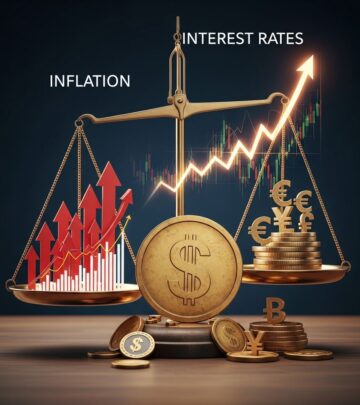
Inflation is the primary factor that separates real from nominal interest rates. When inflation rises unexpectedly, real interest rates decline even if nominal rates remain constant. This creates significant risks for lenders and borrowers because the inflation rate over the course of a loan is typically not known in advance.
Since the actual inflation rate is unknown at the time a loan is made, both lenders and borrowers face inflation risk. Lenders worry that high inflation will erode their real returns, while borrowers benefit from inflation because they repay loans with less valuable dollars. This is why lenders typically demand higher nominal interest rates when inflation is expected to be high—they are attempting to protect their real returns against anticipated inflation.
Practical Applications of Real Interest Rates
Understanding real interest rates has numerous practical applications. Investors use real rate analysis to evaluate whether specific investments justify their risks. A stock market investment might offer returns that exceed nominal interest rates, but if inflation is high, the real return may be disappointing.
Retirees are particularly concerned with real interest rates because they need income to maintain their purchasing power throughout retirement. A pension that pays 4% nominal interest may seem adequate until you account for 3% inflation—leaving only 1% real growth in purchasing power annually.
Policymakers use real interest rate analysis to guide monetary policy decisions. When real rates are very negative, it may signal that the central bank’s policy is too stimulative and could fuel inflation. When real rates are very high, it may indicate that policy is too restrictive and could slow economic growth.
Frequently Asked Questions (FAQs)
Q: How do I calculate the real interest rate on my savings account?
A: Subtract the current inflation rate from your account’s nominal interest rate. For example, if your savings account earns 2.5% and inflation is 3%, your real interest rate is approximately −0.5%. For a more precise calculation, use the Fisher Equation: (nominal rate − inflation rate) / (1 + inflation rate).
Q: Can a real interest rate be negative?
A: Yes. A negative real interest rate occurs when inflation exceeds the nominal interest rate. In this scenario, your purchasing power decreases even though you are earning interest. This discourages saving and rewards borrowing.
Q: What is the difference between expected and realized real interest rates?
A: Expected real interest rates are calculated before a loan matures based on anticipated inflation. Realized real interest rates are calculated after the loan ends using actual inflation. They often differ because inflation rarely matches expectations exactly.
Q: Why do central banks care about real interest rates?
A: Central banks use real interest rates to assess economic conditions and set monetary policy. High real rates reduce borrowing and spending, cooling the economy. Low real rates encourage borrowing and investment, stimulating economic activity.
Q: What are inflation-indexed bonds and how do they work?
A: Inflation-indexed bonds, such as Treasury Inflation-Protected Securities (TIPS), adjust their principal and interest payments based on inflation. They provide investors with a guaranteed real rate of return because actual inflation is factored into the payments.
Q: How do taxes affect real interest rates?
A: Taxes reduce the after-tax nominal return, which then must be adjusted for inflation to calculate the after-tax real return. Many investors find that after-tax real returns are substantially lower than the nominal rates advertised on investments.
References
- Real interest rate — Wikipedia. Accessed 2025-11-29. https://en.wikipedia.org/wiki/Real_interest_rate
- Real interest rate (%) – Glossary — World Bank DataBank. 2024. https://databank.worldbank.org/metadataglossary/world-development-indicators/series/FR.INR.RINR
- Interest Rates (Nominal and Real) — Investopedia Video. https://www.youtube.com/watch?v=5OK30EpMiLw
- Monetary and Financial Statistics Manual — International Monetary Fund. 2018. https://www.imf.org/external/pubs/ft/manual/2008/eng/index.htm
- Consumer Price Index (CPI) and Inflation — U.S. Bureau of Labor Statistics. https://www.bls.gov/cpi/
- Treasury Inflation-Protected Securities (TIPS) — U.S. Department of the Treasury. https://www.treasurydirect.gov/indiv/products/prod_tips_glance.htm
Similar Articles








Read full bio of medha deb