Real GDP Per Capita: Calculation & Historical Data
Understanding real GDP per capita: formulas, calculations, and 75+ years of US economic data.
Understanding Real GDP Per Capita
Real GDP per capita represents one of the most important economic indicators for measuring a nation’s standard of living and overall economic health. Unlike simple GDP figures that can be distorted by population growth and inflation, real GDP per capita provides a more accurate picture of how much wealth each person in an economy actually produces. This metric allows economists, policymakers, and investors to compare economic performance across different countries and time periods on an apples-to-apples basis.
The term “per capita” derives from Latin, meaning “for each head” or “per person.” When combined with real GDP, it transforms aggregate economic measurements into individual-level data that reflects the average economic output per person in a nation. This distinction is crucial because a country might show impressive total GDP growth while simultaneously experiencing a decline in per-capita prosperity if population growth outpaces economic expansion.
The Definition of Real GDP Per Capita
Real GDP per capita is defined as the per-person share of an economy’s production measured in inflation-adjusted prices. This definition encompasses two critical components: “real” and “per capita.”
The “real” component distinguishes this metric from nominal GDP, which doesn’t account for inflation. By using real GDP, economists eliminate the distorting effects of price changes across different time periods. This allows for meaningful comparisons of actual economic production rather than merely comparing nominal dollar values that may reflect inflation rather than genuine economic growth.
The term captures the average economic output distributed across each individual in a population, making it a powerful tool for understanding whether an economy is becoming more or less prosperous for its citizens. A rising real GDP per capita suggests that the average person has access to more goods and services, while a declining figure indicates economic contraction at the individual level.
The Formula for Calculating Real GDP Per Capita
The calculation of real GDP per capita follows a straightforward two-step process involving only four essential elements:
- Base-year prices
- Total quantity sold
- Real GDP
- Population
The mathematical formula is expressed as:
Real GDP Per Capita = Real GDP ÷ Population
However, before applying this formula, you must first calculate real GDP itself. This requires selecting a base year and then multiplying the quantities of all products and services sold by their prices in that base year. This methodology ensures consistent pricing across all years being analyzed, allowing for accurate comparisons of actual economic production changes rather than price fluctuations.
Step-by-Step Calculation Process
To properly calculate real GDP per capita, follow these systematic steps:
Step 1: Determine Real GDP
Select a relevant base year and multiply the total quantities of all goods and services produced by their prices in that base year. This gives you the real GDP adjusted for inflation. For example, if 2015 is your base year, all subsequent years’ production is valued at 2015 prices, providing a consistent measurement standard.
Step 2: Identify Current Population
Obtain the population figure for the same time period as your GDP measurement, typically using end-of-year population data for consistency.
Step 3: Apply the Division
Divide the calculated real GDP by the current population to arrive at the real GDP per capita figure.
Why Base-Year Prices Matter
Understanding base-year pricing is fundamental to grasping why real GDP per capita provides superior information compared to nominal measures. When economists select a base year—typically a recent year or a standardized year like 2015 or 2011—they establish a price reference point for all calculations.
This approach normalizes prices year-to-year, making production values easily quantifiable. For instance, if pencils cost $0.50 in the base year of 2011, all pencil quantities across all years under review are calculated at that $0.50 price point. This eliminates the confusion that would arise from comparing a year when pencils cost $0.75 directly with one where they cost $0.50, since any difference would reflect actual production changes rather than mere price inflation.
By maintaining consistent pricing, economists can isolate genuine changes in economic output from price-driven fluctuations, creating a more reliable picture of whether an economy is actually producing more goods and services or simply charging higher prices.
Practical Example of Real GDP Per Capita Calculation
Consider a simplified economy with the following characteristics:
An economy produces 475,000 million EUR worth of real GDP with a population of 25 million people. Using the formula:
Real GDP Per Capita = €475,000 million ÷ 25 million = €19,000 per person
This calculation reveals that on average, each person in this economy is associated with €19,000 in annual economic production. This figure becomes meaningful when compared to other years’ data—if the next year’s real GDP per capita increases to €20,000, it suggests genuine economic growth benefiting the average citizen.
Real GDP vs. Nominal GDP: Understanding the Distinction
The difference between real and nominal GDP is critical for accurate economic analysis. Nominal GDP measures the value of goods and services at current prices without adjusting for inflation, while real GDP adjusts these values to account for price changes using a selected base year.
Without this adjustment, nominal GDP can appear to grow substantially even when actual production remains flat or declines. For example, if an economy produced the same 10,000 barrels of oil in both 2000 and 2025, but oil prices increased significantly, the nominal GDP would appear to have grown dramatically, even though production volume remained identical. By valuing both years’ output in consistent base-year dollars, real GDP would correctly show no growth in actual production.
This distinction becomes even more important when calculating per-capita figures, as it ensures you’re measuring genuine improvements in living standards rather than mere inflation effects.
Historical Real GDP Per Capita Data Since 1946
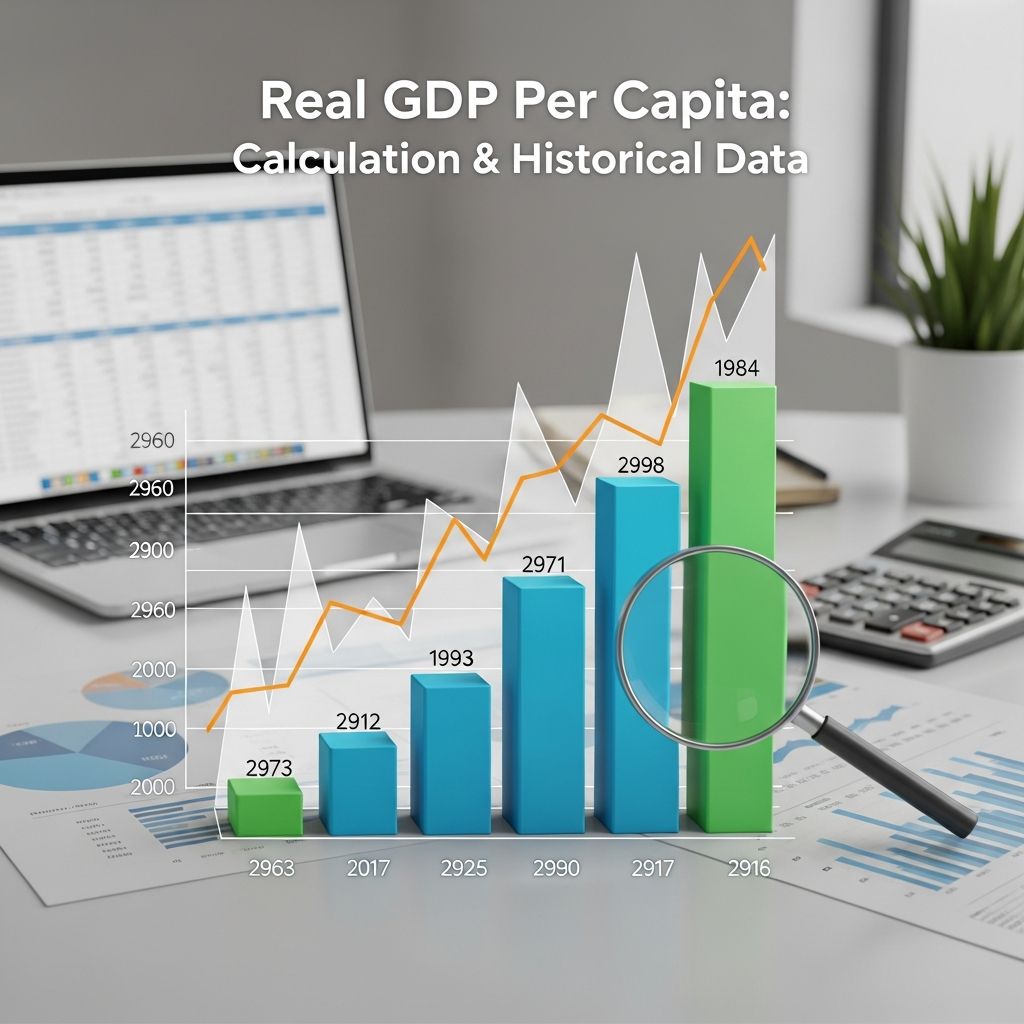
Analyzing real GDP per capita data spanning from 1946 to the present provides valuable insights into long-term economic trends and productivity changes in developed economies. The United States provides one of the most comprehensive historical datasets.
In 1946, immediately following World War II, real GDP per capita in the United States stood at significantly lower levels than today. The post-war period through the 1950s and 1960s saw robust economic growth, with real GDP per capita expanding steadily as productivity increased and living standards rose across the nation.
By 2020, the United States had recorded a real GDP per capita of $63,047.15. This dramatic increase over 74 years reflects both genuine improvements in productivity and living standards as well as the cumulative effects of technological advancement, capital investment, and workforce development.
Long-Term Economic Trends and Growth Patterns
Examining real GDP per capita trends since 1946 reveals several distinct economic periods and patterns. The immediate post-war period witnessed exceptional growth rates as the economy transitioned from wartime to peacetime production. The 1950s and 1960s maintained strong growth trajectories, often referred to as the “Golden Age of Capitalism.”
The 1970s brought stagflation challenges—simultaneous inflation and economic stagnation—which temporarily dampened per-capita growth rates. The 1980s saw renewed growth momentum, followed by the robust expansion of the 1990s driven by technological innovation and productivity improvements.
The 2000s experienced economic volatility, culminating in the 2008 financial crisis, which temporarily reduced real GDP per capita. The recovery that followed showed varying growth rates through the 2010s, with the COVID-19 pandemic in 2020 creating additional economic disruptions before subsequent recovery efforts.
Why Real GDP Per Capita Matters for Economic Policy
Real GDP per capita serves as a fundamental metric for policymakers, economists, and investors because it directly relates to citizens’ standard of living and quality of life. Unlike aggregate GDP figures, real GDP per capita accounts for both population changes and inflation, providing a clearer picture of whether average citizens are becoming more or less prosperous.
This metric informs crucial policy decisions regarding social programs, taxation, education investment, and economic development initiatives. When real GDP per capita stagnates or declines, it signals that despite potentially growing aggregate output, the average citizen may not be experiencing economic improvement. Conversely, steady increases in real GDP per capita suggest that economic growth is broadly distributed and benefiting the general population.
International comparisons using real GDP per capita also help identify which nations have achieved higher living standards and productivity levels, informing both competitive analysis and development strategies for emerging economies.
International GDP Per Capita Comparisons
Real GDP per capita enables meaningful cross-border economic comparisons that would be impossible using nominal figures alone. When economists compare countries with different currencies, inflation rates, and population sizes, they use real GDP per capita converted to a common standard—typically constant US dollars at 2015 prices.
This standardization allows for accurate assessment of which nations maintain the highest living standards and productivity levels. Wealthy developed nations typically show real GDP per capita figures exceeding $50,000 USD, while developing nations might range from $5,000 to $25,000, reflecting genuine differences in productive capacity and material standards of living rather than merely nominal currency values.
Factors Influencing Real GDP Per Capita Growth
Multiple factors drive changes in real GDP per capita over time:
- Productivity Improvements: Technological advancement and operational efficiency directly increase output per worker.
- Capital Investment: Infrastructure, equipment, and human capital investments enhance productive capacity.
- Population Dynamics: Population growth can dilute per-capita metrics unless offset by proportional output increases.
- Education and Workforce Development: A more skilled workforce generates higher productivity levels.
- Policy Environment: Trade policies, regulatory frameworks, and macroeconomic stability influence growth trajectories.
- External Shocks: Recessions, pandemics, wars, and natural disasters can disrupt growth patterns temporarily or permanently.
Limitations and Considerations
While real GDP per capita provides valuable economic insights, it has important limitations. This metric measures average production but masks significant income inequality—a nation with extremely unequal wealth distribution might show robust per-capita figures while many citizens experience poverty.
Real GDP per capita also fails to account for non-market activities, environmental degradation, quality-of-life factors unrelated to consumption, and leisure time. A person working 80-hour weeks in a high-GDP economy might have a lower actual quality of life than someone in a lower-GDP country working 35 hours weekly with stronger community connections and environmental quality.
Additionally, the choice of base year can influence real GDP calculations, and deflators used to adjust nominal GDP for inflation may not perfectly capture price changes across diverse goods and services.
Frequently Asked Questions
Q: How does real GDP per capita differ from nominal GDP per capita?
A: Real GDP per capita adjusts for inflation using a base year’s prices, while nominal GDP per capita uses current prices. Real GDP per capita provides a more accurate picture of genuine economic growth by removing price inflation effects, allowing for meaningful year-to-year and cross-country comparisons.
Q: Why is a base year necessary for calculating real GDP?
A: A base year provides a consistent pricing reference point across all years being analyzed. By valuing all production at base-year prices, economists can isolate actual production changes from price fluctuations, ensuring that growth comparisons reflect real economic activity rather than inflation.
Q: What does a rising real GDP per capita indicate?
A: Rising real GDP per capita suggests that the average person in an economy has access to more goods and services, indicating genuine economic growth and improving living standards. However, this metric alone doesn’t reveal whether wealth is broadly distributed or concentrated among few individuals.
Q: Can real GDP per capita decrease even when aggregate GDP grows?
A: Yes, real GDP per capita can decline while aggregate GDP grows if population growth outpaces economic output expansion. This explains why per-capita metrics are more meaningful than aggregate measures for assessing individual prosperity.
Q: How is real GDP per capita used in international comparisons?
A: International comparisons typically convert real GDP per capita figures to a common currency—usually constant US dollars at 2015 prices—allowing accurate assessment of which nations maintain the highest living standards and productivity levels.
Q: What was US real GDP per capita in 2020?
A: The United States recorded a real GDP per capita of $63,047.15 in 2020. This figure represents the average economic output per person in inflation-adjusted terms.
References
- Real GDP Per Capita | Definition, Formula & Calculation — Study.com. 2025. https://study.com/academy/lesson/real-gdp-per-capita-definition-formula-quiz.html
- Calculating Real GDP — YouTube. 2025. https://www.youtube.com/watch?v=BKeb3K6dBkw
- Annual growth rate of real GDP per capita — United Nations Statistics Division. 2025-03-28. https://unstats.un.org/sdgs/metadata/files/Metadata-08-01-01.pdf
- GDP Per Capita Formula — BYJU’S. 2025. https://byjus.com/commerce/gdp-per-capita-formula/
- Comparing GDP: growth rate and per capita — Eurostat Statistics Explained. 2025. https://ec.europa.eu/eurostat/statistics-explained/index.php/Beginners:GDP_-_Comparing_GDP:_growth_rate_and_per_capita
- Gross domestic product (GDP) per capita — Statistics Canada. 2025. https://www.statcan.gc.ca/hub-carrefour/quality-life-qualite-vie/prosperity-prosperite/gdp-pib-eng.htm
- GDP per capita – Glossary — World Bank DataBank. 2025. https://databank.worldbank.org/metadataglossary/statistical-capacity-indicators/series/5.51.01.10.gdp
Similar Articles








Read full bio of medha deb