Real GDP: Definition, Calculation, and Economic Importance
Understanding Real GDP: How economies measure true economic growth beyond inflation.

What Is Real GDP?
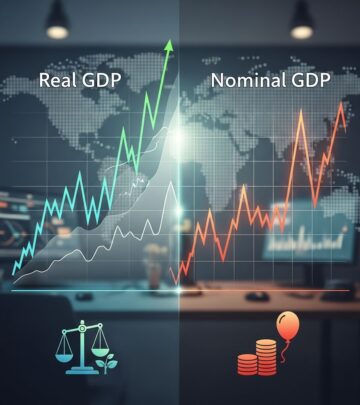
Real gross domestic product (real GDP) is a macroeconomic measure of the value of economic output adjusted for price changes, including inflation or deflation. Unlike nominal GDP, which uses current market prices, real GDP reflects the true volume of goods and services produced by an economy, eliminating the distortion caused by rising or falling price levels. This adjustment is crucial because nominal GDP can increase even when the physical output remains constant, providing a misleading picture of actual economic growth.
Real GDP serves as a fundamental indicator for policymakers, businesses, and investors to understand whether an economy is genuinely expanding or contracting. By isolating the quantity of production from price fluctuations, real GDP allows for meaningful comparisons across different time periods and between economies. This measure is also instrumental in calculating real GDP per capita, which economists widely use as a proxy for the average standard of living within a nation.
Real GDP vs. Nominal GDP
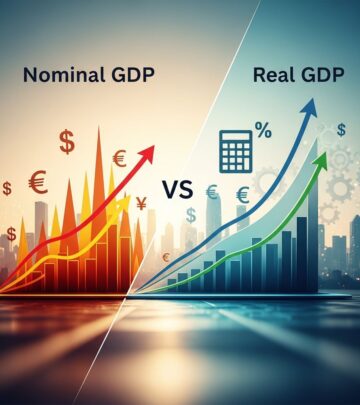
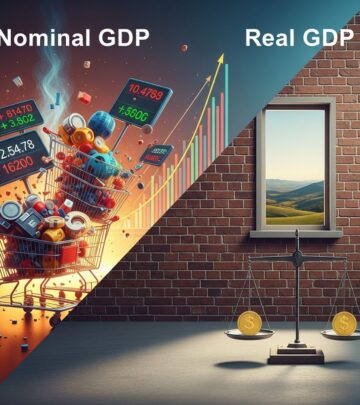
The distinction between real and nominal GDP is one of the most important concepts in economics. Nominal GDP represents the market value of all final goods and services produced within a country during a specific period, calculated using current prices at the time of measurement. If prices rise significantly, nominal GDP can show growth even if the actual quantity of goods and services produced has declined or remained unchanged.
Real GDP, by contrast, is expressed in terms of constant prices, meaning economists select a base year and apply those prices to all periods being analyzed. This approach ensures that differences in real GDP across years reflect only changes in the volume of production, not price movements. The adjustment process involves dividing nominal GDP by a price index, typically the GDP deflator, to arrive at the real figure.
Consider a practical example: if an economy produces the same number of cars and houses in consecutive years, but prices increase by 5% due to inflation, nominal GDP would show a 5% increase while real GDP would remain flat. This distinction is essential for accurately assessing economic performance and making informed policy decisions.
Understanding the GDP Deflator
The GDP deflator is a critical tool used to convert nominal GDP into real GDP and to measure overall price changes in an economy. It is calculated by dividing the nominal GDP for a given year by the real GDP for that same year, then multiplying by 100. The GDP deflator for the base year always equals 100 by definition.
The formula for calculating the GDP deflator is:
GDP Deflator = (Nominal GDP / Real GDP) × 100
This index provides valuable insight into the overall level of inflation or deflation occurring within an economy. A GDP deflator above 100 indicates that prices have risen since the base year, while a deflator below 100 suggests prices have fallen. By examining changes in the GDP deflator over time, economists can assess inflationary pressures and adjust economic policies accordingly.
Methods for Calculating GDP
Economists employ several approaches to calculate GDP, each providing complementary perspectives on economic activity. Understanding these methods is essential for comprehending how real GDP is derived.
The Product Approach
The product approach, also called the output approach, is the most straightforward method for calculating GDP. It involves summing the market value of all final goods and services newly produced within a nation during a specific period. A critical distinction is made between intermediate goods and final goods. Intermediate goods are consumed during the production of other goods and are excluded from GDP calculations to avoid double counting. Only the final value of finished products is included in the total.
The formula for the product approach is:
GDP = P − C
Where P represents the market price of final goods and services, and C represents intermediate consumption. This method directly measures what is produced, making it intuitive and transparent.
The Expenditure Approach
The expenditure approach operates on the principle that all products produced must ultimately be consumed or invested, so total product value equals total expenditures in the economy. This method identifies four primary components: consumption expenditures by households (C), gross private investment spending (I), government purchases of goods and services (G), and net exports, calculated as exports minus imports (EX − IM).
The expenditure formula is expressed as:
GDP = C + I + G + (EX − IM)
This approach is widely used by government statistical agencies, including the U.S. Department of Commerce, to calculate official GDP figures. It provides clear insight into the sources of economic demand and growth.
The Income Approach
The income approach calculates GDP by summing all income earned in producing goods and services, including wages, rents, dividends, interest, and profits received by producers during a specified timeframe. The basic formula incorporates compensation of employees (W), proprietor’s income (P), rental income (R), corporate profits (C), and net interest (I).
Several adjustments must be made to arrive at final GDP figures using the income approach: indirect business taxes, depreciation (the consumption of fixed capital), and net foreign factor income (NFI), which represents the difference between payments received from and made to the foreign sector. These adjustments account for the distinction between gross domestic product and gross national product.
Real GDP Growth Rate
Real GDP growth on an annual basis represents the nominal GDP growth rate adjusted for inflation, typically expressed as a percentage. This metric is crucial for assessing whether an economy is genuinely expanding or contracting. For instance, if nominal GDP grows by 5% but inflation is 3%, real GDP growth is approximately 2%, indicating more modest expansion than the nominal figure suggests.
Policymakers and economists closely monitor real GDP growth rates to evaluate economic health, determine appropriate monetary and fiscal policies, and forecast future economic conditions. Sustained positive real GDP growth generally indicates an expanding economy with rising living standards, while negative growth signals recession or contraction.
Base Year and Constant Prices
Real GDP relies on the concept of a base year—a reference period whose prices are used to value production in all other years. Different organizations use different base years. For example, the UNCTAD uses 2015 constant prices and exchange rates, while the FRED uses 2009 constant prices, and the World Bank has shifted from 2005 to 2010 constant prices and exchange rates. The choice of base year can affect the magnitude of real GDP figures but not their growth rates or relative comparisons.
By expressing real GDP in terms of constant prices from a base year, economists create an index for the quantity of total output that can be meaningfully compared across time periods. This standardization ensures that discussions about economic growth are based on actual production changes rather than nominal price movements.
Global Real GDP Rankings
According to the UNCTAD at 2015 constant prices and exchange rates, the world’s largest economies by real GDP in 2023 were:
| Rank | Country | Real GDP (Millions in 2015 Constant USD) |
|---|---|---|
| 1 | United States | 22,062,582 |
| 2 | China | 17,175,673 |
| 3 | Japan | 4,605,912 |
| 4 | Germany | 3,692,367 |
| 5 | India | 3,281,972 |
| 6 | United Kingdom | 3,234,504 |
| 7 | France | 2,671,235 |
| 8 | Italy | 2,010,975 |
| 9 | Brazil | 1,961,081 |
| 10 | Canada | 1,783,096 |
Why Real GDP Matters
Real GDP is essential for multiple stakeholders in the economy. For governments, it provides the foundation for evaluating policies and defining emerging economic trends. Corporations use real GDP data to forecast sales, adjust production levels, and make investment decisions based on expected demand. Social scientists monitor real GDP as an indicator of well-being and as a proxy for understanding individuals’ voting and investment decisions.
Investors rely on real GDP figures to assess economic conditions and market opportunities, while international organizations use real GDP comparisons to evaluate global economic development and inequality. The metric transcends simple accounting—it reflects the material well-being and productive capacity of entire societies.
Seasonal Adjustments in GDP Data
Official GDP data are seasonally adjusted to remove the effects of yearly patterns such as winter weather, holidays, or factory production schedules. This adjustment ensures that remaining movements in GDP better reflect true patterns in economic activity rather than predictable seasonal variations. Statistical agencies also release non-seasonally adjusted GDP data for reference, allowing analysts to study seasonal patterns when needed.
Real vs. Nominal GDP in Practice
Understanding the practical implications of real versus nominal GDP helps illuminate why this distinction matters for economic analysis. When an economy experiences high inflation, nominal GDP can appear robust while real GDP reveals stagnant or declining growth. Conversely, during deflationary periods, nominal GDP may appear weak while real GDP shows actual expansion. Real GDP thus provides the more accurate representation of whether people have access to more goods and services—the true measure of economic progress.
Frequently Asked Questions
Q: How is real GDP different from nominal GDP?
A: Nominal GDP uses current market prices to value goods and services, while real GDP adjusts for inflation using constant prices from a base year. This allows real GDP to isolate actual production changes from price movements, providing a more accurate measure of economic growth.
Q: What is the GDP deflator and how is it calculated?
A: The GDP deflator measures overall price changes in an economy and is calculated by dividing nominal GDP by real GDP and multiplying by 100. A deflator above 100 indicates prices have risen since the base year, while below 100 indicates prices have fallen.
Q: Why do economists use different base years for calculating real GDP?
A: Different organizations use different base years based on their preferences and analytical needs. The UNCTAD uses 2015 constant prices, FRED uses 2009 constant prices, and the World Bank uses 2010 constant prices. The choice of base year doesn’t affect growth rate comparisons but may affect absolute values.
Q: How is real GDP used to measure standard of living?
A: Real GDP per capita, calculated by dividing real GDP by population, is widely used as an indicator of aggregate standard of living because it shows the average economic output and consumption available per person in an economy.
Q: What are the three main methods for calculating GDP?
A: The three approaches are the product approach (summing final goods and services), the expenditure approach (summing consumption, investment, government spending, and net exports), and the income approach (summing all income earned in production).
Q: Why is seasonal adjustment important for GDP data?
A: Seasonal adjustments remove predictable yearly patterns like holiday shopping or winter weather effects, allowing analysts to identify true economic trends rather than normal seasonal variations.
References
- Real Gross Domestic Product — Wikipedia. Accessed November 2025. https://en.wikipedia.org/wiki/Real_gross_domestic_product
- Gross Domestic Product (GDP) — EBSCO Research Starters. Accessed November 2025. https://www.ebsco.com/research-starters/economics/gross-domestic-product-gdp
- Gross Domestic Product — U.S. Bureau of Economic Analysis (BEA). U.S. Department of Commerce. Accessed November 2025. https://www.bea.gov/resources/learning-center/what-to-know-gdp
Similar Articles








Read full bio of medha deb