Real Estate Investment Pathways: Commercial and Residential Compared
Explore the defining characteristics, financial returns, and operational demands of both investment property types.
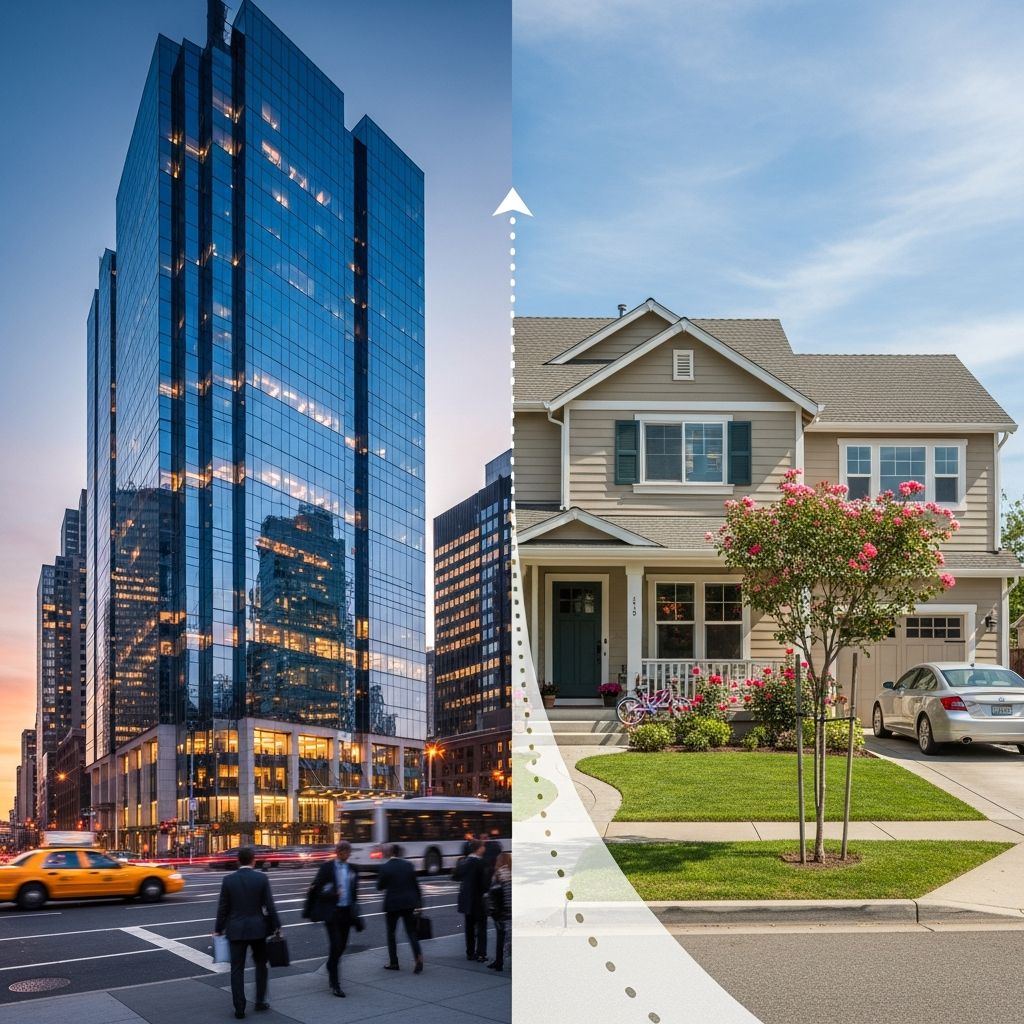
Investors seeking to build wealth through property ownership face a fundamental decision: should they pursue commercial real estate ventures or focus on residential properties? Each path offers distinct advantages and challenges that significantly impact long-term financial outcomes, operational responsibilities, and portfolio diversification strategies. Understanding these differences enables investors to align their capital deployment with personal objectives, experience levels, and risk appetite.
Defining the Two Property Categories
Real estate investing encompasses two primary categories, each serving different tenant populations and generating income through distinct mechanisms.
Residential real estate focuses on properties designed for occupancy by individuals and families. This category includes single-family homes, duplexes, townhouses, condominiums, and small multifamily buildings containing four or fewer units. These properties operate on relatively simple business models, with tenants paying monthly or annual rent in exchange for living space.
Commercial real estate encompasses all properties with five or more residential units or structures used for business operations. This broad category includes office buildings, retail centers, industrial warehouses, hotels and resorts, self-storage facilities, senior housing communities, and vacant land held for development. Commercial properties serve business entities rather than individual residents, fundamentally changing how investors structure leases, manage operations, and anticipate cash flows.
Capital Requirements and Investment Barriers
One of the most significant differences between these two investment paths involves the upfront financial commitment required to acquire each property type.
Residential properties typically demand substantially lower initial capital, with down payments generally ranging from 15 to 25 percent of purchase price. This lower entry threshold makes residential real estate more accessible to new investors, those with limited liquid capital, and individual savers building their first investment portfolio. A person with modest savings can potentially acquire a single-family rental home through conventional financing with manageable down payment requirements.
Commercial properties, by contrast, require considerably larger upfront investments. The higher purchase prices, more stringent underwriting standards, and often substantial due diligence expenses create formidable barriers for individual investors entering the commercial market. Financing for commercial properties involves more complex underwriting processes, higher documentation requirements, and often demands from lenders that investors demonstrate commercial real estate experience.
Income Generation and Return Potential
The financial returns available from each property type reflect fundamental differences in how businesses and individuals approach leasing.
Residential Income Streams
Residential rental income emerges from individual tenants paying monthly rent. These properties generate lower rental yields per square foot compared to commercial alternatives. Residential leases typically run for one to two years, meaning rent adjustments can occur relatively frequently but vacancy creates rapid income loss. The shorter lease terms offer flexibility for investors to adjust rental rates according to market conditions, but they also introduce greater variability in income stability.
Residential properties generate returns through both rental income and property appreciation over extended holding periods. As neighborhoods develop and housing demand strengthens, property values often increase substantially, enabling investors to realize capital gains through eventual sale.
Commercial Income Advantages
Commercial properties typically generate higher rental yields, commanding substantially higher rental rates per square foot compared to residential properties. These higher rates reflect the business nature of the tenancy and the income-producing capacity of commercial enterprises.
The lease structure fundamentally differs from residential arrangements. Commercial leases commonly extend across multiple years or even decades, with many including escalation clauses that increase rent annually to hedge against inflation and rising costs. These longer-term agreements provide investors with predictable, stable income streams extending many years into the future. A business tenant signing a five-year lease with annual 3 percent escalations provides the investor with highly predictable cash flow planning opportunities.
Commercial properties can also appreciate significantly in value, particularly those located in thriving economic areas or growing metropolitan regions. Additionally, certain commercial lease structures—particularly triple net leases (NNN)—require tenants to pay not only rent but also property taxes, insurance, maintenance, and utilities. This arrangement substantially reduces investor obligations for property upkeep and operational costs.
Management Complexity and Operational Demands
The day-to-day operational requirements and management responsibilities differ markedly between residential and commercial properties.
Residential Property Management
Residential properties typically involve simpler lease agreements and fewer regulatory compliance requirements. Many individual investors successfully manage their own residential rental properties, particularly single-family homes or duplexes. Tenant interactions, while sometimes requiring attention to maintenance requests or lease violations, generally follow straightforward patterns established through standard residential lease terms.
Residential leases address fundamental issues: rent amount, payment due date, lease duration, and basic maintenance responsibilities. Tenants are individuals focused on finding affordable housing in desirable locations, making their priorities and concerns relatively predictable and standardized.
Commercial Property Management
Commercial properties demand substantially more sophisticated management approaches. Commercial leases address complex issues including rent calculation methods, tenant improvement allowances, exclusive use clauses, operating cost sharing, insurance requirements, and extensive default provisions. Multiple commercial tenants within a single property create frequent interactions, negotiations, and coordination requirements.
Commercial tenants—whether retail businesses, office corporations, or industrial operators—have specialized needs and sophisticated expectations. A retail tenant might require specific build-outs, signage rights, and traffic pattern guarantees. An office tenant might need climate control specifications, parking provisions, and telecommunications infrastructure. Industrial tenants have safety, loading, and operational requirements distinct from other property types.
Most commercial investors hire professional property management firms equipped to handle lease administration, tenant relations, maintenance coordination, and regulatory compliance. These professional services, while improving operational efficiency and expertise, represent ongoing operational costs that reduce net investor returns.
Risk Profiles and Economic Sensitivity
Different economic conditions and market cycles impact residential and commercial properties with varying severity.
Residential Market Stability
Residential properties benefit from fundamental housing demand that remains relatively stable across economic cycles. People require housing regardless of economic conditions, though affordability and occupancy rates may fluctuate. This essential demand provides residential properties with inherent demand stability that supports long-term value retention and rental income reliability.
Residential markets exhibit lower sensitivity to economic downturns compared to commercial alternatives. During recessions, while rental demand may shift to more affordable neighborhoods, the total demand for residential housing persists. Vacancy risks in residential markets, while present, typically remain manageable when properties are well-maintained and appropriately priced for local market conditions.
Commercial Market Cyclicality
Commercial real estate demonstrates greater sensitivity to economic cycles and market fluctuations. During economic recessions, businesses reduce expansion, delay relocations, and may exit leases early. Office occupancy declines as companies implement remote work arrangements or reduce headcount. Retail spaces face pressure as consumer spending contracts. Industrial properties may experience reduced demand as manufacturing and distribution activity slow.
Commercial property values are driven primarily by income flows and capitalization rates (cap rates) rather than aesthetic considerations or neighborhood amenities. This income-driven valuation model means that declining business activity immediately threatens property values through reduced rental income and lower cap rates. Longer commercial lease terms, while providing income stability during the lease period, can create extended vacancy challenges when tenants default or fail to renew agreements.
Comparing Risk and Return Trade-offs
| Factor | Residential Properties | Commercial Properties |
|---|---|---|
| Initial Capital Investment | Lower (15-25% down payment typical) | Higher (more substantial upfront requirement) |
| Annual Rental Yields | Moderate yields per square foot | Higher yields per square foot |
| Lease Terms | Shorter (1-2 years typical) | Longer (multiple years with escalations) |
| Income Predictability | Variable due to short leases | More stable with long-term agreements |
| Management Requirements | Simpler; often self-managed | Complex; typically professional management |
| Tenant Turnover | Higher turnover risk | Lower turnover with longer leases |
| Economic Sensitivity | Lower sensitivity to cycles | Higher sensitivity to economic shifts |
| Capital Appreciation | Steady, market-dependent growth | Higher appreciation potential in growth areas |
Profitability Comparison and Return Expectations
Both investment types can generate substantial profits, but through different mechanisms and with different risk-return profiles.
Commercial real estate generally offers higher potential returns due to superior rental yields, longer lease agreements, and the ability to charge business tenants premium rates compared to individual residential tenants. A well-positioned commercial property in a growing urban market can generate consistent double-digit returns through the combination of rental income, expense management efficiency, and property appreciation.
Residential properties provide more modest but potentially more stable returns. These properties tend to generate consistent long-term appreciation alongside rental income, though individual returns vary considerably based on location, property condition, and local market dynamics. The lower barrier to entry enables more investors to participate in residential returns, though total returns per dollar invested may trail high-quality commercial properties.
The key recognition is that specific property characteristics, market location, tenant quality, and macroeconomic conditions ultimately determine profitability more than the mere classification as commercial or residential. An exceptional residential property in a desirable neighborhood may outperform a mediocre commercial space in a declining area.
Financing Considerations and Loan Availability
Access to financing varies significantly between residential and commercial property acquisition.
Residential properties benefit from standardized, readily available financing through conventional mortgages offered by banks and mortgage companies. Loan programs for residential properties have been refined across decades, with clear underwriting standards, competitive rates, and flexible terms. Investors can typically access residential financing with reasonable terms and moderate documentation requirements.
Commercial property financing involves more specialized lenders, more complex underwriting processes, and typically requires extensive financial documentation and borrower experience verification. Commercial lenders conduct deeper analysis of tenant quality, lease terms, market conditions, and property-specific risks. Interest rates on commercial loans often exceed residential rates, and lenders may require larger down payments or demand additional collateral.
Portfolio Diversification Strategy
Forward-thinking investors recognize that commercial and residential properties serve complementary roles within comprehensive investment portfolios. Combining both property types enables investors to balance income stability with growth potential and manage risk across different economic cycles.
Residential properties provide portfolio ballast, offering relatively predictable cash flows and lower volatility during economic uncertainty. Commercial properties add growth dimension and superior income generation when economic conditions remain favorable. Together, they create a more robust portfolio than either category alone.
Selecting Your Investment Path: Key Considerations
Determining whether to pursue commercial or residential real estate investing depends on multiple personal and financial factors:
- Available Capital: Investors with limited funds should consider residential properties; those with substantial capital can access commercial opportunities
- Experience Level: First-time investors often succeed with residential properties; commercial investing typically suits experienced investors
- Time Commitment: Investors seeking passive income benefit from commercial properties with professional management; active investors may prefer hands-on residential management
- Risk Tolerance: Conservative investors favor residential properties’ stability; aggressive investors pursue commercial properties’ higher return potential
- Geographic Market: Local market conditions, tenant quality, and economic outlook should influence whether to prioritize residential or commercial investment
- Income Goals: Investors seeking maximum current income favor commercial; those prioritizing long-term wealth accumulation may prefer residential appreciation potential
Frequently Asked Questions
Which investment type generates higher profits?
Commercial real estate typically offers higher profit potential through superior rental yields and longer lease terms. However, actual profitability depends on specific properties, locations, market conditions, and management quality rather than the property type alone.
Is commercial real estate riskier than residential?
Commercial properties carry higher sensitivity to economic cycles and market fluctuations, but they are not inherently riskier. Both property types present distinct risk profiles; residential risks involve tenant turnover and market saturation, while commercial risks involve economic sensitivity and tenant concentration.
Can beginning investors access commercial properties?
New investors typically begin with residential properties due to lower capital requirements and simpler management demands. Commercial real estate investing becomes more accessible as investors gain experience and accumulate capital.
What lease structures minimize investor responsibilities?
Triple net (NNN) leases, common in commercial properties, require tenants to pay rent plus property taxes, insurance, and maintenance costs, substantially reducing investor management burden.
How does property appreciation differ between types?
Both property types appreciate, but through different mechanisms. Residential appreciation relies on neighborhood development and housing demand; commercial appreciation depends on business growth, occupancy rates, and income flows within specific markets.
Conclusion: Building Your Investment Foundation
Commercial and residential real estate each offer distinct pathways toward wealth creation through property investment. Residential properties provide accessible entry points with manageable capital requirements, simpler operations, and relatively stable demand dynamics. Commercial properties deliver superior income generation potential and longer lease security, balanced against higher capital barriers, operational complexity, and economic sensitivity.
Rather than viewing these as mutually exclusive choices, successful investors often build portfolios incorporating both property types, capturing residential stability while pursuing commercial growth. Your selection should reflect your available capital, experience level, management capacity, and financial objectives within your broader wealth-building strategy.
References
- Commercial vs. Residential Real Estate Investing: Understanding the Differences, Benefits, and Risks — LoopNet.com. 2024. https://www.loopnet.com/cre-explained/getting-started/commercial-vs-residential-real-estate-investing/
- Commercial vs. Residential Real Estate Investing — Santa Clara County Assessor’s Office. 2024. https://sjcad.org/wp-content/uploads/2024/04/Real-Estate-Investing.pdf
- Commercial vs. Residential Real Estate Investments — 1031 Crowdfunding. 2024. https://www.1031crowdfunding.com/investing-in-commercial-real-estate-vs-residential-real-estate/
- Commercial vs. Residential Real Estate: A Comprehensive Guide — Commercial Real Estate Loans. 2024. https://www.commercialrealestate.loans/blog/commercial-vs-residential-real-estate-guide/
- Commercial Real Estate vs Residential Real Estate: What’s Best? — Equity Multiple. 2024. https://equitymultiple.com/blog/commercial-real-estate-vs-residential-real-estate
Similar Articles








Read full bio of Sneha Tete