Reaganomics: Supply-Side Economics and Free Market Policy
Understanding Reagan's economic policies: tax cuts, deregulation, and supply-side economics.
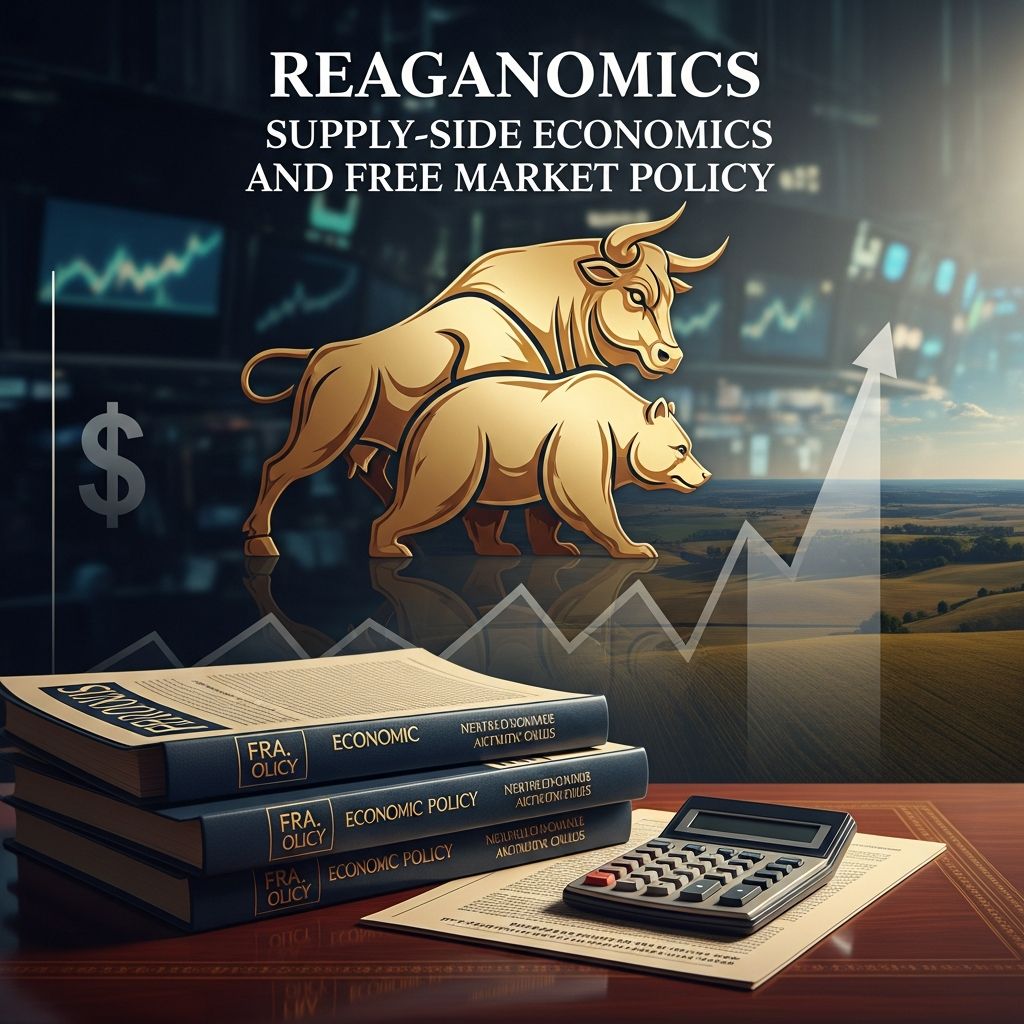
Understanding Reaganomics: The Economic Policy That Shaped America
Reaganomics refers to the comprehensive economic policies implemented by President Ronald Reagan during his administration from 1981 to 1989. These policies emerged in response to severe economic challenges that plagued the United States in the late 1970s and early 1980s, including stagflation (a combination of high inflation and stagnant economic growth), elevated interest rates, and rising unemployment. At the heart of Reaganomics lay a revolutionary economic philosophy grounded in supply-side economics, a theory that fundamentally challenged the prevailing Keynesian approach to economic management. The Reagan administration believed that by reducing government intervention, lowering taxes, and encouraging private sector investment, the nation could restore economic vitality and reclaim its position as a global economic powerhouse.
The Core Philosophy Behind Reaganomics
Reagan’s economic vision represented a dramatic departure from post-World War II economic policy. During his 1980 campaign, Reagan articulated a vision to revive America’s free enterprise tradition, emphasizing that the dynamism of the market economy had fueled prosperity before the Great Depression. He argued that the United States could regain its economic vitality by reducing government intervention and restoring confidence in the private sector. This message resonated deeply with advocates of supply-side economics, who believed that lowering tax burdens would unleash innovation, expand productivity, and ultimately strengthen the nation’s fiscal foundation.
Supply-side economics, popularized in the late 1970s and early 1980s, was rooted in the straightforward idea that tax cuts stimulate growth by incentivizing individuals and businesses to invest and produce more. Rather than focusing on demand-side stimulation through government spending, supply-side theorists argued that the economy responds more effectively to increased productive capacity. Reagan embraced this philosophy with conviction, believing that if people and businesses were allowed to keep more of what they earned, they would invest, innovate, and expand, ultimately benefiting the entire nation.
The Laffer Curve: The Economic Blueprint
A central theoretical underpinning of Reagan’s program was the Laffer Curve, developed by economist Arthur Laffer. This economic model illustrates that there exists an optimal tax rate that maximizes government revenue: excessively high taxes discourage work and investment, while excessively low taxes fail to generate sufficient revenue. Reagan embraced this principle, presenting it as common sense economics. Laffer himself served on Reagan’s Economic Policy Advisory Board, giving intellectual weight to the administration’s policies. The Laffer Curve became the visual representation of Reaganomics philosophy, suggesting that lower tax rates would expand the tax base sufficiently to maintain or increase government revenues while simultaneously stimulating economic growth.
Key Components of Reaganomics
Reaganomics was not limited to tax policy alone. The economic program encompassed several interconnected elements designed to work synergistically:
Tax Cuts and Economic Recovery
The cornerstone of Reaganomics was the Economic Recovery Tax Act of 1981, which enacted one of the largest tax cuts in U.S. history. This legislation dramatically reduced tax rates across all income brackets, with particular emphasis on reducing rates for high earners and corporations. The top marginal individual income tax rate fell from 70.1% to 28.4%, representing a fundamental restructuring of the tax code. According to William A. Niskanen, one of the architects of Reaganomics, “Reagan delivered on each of his four major policy objectives, although not to the extent that he and his supporters had hoped,” noting that the most substantial change was in the tax code.
A major element of the 1981 Act was the Accelerated Cost Recovery System (ACRS), which changed the way depreciation was counted, leading to significant reductions in tax burdens on businesses. This provision allowed corporations to recover their investments in equipment and facilities more rapidly, thereby reducing their tax liability and freeing capital for reinvestment and expansion.
Deregulation and Free Markets
A fundamental tenet of Reaganomics was to reduce governmental regulation of business. Reagan reasoned that corporations were burdened by complicated bureaucratic rules and regulations that were unnecessarily restrictive. His administration pursued an aggressive deregulation agenda that freed corporations from many regulatory constraints. This included efforts to reduce federal oversight of corporations and permit accelerated depreciation. Because the administration believed that free markets, rather than government directives, should allocate economic resources, many environmental regulations imposed by earlier administrations were relaxed. The administration approved measures that promoted the corporate use of federal lands for drilling, mining, and harvesting timber.
Monetary Policy and Inflation Control
While often overlooked in discussions of Reaganomics, the administration’s monetary policy was equally important. Reagan supported Federal Reserve Chair Paul Volcker’s efforts to control inflation through tight monetary policy, despite the short-term pain this caused the economy. This commitment to fighting inflation was part of Reagan’s broader economic formula for successful economic turnaround, which included maintaining low interest rates and keeping a watchful inflation hedge on the monetary supply.
The Tax Reform Act of 1986
Building on the success of the 1981 tax cuts, the Reagan administration pursued further tax reform with the Tax Reform Act of 1986. This legislation represented a second major restructuring of the tax code. The act reduced nominal rates on the wealthy while eliminating certain tax deductions, while raising tax rates on lower-income individuals. The across-the-board tax system reduced marginal rates and further reduced bracket creep from inflation. Notably, the highest income earners received a tax break, restoring what was seen as a flatter tax system.
Critics and Controversies: The “Voodoo Economics” Debate
While Reagan and his advocates preferred to call Reaganomics “free-market economics,” opponents—including some Republicans—characterized the policies as “trickle-down economics” or, more derisively, as “Voodoo Economics.” The most famous critic was Vice President George H.W. Bush, who used the “voodoo economics” label during the 1980 Republican primary campaign to characterize what he saw as unrealistic promises.
The trickle-down theory that underpinned Reaganomics argued that if you lower costs for corporations by cutting their taxes, businesses would use those savings to invest. The thinking was that more money for corporations would mean more jobs and higher wages for workers and thus increase spending throughout the economy. However, critics argued that corporations might use tax savings for other purposes, such as executive compensation or stock buybacks, rather than investing in productive capacity or raising worker wages.
Economic Outcomes and Results
The effects of Reaganomics remain debated among economists and policymakers. Supporters have pointed to significant positive outcomes: the end of stagflation, stronger GDP growth, and an entrepreneurial revolution in the decades that followed. According to economic analysis, the American economy grew by more than a third in size, producing a $15 trillion increase in American wealth. Consumer and investor confidence soared during this period.
Following the 1981 Act, there was an economic boom beginning in 1982. This boom was concentrated in the investment spaces of stocks, bonds, and real estate. The new wealth generated by the top investing and profiting in these spaces led to a number of lower level positions like bankers and accountants seeing significant growth in their wages. In turn, they had more wealth to spend on services in further downstream positions like retail and childcare services.
However, critics have pointed to significant negative consequences. The widening income gap accelerated during the Reagan years, with wealth increasingly concentrated at the top of the income distribution. Critics described an atmosphere of greed permeating the economy, while reduced economic mobility affected lower and middle-income Americans. Most notably, the national debt tripled in eight years, which ultimately reversed the post-World War II trend of a shrinking national U.S. debt as a percentage of GDP.
Initial Challenges and the 1981-1982 Recession
Reaganomics initially resulted in a severe recession in 1981-1982 as the Federal Reserve maintained tight monetary policy to combat inflation. The supply-side economic policies of the Reagan administration resulted initially in a severe recession and in a drastic reduction in social services that adversely affected the poor, while they simultaneously ran up huge federal deficits. However, before Reagan left office, the American economy had improved significantly. The administration argued that this short-term pain was necessary medicine to purge the economy of inflationary expectations and to set the stage for sustainable long-term growth.
Social Programs and Government Downsizing
Closely related to the tax cuts was Reagan’s commitment to downsizing government. An economic policy that emphasizes the downsizing of government and of costly government-supported social programs whose curtailment permits reductions in taxation was a defining characteristic of Reaganomics. However, Reagan also vowed to protect certain entitlement programs like Medicare and Social Security while cutting the budgets for other social programs by targeting waste, fraud and abuse.
The Legacy of Reaganomics
A quarter century after Ronald Reagan left the presidency, many results of his economic policies—Reaganomics—were still evident. The comprehensive tax reform he championed reshaped the structure of American taxation. The deregulation initiatives launched during his administration continued to influence business and environmental policy for decades. The emphasis on free markets and entrepreneurship became a dominant theme in American economic policy, influencing politicians and policymakers across the political spectrum.
The supply-side economics philosophy that undergirded Reaganomics influenced subsequent tax policy debates. Whenever policymakers proposed tax cuts, they often invoked the Laffer Curve and supply-side reasoning. The debate over whether lower taxes stimulate sufficient economic growth to pay for themselves remained contentious, with economists divided on the empirical evidence.
Frequently Asked Questions (FAQs)
Q: What exactly is Reaganomics?
A: Reaganomics refers to the economic policies of President Ronald Reagan (1981-1989), centered on supply-side economics, significant tax cuts, deregulation, and reduced government spending. The philosophy emphasized that lower taxes and less government intervention would stimulate investment, growth, and ultimately benefit all income levels.
Q: What is the Laffer Curve and why was it important to Reaganomics?
A: The Laffer Curve, developed by economist Arthur Laffer, illustrates that there is an optimal tax rate that maximizes government revenue. Reagan used this concept to argue that lower tax rates would expand the tax base sufficiently to maintain government revenues while stimulating economic growth. It became the intellectual foundation for his tax cut policies.
Q: What does “trickle-down economics” mean?
A: Trickle-down economics is the theory that tax cuts and benefits for corporations and wealthy individuals will lead to increased investment, job creation, and higher wages for workers, with benefits trickling down through the entire economy. Critics argue that these benefits don’t always materialize as promised.
Q: Did Reaganomics achieve its goals?
A: This question remains contested. Supporters point to the end of stagflation, strong GDP growth, and entrepreneurial expansion. Critics highlight the tripling of national debt, widening income inequality, and reduced economic mobility for lower-income Americans.
Q: What was the Economic Recovery Tax Act of 1981?
A: This landmark legislation implemented one of the largest tax cuts in U.S. history, reducing top marginal income tax rates from 70.1% to approximately 50% initially, with further reductions following. It also included the Accelerated Cost Recovery System (ACRS) for business depreciation.
Q: How did Reaganomics affect the environment?
A: The Reagan administration relaxed many environmental regulations imposed by earlier administrations, approving measures that promoted corporate use of federal lands for drilling, mining, and timber harvesting. This deregulatory approach was controversial and had lasting environmental consequences.
References
- Reaganomics — EBSCO Research Starters. 2024. https://www.ebsco.com/research-starters/economics/reaganomics
- Reaganomics — Wikipedia Contributors. 2024. https://en.wikipedia.org/wiki/Reaganomics
- Reaganomics Trickled Down to Basics — Georgetown Law, Denny Center. 2024. https://www.law.georgetown.edu/denny-center/blog/reaganomics/
- The Reagan Presidency — Ronald Reagan Presidential Library. 2024. https://www.reaganlibrary.gov/reagans/reagan-administration/reagan-presidency
- Here’s Why Reaganomics is so Controversial — History Channel (YouTube). 2024. https://www.youtube.com/watch?v=EeyGdy_SdhQ
Similar Articles








Read full bio of medha deb