Rate of Change (ROC): Momentum Indicator Guide
Understand Rate of Change (ROC), a key momentum indicator for technical analysis.
What Is Rate of Change (ROC)?
The Rate of Change (ROC) is a momentum-based technical indicator that measures the percentage change in price between the current period and a period in the past. This oscillating indicator compares the current closing price with the closing price from a specified number of days, weeks, or months ago. The ROC indicator is used by traders and technical analysts to identify the speed at which prices are moving upward or downward, making it an essential tool for assessing momentum in financial markets.
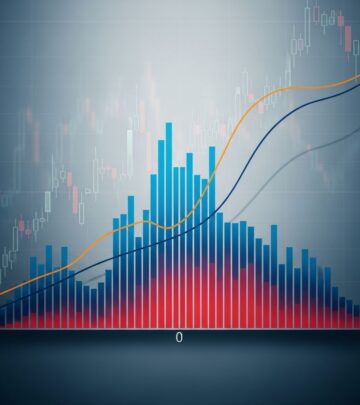
The ROC indicator oscillates around a zero line, which serves as an equilibrium point. When the ROC rises above zero, it signals that prices are increasing, indicating positive momentum. Conversely, when the ROC falls below zero, it suggests that prices are declining, indicating negative momentum. This simple yet effective approach makes ROC a popular choice among traders who want to quickly gauge market sentiment and identify potential trading opportunities.
Understanding the Rate of Change Formula
The mathematical formula for calculating the Rate of Change is straightforward and can be expressed as follows:
Rate of Change (ROC) = ((Current Price – Previous Price) / Previous Price) × 100
In this formula, the “Current Price” represents the most recent closing price, while “Previous Price” refers to the closing price from a specific number of periods ago. The result is multiplied by 100 to express the change as a percentage rather than as a decimal.
For example, if a stock closed at $50 ten days ago and closes at $55 today, the ROC calculation would be: ((55 – 50) / 50) × 100 = 10%. This indicates that the stock has experienced a 10% positive change over the ten-day period, reflecting upward momentum.
How to Calculate Rate of Change
Calculating the ROC involves several straightforward steps that any trader can implement:
Step-by-Step Calculation Process
Step 1: Identify the Time Period – Choose the lookback period for your analysis. Common periods include 10 days for short-term momentum, 26 to 52 weeks for long-term perspectives, or any custom timeframe that suits your trading strategy.
Step 2: Locate the Current Price – Identify the most recent closing price for the security you are analyzing.
Step 3: Find the Historical Price – Determine the closing price from the specific number of periods ago that you selected in Step 1.
Step 4: Apply the Formula – Subtract the historical price from the current price, divide by the historical price, and multiply by 100.
Step 5: Plot the Result – Most trading platforms calculate ROC automatically and display it as a line chart that oscillates around the zero line.
Interpreting ROC Values and Signals
Understanding how to interpret ROC values is crucial for effective trading decisions. The indicator provides several important signals that traders can use to inform their strategies.
Bullish Signals
When the ROC rises above the zero line and continues moving upward, it generates a bullish signal. This indicates that the rate of price increase is accelerating, suggesting strong positive momentum. A rising ROC above zero often precedes price increases and can signal a good time to enter long positions. Additionally, when the ROC reaches new highs while prices make new highs, it confirms the strength of the uptrend.
Bearish Signals
Conversely, when the ROC falls below the zero line and continues declining, it produces a bearish signal. This suggests that prices are declining at an accelerating rate, indicating negative momentum. A falling ROC below zero often precedes further price declines and may signal an opportune time to exit long positions or enter short positions. When ROC reaches new lows while prices make new lows, it confirms the strength of the downtrend.
Divergence Trading
One of the most valuable applications of the ROC indicator is identifying divergences. A divergence occurs when the price and the ROC indicator move in opposite directions. For instance, if prices reach a new high but the ROC fails to reach a new high (bearish divergence), it suggests that momentum is weakening despite rising prices, potentially signaling a reversal. Similarly, a bullish divergence occurs when prices reach a new low but the ROC fails to reach a new low, suggesting that downward momentum is weakening.
Choosing the Right Time Period
The selection of the time period is critical to the effectiveness of the ROC indicator. Different periods serve different analytical objectives:
| Time Period | Use Case | Best For |
|---|---|---|
| 5-10 Days | Short-term momentum | Day traders, scalpers |
| 20-30 Days | Intermediate momentum | Swing traders |
| 26-52 Weeks | Long-term momentum | Position traders, investors |
The standard timeframe for ROC measurement is 10 days, which provides a good balance between responsiveness to recent price movements and stability. However, traders often experiment with different periods to align with their specific trading style and market outlook. Shorter periods make the indicator more sensitive to price changes, while longer periods smooth out volatility and provide a clearer picture of overall trend momentum.
Advantages of Using ROC
The Rate of Change indicator offers several compelling advantages that make it a valuable addition to any trader’s toolkit:
Early Momentum Detection – ROC can identify momentum shifts before they become apparent in price action, providing traders with early warning signals of potential trend changes.
Minimal Lag – Compared to other momentum indicators like MACD and stochastic oscillators, ROC tends to respond more quickly to price movements without significant lag, enabling faster reaction times to market changes.
Simplicity – The straightforward formula and interpretation make ROC accessible to traders of all experience levels, from beginners to seasoned professionals.
Divergence Detection – ROC excels at identifying divergences between price and momentum, which are powerful predictors of potential reversals.
Versatility – The indicator works effectively across different asset classes, including stocks, currencies, commodities, and cryptocurrencies.
Limitations and Considerations
While ROC is a powerful indicator, traders should be aware of its limitations. The indicator can produce false signals during sideways or choppy markets where prices are consolidating. Additionally, ROC is most effective when used in combination with other technical analysis tools rather than as a standalone indicator. Market gaps and sudden price spikes can create misleading ROC values, and the indicator may not perform well in low-volatility environments.
ROC vs. Other Momentum Indicators
| Indicator | Response Speed | Complexity | Best Use |
|---|---|---|---|
| ROC | Fast | Simple | Momentum confirmation |
| MACD | Medium | Complex | Trend following |
| Stochastic | Medium | Complex | Overbought/Oversold |
Frequently Asked Questions
What does it mean when ROC crosses above zero?
When ROC crosses above zero, it indicates that prices are accelerating upward, suggesting positive momentum and a potential bullish opportunity. This is often considered a buy signal by technical traders.
Can ROC be used for all timeframes?
Yes, ROC can be applied to any timeframe, from intraday charts to monthly or yearly charts. The choice of timeframe depends on your trading strategy and investment horizon.
How does ROC differ from simple price change?
ROC expresses price change as a percentage relative to the historical price, making it easier to compare momentum across different securities trading at different price levels. This normalization makes ROC more useful for comparative analysis.
What is the best ROC period for day trading?
Day traders typically use ROC periods between 5 and 10 days to capture short-term momentum. However, the optimal period depends on individual trading strategies and market conditions.
Should I use ROC alone for trading decisions?
No, ROC is most effective when used in combination with other technical indicators, support and resistance levels, and fundamental analysis. Using multiple confirmation signals reduces the risk of false signals.
How can I identify a bullish divergence using ROC?
A bullish divergence occurs when prices make a lower low while ROC makes a higher low. This suggests weakening downward momentum and potential reversal to the upside.
References
- Rate of Change (ROC) Definition — Investopedia. Accessed November 2025. https://www.investopedia.com/terms/r/rateofchange.asp
- Technical Analysis from A to Z — Steven B. Achelis, McGraw-Hill Education. 2001.
- Momentum Indicators: Advanced Tools for Traders — CFA Institute. 2023. https://www.cfainstitute.org/
- Market Technical Analysis Best Practices — Financial Industry Regulatory Authority (FINRA). 2024. https://www.finra.org/
Similar Articles








Read full bio of medha deb